Victor Konrad - Böcker
Visar alla böcker från författaren Victor Konrad. Handla med fri frakt och snabb leverans.
10 produkter
10 produkter
2 155 kr
Skickas inom 10-15 vardagar
September 11, 2001 marked the beginning of a new era of security imperatives for many countries. The border between Canada and the United States suddenly emerged from relative obscurity to become a focus of constant attention by media, federal and state/provincial governments on both sides of the boundary, and the public at large. This book provides a comprehensive examination of the Canada-USA border in its 21st century form, placing it within the context of border and borderlands theory, globalization and the changing geopolitical dialogue. It argues that this border has been reinvented as a 'state of the art', technology-steeped crossing system, while the image of the border has been engineered to appear consistent with the 'friendly' border of the past. It shows how a border can evolve to a heightened level of security and yet continue to function well, sustaining the massive flow of trade. It argues whether, in doing so, the US-Canada border offers a model for future borderlands. Although this model is still evolving and still aspires toward better management practices, the template may prove useful, not only for North America, but also in conflict border zones as well as the meshed border regions of the EU, Africa's artificial line boundaries and other global situations.
489 kr
Skickas inom 3-6 vardagar
694 kr
Skickas inom 3-6 vardagar
Border culture emerges through the intersection and engagement of imagination, affinity and identity. It is evident wherever boundaries separate or sort people and their goods, ideas or other belongings. It is the vessel of engagement between countries and peoples—assuming many forms, exuding a variety of expressions, changing shapes—but border culture does not disappear once it is developed, and it may be visualized as a thread that runs throughout the process of globalization.Border culture is conveyed in imaginaries and productions that are linked to borderland identities constructed in the borderlands. These identities underlie the enforcement of control and resistance to power that also comprise border cultures. Canada’s borders in globalization offer an opportunity to explore the interplay of borders and culture, identify the fundamental currents of border culture in motion, and establish an approach to understanding how border culture is placed and replaced in globalization.Published in English.
428 kr
Skickas inom 7-10 vardagar
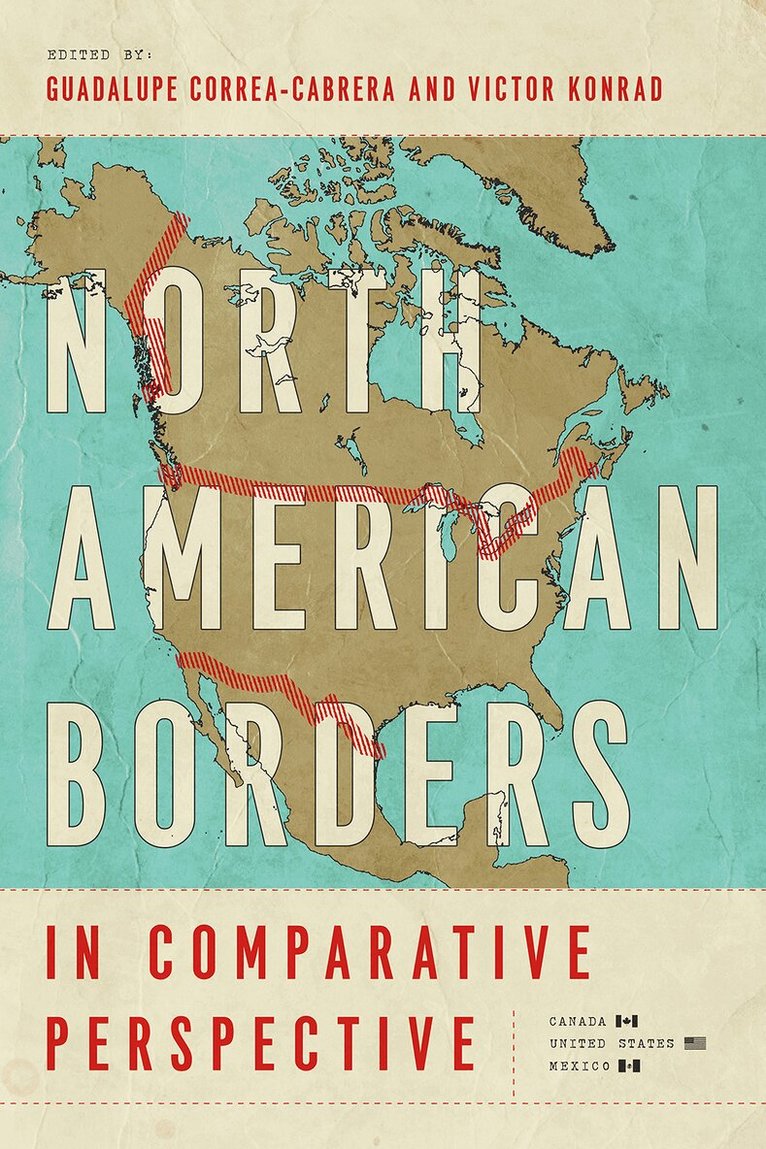
The northern and southern borders and borderlands of the United States should have much in common; instead they offer mirror articulations of the complex relationships and engagements between the United States, Mexico, and Canada. In North American Borders in Comparative Perspective leading experts provide a contemporary analysis of how globalization and security imperatives have redefined the shared border regions of these three nations.This volume offers a comparative perspective on North American borders and reveals the distinctive nature first of the overportrayed Mexico-U.S. border and then of the largely overlooked Canada-U.S. border. The perspectives on either border are rarely compared. Essays in this volume bring North American borders into comparative focus; the contributors advance the understanding of borders in a variety of theoretical and empirical contexts pertaining to North America with an intense sharing of knowledge, ideas, and perspectives.Adding to the regional analysis of North American borders and borderlands, this book cuts across disciplinary and topical areas to provide a balanced, comparative view of borders. Scholars, policy makers, and practitioners convey perspectives on current research and understanding of the United States' borders with its immediate neighbors. Developing current border theories, the authors address timely and practical border issues that are significant to our understanding and management of North American borderlands.The future of borders demands a deep understanding of borderlands and borders. This volume is a major step in that direction.
1 118 kr
Skickas inom 11-20 vardagar
The northern and southern borders and borderlands of the United States should have much in common; instead they offer mirror articulations of the complex relationships and engagements between the United States, Mexico, and Canada. In North American Borders in Comparative Perspective leading experts provide a contemporary analysis of how globalization and security imperatives have redefined the shared border regions of these three nations.This volume offers a comparative perspective on North American borders and reveals the distinctive nature first of the overportrayed Mexico-U.S. border and then of the largely overlooked Canada-U.S. border. The perspectives on either border are rarely compared. Essays in this volume bring North American borders into comparative focus; the contributors advance the understanding of borders in a variety of theoretical and empirical contexts pertaining to North America with an intense sharing of knowledge, ideas, and perspectives.Adding to the regional analysis of North American borders and borderlands, this book cuts across disciplinary and topical areas to provide a balanced, comparative view of borders. Scholars, policy makers, and practitioners convey perspectives on current research and understanding of the United States' borders with its immediate neighbors. Developing current border theories, the authors address timely and practical border issues that are significant to our understanding and management of North American borderlands.The future of borders demands a deep understanding of borderlands and borders. This volume is a major step in that direction.
1 887 kr
Skickas inom 10-15 vardagar
This book introduces readers to the cultural imaginings of borders: the in-between spaces in which transnationalism collides with geopolitical cooperation and contestation.Recent debates about the "refugee crisis" and the spread of the COVID-19 pandemic have politicized culture at and of borders like never before. Border culture is no longer culture at the margins but rather culture at the heart of geopolitics, flows, and experience of the transnational world. Increasingly, culture and borders are everywhere yet nowhere. In border spaces, national narratives and counter-narratives are tested and evaluated, coming up against transnational culture. This book provides an extensive and critical vision of border culture on the move, drawing on numerous examples worldwide and a growing international literature across border and cultural studies. It shows how border culture develops in the human imagination and manifests in human constructs of "nation" and "state", as well as in transnationalism. By analyzing this new and expanding cultural geography of border landscapes, the book shows the way to a fresh, broader dialogue.Exploring the nature and meaning of the intersection of border and culture, this book will be an essential read for students and researchers across border studies, geopolitics, geography, and cultural studies.
536 kr
Skickas inom 10-15 vardagar
This book introduces readers to the cultural imaginings of borders: the in-between spaces in which transnationalism collides with geopolitical cooperation and contestation.Recent debates about the "refugee crisis" and the spread of the COVID-19 pandemic have politicized culture at and of borders like never before. Border culture is no longer culture at the margins but rather culture at the heart of geopolitics, flows, and experience of the transnational world. Increasingly, culture and borders are everywhere yet nowhere. In border spaces, national narratives and counter-narratives are tested and evaluated, coming up against transnational culture. This book provides an extensive and critical vision of border culture on the move, drawing on numerous examples worldwide and a growing international literature across border and cultural studies. It shows how border culture develops in the human imagination and manifests in human constructs of "nation" and "state", as well as in transnationalism. By analyzing this new and expanding cultural geography of border landscapes, the book shows the way to a fresh, broader dialogue.Exploring the nature and meaning of the intersection of border and culture, this book will be an essential read for students and researchers across border studies, geopolitics, geography, and cultural studies.
617 kr
Kommande
This book uncovers the rich heritage of borderlands. At the border, people exist in-between, whether they live their lives at the near boundaries, or whether they are just passing through, as travellers or tourists.The heritage of these spaces is a vast collection of remnants and reminiscences, defined by memory, preservation, and geopolitics at the margins. It is at once a heritage of borders, and the bordering of heritage. This book defines border heritage as a realization, valuation and manifestation of this being and belonging in-between: a form of heritage bordered by the politics of inclusion and exclusion of the various authorities of states, heritage organizations, communities, and tourism agencies. Richly illustrated with case studies and examples drawn from around the world, the book considers post-colonial border heritage, the growing pursuit of border heritage tourism, a new agenda for border wall studies, the continuing politics of legacy, the temporal cycles and rhythms in border heritage, and the heritage of border culture endurance, recurrence, and revival.Bringing together a wide range of spatial and temporal approaches to border heritage, this book will be perfect for researchers and students of border and heritage studies, as well as professionals specialising in heritage management or tourism.
2 258 kr
Kommande
This book uncovers the rich heritage of borderlands. At the border, people exist in-between, whether they live their lives at the near boundaries, or whether they are just passing through, as travellers or tourists.The heritage of these spaces is a vast collection of remnants and reminiscences, defined by memory, preservation, and geopolitics at the margins. It is at once a heritage of borders, and the bordering of heritage. This book defines border heritage as a realization, valuation and manifestation of this being and belonging in-between: a form of heritage bordered by the politics of inclusion and exclusion of the various authorities of states, heritage organizations, communities, and tourism agencies. Richly illustrated with case studies and examples drawn from around the world, the book considers post-colonial border heritage, the growing pursuit of border heritage tourism, a new agenda for border wall studies, the continuing politics of legacy, the temporal cycles and rhythms in border heritage, and the heritage of border culture endurance, recurrence, and revival.Bringing together a wide range of spatial and temporal approaches to border heritage, this book will be perfect for researchers and students of border and heritage studies, as well as professionals specialising in heritage management or tourism.
753 kr
Skickas inom 10-15 vardagar
September 11, 2001 marked the beginning of a new era of security imperatives for many countries. The border between Canada and the United States suddenly emerged from relative obscurity to become a focus of constant attention by media, federal and state/provincial governments on both sides of the boundary, and the public at large. This book provides a comprehensive examination of the Canada-USA border in its 21st century form, placing it within the context of border and borderlands theory, globalization and the changing geopolitical dialogue. It argues that this border has been reinvented as a 'state of the art', technology-steeped crossing system, while the image of the border has been engineered to appear consistent with the 'friendly' border of the past. It shows how a border can evolve to a heightened level of security and yet continue to function well, sustaining the massive flow of trade. It argues whether, in doing so, the US-Canada border offers a model for future borderlands. Although this model is still evolving and still aspires toward better management practices, the template may prove useful, not only for North America, but also in conflict border zones as well as the meshed border regions of the EU, Africa's artificial line boundaries and other global situations.