Victoria Grau - Böcker
Visar alla böcker från författaren Victoria Grau. Handla med fri frakt och snabb leverans.
4 produkter
4 produkter
563 kr
Skickas inom 10-15 vardagar
Urban planning has always been a preeminent instrument of political power. In this volume, contributions from Europe and Latin America provide insight into the functions of planning under very different political and societal constellations over the last hundred years: dictatorships, parliamentary democracies, and illiberalism; capitalism and state socialism; state interventionism and neoliberalism; societies in times of peace and societies marked by colonial, civil, world, or cold wars.The dictatorships of the 1920s and 1930s made extensive use of the potential of planning for economic growth, for brutal repression, but also for the integration of certain population groups and as an effective means of propaganda. The legacy of these dictatorships still characterizes many European cities today and confronts planning with complex tasks. Dictatorial state socialism planned to establish a new social order with a particular technocratic rationality, which did not, however, cancel completely the tendential autonomy of the professional planning sphere. Parliamentary democracies and illiberal regimes have developed specific new practices of using planning to rebuild cities in the interests of neoliberal economic growth and populistic legitimization of power.Histories of Urban Planning and Political Power takes the next steps in significantly expanding our understanding of planning and politics. The book will be of interest to students and scholars of urbanism, urban/town planning, spatial planning, spatial politics, urban development, urban policies, and planning history and European history of the 20th century.The Open Access version of this book, available at http://www.taylorfrancis.com, has been made available under a Creative Commons Attribution-Non Commercial-No Derivatives (CC-BY-NC-ND) 4.0 license.
2 088 kr
Skickas inom 10-15 vardagar
Urban planning has always been a preeminent instrument of political power. In this volume, contributions from Europe and Latin America provide insight into the functions of planning under very different political and societal constellations over the last hundred years: dictatorships, parliamentary democracies, and illiberalism; capitalism and state socialism; state interventionism and neoliberalism; societies in times of peace and societies marked by colonial, civil, world, or cold wars.The dictatorships of the 1920s and 1930s made extensive use of the potential of planning for economic growth, for brutal repression, but also for the integration of certain population groups and as an effective means of propaganda. The legacy of these dictatorships still characterizes many European cities today and confronts planning with complex tasks. Dictatorial state socialism planned to establish a new social order with a particular technocratic rationality, which did not, however, cancel completely the tendential autonomy of the professional planning sphere. Parliamentary democracies and illiberal regimes have developed specific new practices of using planning to rebuild cities in the interests of neoliberal economic growth and populistic legitimization of power.Histories of Urban Planning and Political Power takes the next steps in significantly expanding our understanding of planning and politics. The book will be of interest to students and scholars of urbanism, urban/town planning, spatial planning, spatial politics, urban development, urban policies, and planning history and European history of the 20th century.The Open Access version of this book, available at http://www.taylorfrancis.com, has been made available under a Creative Commons Attribution-Non Commercial-No Derivatives (CC-BY-NC-ND) 4.0 license.
1 349 kr
Skickas inom 3-6 vardagar
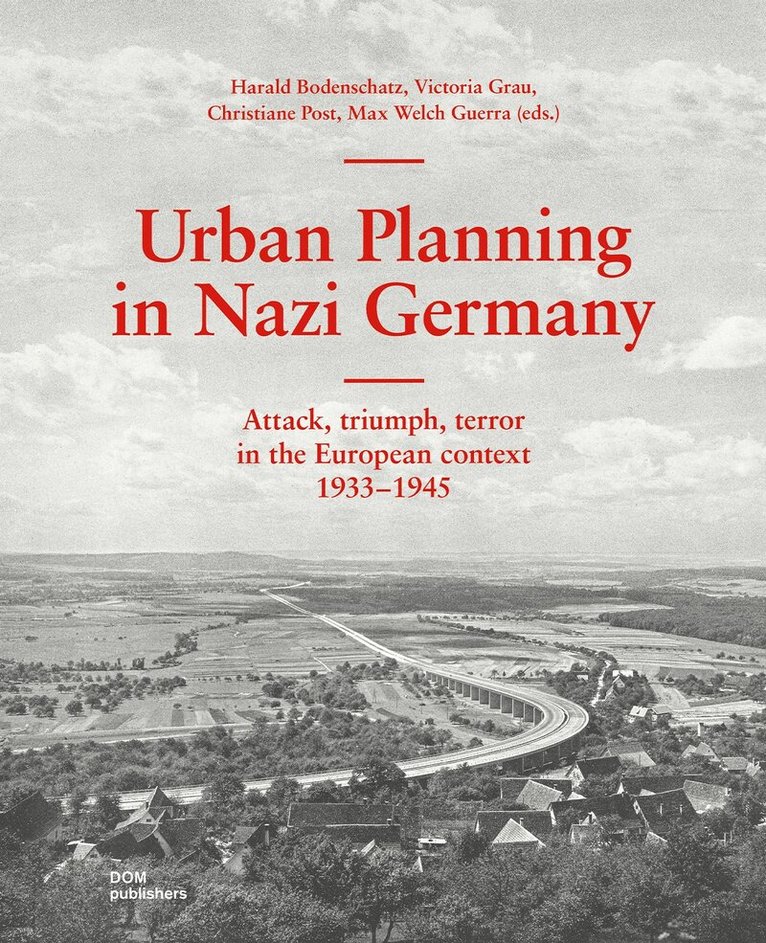
Urban Planning in Nazi Germany
Attack, Triumph, Terror in the European Context: 19331945
Inbunden, Engelska, 2025
1 315 kr
Skickas inom 3-6 vardagar
Urban planning was an essential instrument of the National Socialist dictatorship. It served to legitimize rule and demonstrate strength, accompanied rearmament and war, conveyed the socio-political program, was a medium of competition with other states, tied old and new professionals to the regime, and systematically marginalized population groups.In this book urban planning under the Nazi dictatorship is for the first time examined not only as something that evolved during the different periods of Nazi rule but also in the context of other European dictatorships of the time. The period between 1933 and 1945 saw important changes in the focus of Nazi urban planning. These affected the cast of principal actors, the content of the regime’s propaganda, cities and areas affected, programs and practices, and winners and losers. The result of this survey is a multi-layered picture that goes beyond the usual presentation of well-known power-projecting buildings to take into account a range of other important aspects including housing construction, urban renewal, internal colonization, buildings for rearmament, large-scale infrastructure, industrial areas, educational institutions, and camps.