Vladimir Hahanov – författare
Visar alla böcker från författaren Vladimir Hahanov. Handla med fri frakt och snabb leverans.
5 produkter
5 produkter
Advanced IoT Technologies and Applications in the Industry 4.0 Digital Economy
Inbunden, Engelska, 2024
1 791 kr
Skickas inom 10-15 vardagar
The application of internet of things (IoT) technologies and artificial intelligence (AI)-enabled IoT solutions has gradually become accepted by business and production organizations as an effective tool for automating several activities effectively and efficiently and developing and distributing products to the global market. Within this book, the reader will learn how to implement IoT devices, IoT-equipped machines, and AI-equipped IoT applications using models and methodologies along with an array of case studies.Advanced IoT Technologies and Applications in the Industry 4.0 Digital Economy covers the basics of IoT-equipped machines in developing and managing various activities in many industries. It discusses all of the key points of an AI-enabled IoT solution, which includes predictive analytics, robotic process automation, predictive maintenance, automated processes, IoT technologies and IoT-equipped sensors related to machines and processes, production testing systems, and product assessment processes in the production environment. The book presents the concepts and interactive methods using datasets, processing workflow charts, and architectural diagrams along with additional real-time systems for easy and fast understanding of the application of IoT-equipped machines and AI-enabled solutions in organizations and includes many case studies throughout the book to enforce reader comprehension.This book is an ideal read for industry specialists, practitioners, researchers, scientists, and engineers working or involved in the fields of Robotics, IT, Computer Science, Soft Computing, IoT, AL/ML/DL, Data Science, the Semantic Web, Knowledge Engineering, and other related fields.
Advanced IoT Technologies and Applications in the Industry 4.0 Digital Economy
Häftad, Engelska, 2025
756 kr
Skickas inom 10-15 vardagar
The application of internet of things (IoT) technologies and artificial intelligence (AI)-enabled IoT solutions has gradually become accepted by business and production organizations as an effective tool for automating several activities effectively and efficiently and developing and distributing products to the global market. Within this book, the reader will learn how to implement IoT devices, IoT-equipped machines, and AI-equipped IoT applications using models and methodologies along with an array of case studies.Advanced IoT Technologies and Applications in the Industry 4.0 Digital Economy covers the basics of IoT-equipped machines in developing and managing various activities in many industries. It discusses all of the key points of an AI-enabled IoT solution, which includes predictive analytics, robotic process automation, predictive maintenance, automated processes, IoT technologies and IoT-equipped sensors related to machines and processes, production testing systems, and product assessment processes in the production environment. The book presents the concepts and interactive methods using datasets, processing workflow charts, and architectural diagrams along with additional real-time systems for easy and fast understanding of the application of IoT-equipped machines and AI-enabled solutions in organizations and includes many case studies throughout the book to enforce reader comprehension.This book is an ideal read for industry specialists, practitioners, researchers, scientists, and engineers working or involved in the fields of Robotics, IT, Computer Science, Soft Computing, IoT, AL/ML/DL, Data Science, the Semantic Web, Knowledge Engineering, and other related fields.
2 082 kr
Kommande
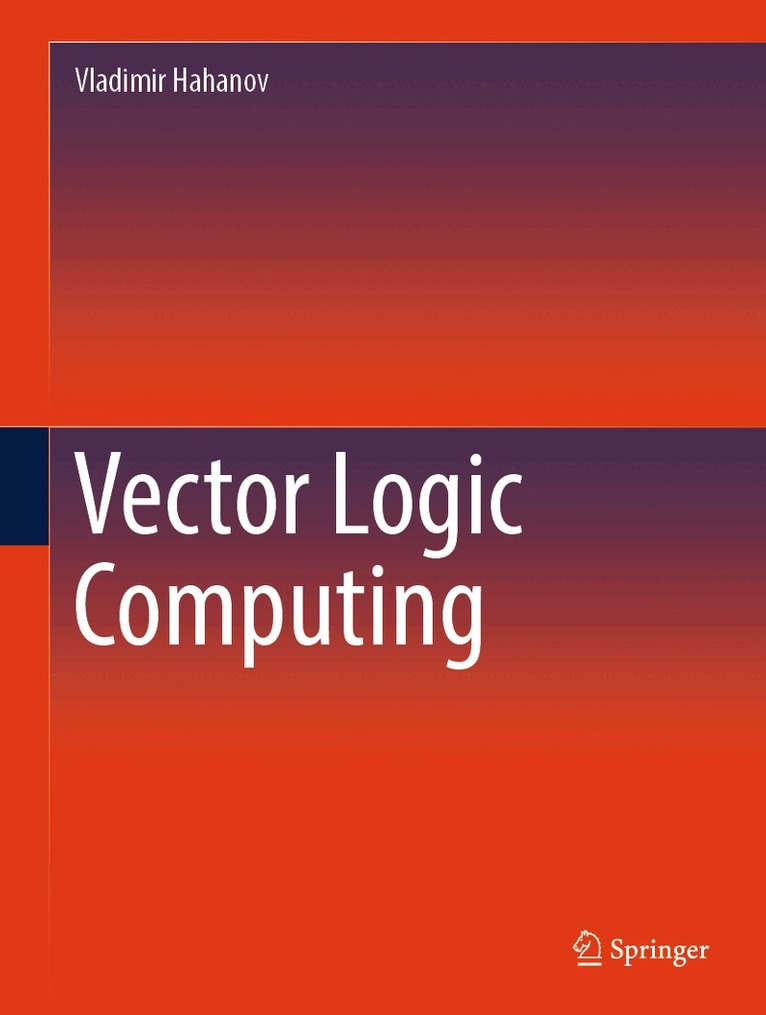
This book creates a non-processor economy vector logic in-memory computing based on read-write transactions on logical vectors, truth tables, and matrices. In-memory vector logic is a harmonic relationship between a model and an algorithm that aims to reduce time and energy in modeling for simulation by using additional space and matter. Vector logic is an ideal form of representation of functions and structures for modelling and simulating social and physical processes. Modeling without simulation is a prompt-computing for creating a comprehensive testing map of any functionality or structure on a logical vector. Intelligent computing is here the integration of classical and artificial intelligence mechanisms for modeling and simulation, using vector-logical and matrix models to process functions and structures. The book first discusses the development of smart vector logic data structures to reduce the computational complexity of simulation algorithms. Then it explores the creation of mechanisms for vector logic modeling and testing, leveraging truth tables and matrices built on a logical vector. After that, novelty goes on to cover the following: vector testing of logic circuits by simulating faults as addresses of logical vector bits; vector testing of graph structures by simulating transition faults as truth table addresses, and vector logic in-memory computing of unitary-encoded big data as truth table addresses. The book then explores the logical vector modeling for the simulation of social processes via unitary pattern encoding on the universe primitives. The goal of cyber-social vector logic computing is energy-effective monitoring and moral management of cyber-social processes and phenomena. Vector logic is a functional and structural relationship for in-memory computing, which forms an exponentially redundant data structure in memory to minimize its processing time and energy. The original vector logic mechanisms are implemented in the MOSI cloud service – Modeling for Simulation, written in Python, for simulating good-value states and faults, as addresses for logical circuits, functionalities, and structures. The book can be helpful for specialists in the field of big data prompt computing, including social and physical processes, as well as for engineers involved in testing digital GL, RTL, and system-level projects, automatic test generation, and good-value and fault address simulation. The theory and practice of vector-logical computing, algorithms, models, mechanisms, and codes are an original development to create energy- and time-saving processor-less new computing in memory.
933 kr
Skickas inom 10-15 vardagar
This book presents the cyber culture of micro, macro, cosmological, and virtual computing. The book shows how these work to formulate, explain, and predict the current processes and phenomena monitoring and controlling technology in the physical and virtual space.The authors posit a basic proposal to transform description of the function truth table and structure adjacency matrix to a qubit vector that focuses on memory-driven computing based on logic parallel operations performance. The authors offer a metric for the measurement of processes and phenomena in a cyberspace, and also the architecture of logic associative computing for decision-making and big data analysis.The book outlines an innovative theory and practice of design, test, simulation, and diagnosis of digital systems based on the use of a qubit coverage-vector to describe the functional components and structures. Authors provide a description of the technology for SoC HDL-model diagnosis, based on Test Assertion Blocks Activated Graph. Examples of cyber-physical systems for digital monitoring and cloud management of social objects and transport are proposed. A presented automaton model of cosmological computing explains the cyclical and harmonious evolution of matter-energy essence, and also a space-time form of the Universe.
933 kr
Skickas inom 10-15 vardagar
This book presents the cyber culture of micro, macro, cosmological, and virtual computing. The book shows how these work to formulate, explain, and predict the current processes and phenomena monitoring and controlling technology in the physical and virtual space.The authors posit a basic proposal to transform description of the function truth table and structure adjacency matrix to a qubit vector that focuses on memory-driven computing based on logic parallel operations performance. The authors offer a metric for the measurement of processes and phenomena in a cyberspace, and also the architecture of logic associative computing for decision-making and big data analysis.The book outlines an innovative theory and practice of design, test, simulation, and diagnosis of digital systems based on the use of a qubit coverage-vector to describe the functional components and structures. Authors provide a description of the technology for SoC HDL-model diagnosis, based on Test Assertion Blocks Activated Graph. Examples of cyber-physical systems for digital monitoring and cloud management of social objects and transport are proposed. A presented automaton model of cosmological computing explains the cyclical and harmonious evolution of matter-energy essence, and also a space-time form of the Universe.