Vladimir Mayakovsky - Böcker
Visar alla böcker från författaren Vladimir Mayakovsky. Handla med fri frakt och snabb leverans.
7 produkter
7 produkter
429 kr
Skickas inom 3-6 vardagar
This selection of Mayakovsky's work covers his entire career—from the earliest pre-revolutionary lyrics to a poem found in a notebook after his suicide. Splendid translations of the poems, with the Russian on a facing page, and a fresh, colloquial version of Mayakovsky's dramatic masterpiece, The Bedbug.
235 kr
Skickas inom 7-10 vardagar
James McGavran’s new translation of Vladimir Mayakovsky’s poetry is the first to fully capture the Futurist and Soviet agitprop artist’s voice. Because of his work as a propagandist for the Soviet regime, and because of his posthumous enshrinement by Stalin as “the best and most talented poet of our Soviet epoch,” Mayakovsky has most often been interpreted—and translated—within a political context. McGavran’s translations reveal a more nuanced poet who possessed a passion for word creation and linguistic manipulation. Mayakovsky’s bombastic metaphors and formal élan shine through in these translations, and McGavran’s commentary provides vital information on Mayakovsky, illuminating the poet’s many references to the Russian literary canon, his contemporaries in art and culture, and Soviet figures and policies.
199 kr
Skickas inom 3-6 vardagar
"what a poetand the clear water is thickwith bloody blows on its head.I embraced a cloudBut when I soaredit rained."—Frank O’Hara, “Mayakovsky” (1954)Mayakovsky's is one of the most compelling voices in twentieth-century Russian poetry. Born in 1893, he joined the Futurist movement in 1912 and soon established himself as one of Russia's major poets. In 1917, he rallied to the Russian Revolution and remained the indisputable leader of its artistic avant-garde until his suicide in 1930.Many of the poems in this book are translated for the first time into English. Accompanying the poems are rare drawings and lithographs by Mayakovsky and his circle, found in private collections of futurist books.
368 kr
Skickas inom 5-8 vardagar
181 kr
Skickas
Longlisted for the 2018 Read Russia Prize. 'Vladimir Mayakovsky' & Other Poems is the only single-volume selection in English to fully represent the work of one of Modernism's vital literary forces. The poems encompass Mayakovsky's pre-Revolutionary surrealism as well as his exclamatory agitprop of the 1920s, by which time he had become the pre-eminent Soviet poet. New translations of key works are included alongside several poems that have never been translated into English before, while an introduction and notes provide helpful contexts and elucidations. Screenplays, dramatic scripts and advertising slogans give a sense of the unusual breadth and invention of Mayakovsky's project, and his skill both as poet and propagandist. 'A poet needs to be good at life as well', he writes; his job is to 'smooth brains with the file of his tongue'. Womack's translations help to revise the predominant image of Mayakovsky as a hectoring egoist, offering a more nuanced impression of a poet whose concern was as much comradeship and intimacy as politics and posterity: 'all of this - do you want it? - I will abandon for one single tender human word.'
145 kr
Skickas
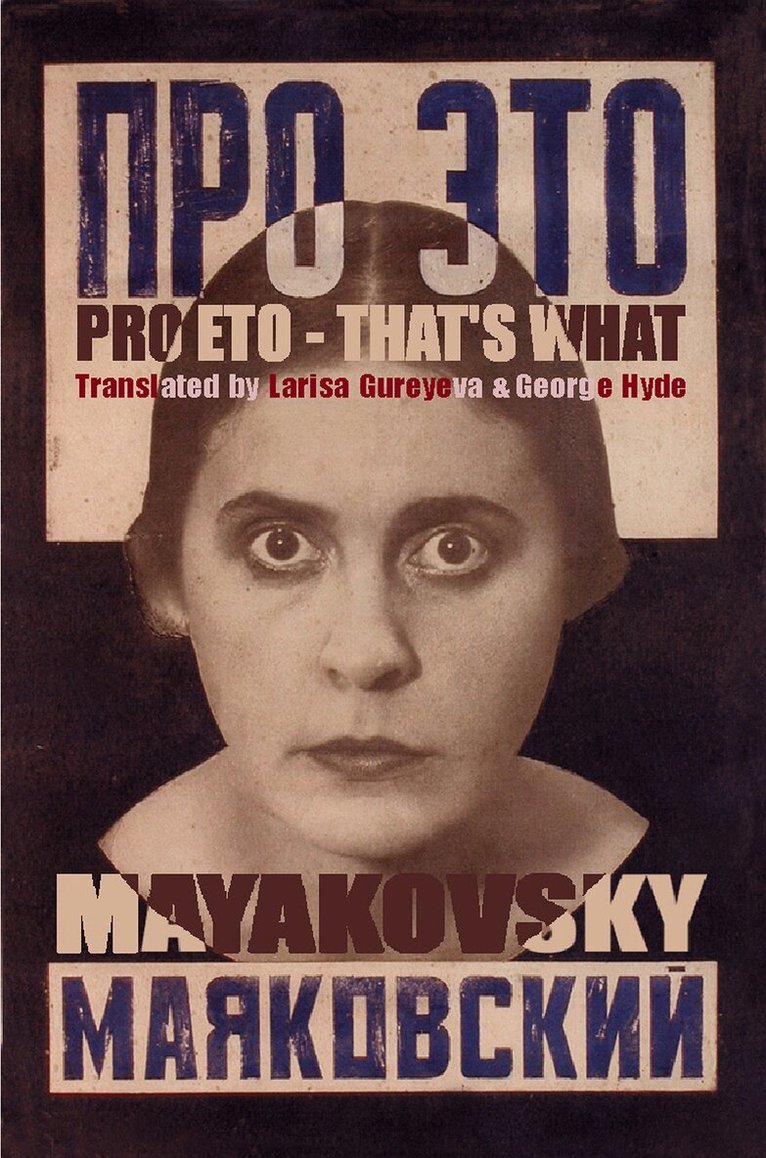
Vladimir Mayakovsky was one of the towering literary figures of pre- and post-revolutionary Russia, speaking as much to the working man as to other poets. His fascination with sound and form, linguistic metamorphosis and variation made him a sort of 'poet's poet', the doyen, if not the envy, of his contemporaries, (Pasternak among them). His poetry is strangely akin to modern rock poetry in its erotic thrust, bluesy complaints and cries of pain, not to mention its sardonic humour. It is often aggressive, mocking and yet tender, and can be fantastic or grotesque.That's What is a long love poem detailing the pain and suffering inflicted on the poet by his lover Maria and her final rejection of him. But as well as being an agonising parable of separation and betrayal, it is also a political work, highly critical of Lenin's reforms of Soviet Socialism. The publication of That's What is something of a landmark as this the first time that this seminal work has appeared in its entirety in translation. Included also are the 12 inspired photomontages that Rodchenko designed to interleave and illuminate the text, illustrations which inaugurate a world of new possibilities in combining verbal and visual forms of expression and which are reproduced in colour for the first time. "Arc have produced a handsome Russian-English edition of this personal epic of the early years of the Revolution, first published in the LEF journal (Left Front of the Arts) in 1923. George Hyde adds a lively note on 'Translating Mayakovsky's That's What'. His co-translator, Larisa Gureyeva, is the granddaughter of V.M. Molotov-Skryabin, co-signatory of the notorious pact with Germany of 1939. Hyde writes of the 'permissive' 1920s in the early Soviet Union. Following the recent splendid exhibition of Rodchenko and Popova at the Tate Modern, there are increasing signs of a growing interest in the early, tumultuous years of the Russian Revolution."The Spokesman Vladimir Mayakovsky was born in Georgia in 1893, but moved with his family to Moscow after his father's sudden death. By the time he was 20, he was a well-known literary figure, having toured Russia in the winter of 1913-14 with the Futurists (with whom he had identified). He made several trips abroad during the 1920s, including a long visit to America in 1925. A prolific writer, he still remains a popular poet among present-day Russian readers. He died in 1930 by his own hand, killing himself playing Russian roulette with a single bullet. Aleksander Rodchenko was a Russian artist, sculptor and photographer and one of the most versatile Constructivist and Productivist artists to emerge after the Russian Revolution.This book is also available as an ebook: buy it from Amazon here.
181 kr
Skickas
'This exhibition is not a jubilee, it's an account of my work. I demand help - not the glorification of non-existent virtues. That's what we are talking about, comrades, and not about glorifying private persons.' Mayakovsky was a poet, playwright, artist, director, actor, diarist, producer of agitprop posters and advertisement slogans, and writer of articles, essays and speeches. The inherent conflict of his status as an avant-garde communist writer working within the steadily narrowing cultural conditions of early Soviet Russia runs vividly throughout his work, and was a significant contributing factor to his suicide at the age of thirty-six. This groundbreaking collection draws together for the first time Mayakovsky's key translators from the 1930s to the present day, bringing some remarkable works back into print in the process and introducing poems which have never before been translated.The radical scope of its representation makes for the most comprehensive account of Mayakovsky's work to date - an account which charts not only the extraordinary range of his creative output, his rigorous and passionate innovation of language and form, and the intense power of his electrifying live performances, but also the fascinating and turbulent history of Mayakovsky's cultural and political representation in the western world.Edited by Rosy Patience Carrick