W. Goebel - Böcker
Visar alla böcker från författaren . Handla med fri frakt och snabb leverans.
4 produkter
4 produkter
1 094 kr
Skickas inom 10-15 vardagar
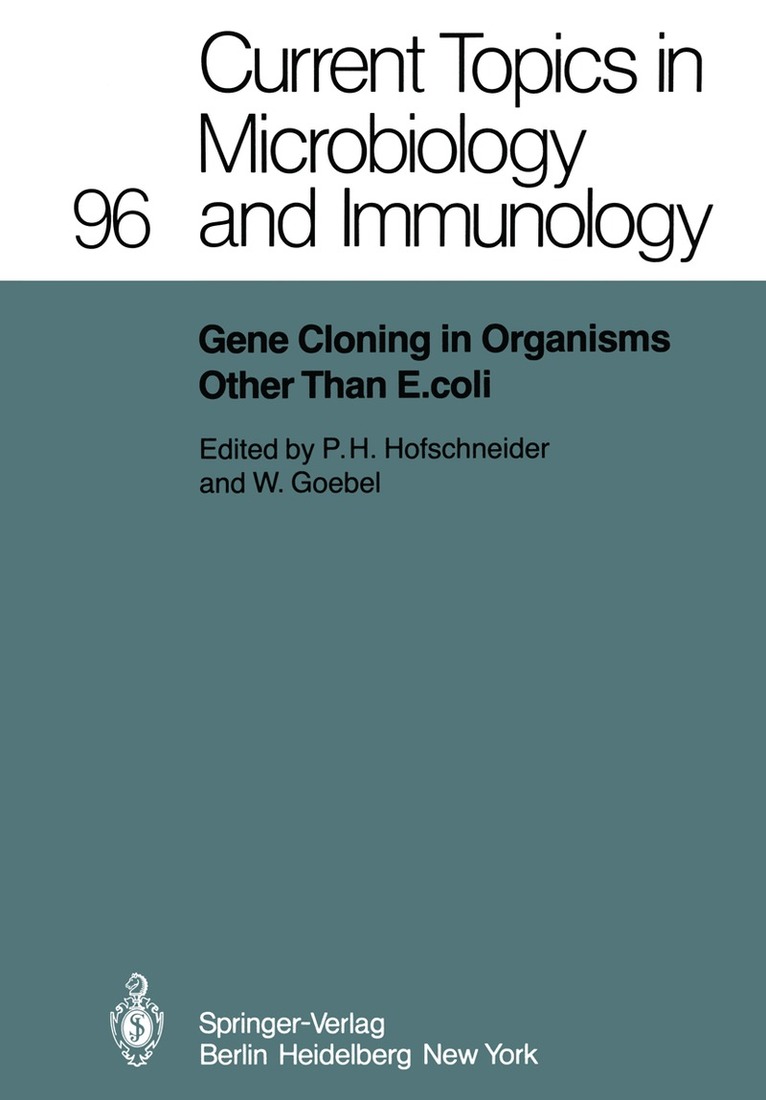
Gene cloning for the production of recombinant DNA is usually performed with E. coli. There is, however, no doubt that gene cloning in organisms other than E. coli will assume a much more important role in the future: efficient cloning systems are needed for the analysis of gene expression and its regulation in eukaryotic cells, for the elucidation ofthe genetic mechanisms of transform a- tion, and for the study of the genetic rearrangement during dif- ferentiation and embryogenesis. Furthermore, optimal cloning systems will be required for practical applications in the near future: for the optimal production of antibiotics, amino acids, vitamins, enzymes etc. , for the expression of gene products under favorable energetic conditions for mass production, for the ex- pression of glycolysated animal proteins, for the genetic manipu- 'lation of plants -and in the more distant future, for gene therapy inman. The editors have therefore invited leading scientists to sum- marize the present status and the future applicability of gene cloning systems in their fields of research.To ensure a complete coverage of a genetic system, the editors have generally asked two authors to cover one system. This volume is a frrst and unique account of our knowledge of cloning systems employing organisms other than E. coli such as B. subtilis, pseudomonas, neurospora, saccharomyces and streptomyces, as well as of vectors and selection procedures for animal and plant systems including the liposome technique. October 1981 P. R.
Del 118 - Current Topics in Microbiology and Immunology
Genetic Approaches to Microbial Pathogenicity
Häftad, Engelska, 2011
1 094 kr
Skickas inom 10-15 vardagar
Important progress in the elucidation of the mechanisms influencing bacterial pathogenicity has recently been made through the introduction of modem genetic techniques. Molecular cloning allows the isolation of genes for pheno- types that epidemiological surveys have suggested play an important role in pathogenesis. The structural analysis of determinants for pathogenic traits can lead to the identifica- tion not only of the primary sequence but also of the possi- ble secondary and tertiary structures for important viru- lence factors such as toxins and adhesins. From these data, the prediction of antigenic domains suitable for the devel- opment of new vaccines appears to be feasible. The regula- tion of virulence determinants by endogenous and exoge- nous factors can be more clearly understood through the functional analysis of the cloned virulence genes. This volume surveys representative virulence properties of gram-positive and gram-negative bacteria to which the genetic approach has been successfully applied. The exam- ples described here include important bacterial toxins (e.g., diphtheria toxin, cholera toxin, toxic shock syndrome toxin, hemolysins), adhesion structures from E.coli and Neisseria gonorrhoeae, and factors supporting iron uptake, serum resistance, and invasiveness in a variety of bacteria. Both the present state and the possible futural develop- ments of these systems are described.
1 094 kr
Skickas inom 10-15 vardagar
1 094 kr
Skickas inom 10-15 vardagar