Walter Freeman - Böcker
Visar alla böcker från författaren Walter Freeman. Handla med fri frakt och snabb leverans.
4 produkter
4 produkter
621 kr
Skickas inom 3-6 vardagar
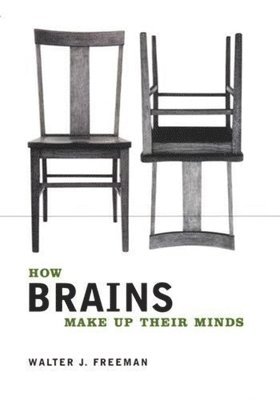
I think, therefore I am. The legendary pronouncement of philosopher Rene Descartes lingers as accepted wisdom in the Western world nearly four centuries after its author's death. But does thought really come first? Who actually runs the show: we, our thoughts, or the neurons firing within our brains? Walter J. Freeman explores how we control our behavior and make sense of the world around us. Avoiding determinism both in sociobiology, which proposes that persons' genes control their brains' functioning, and in neuroscience, which posits that their brains' disposition is molded by chemistry and environmental forces, Freeman charts a new course-one that gives individuals due credit and responsibility for their actions. Drawing upon his five decades of research in neuroscience, Freeman utilizes the latest advances in his field as well as perspectives from disciplines as diverse as mathematics, psychology, and philosophy to explicate how different human brains act in their chosen diverse ways.He clarifies the implications of brain imaging, by which neural activity can be observed during the course of normal movements, and shows how nonlinear dynamics reveals order within the fecund chaos of brain function.
Imaging Brain Function With EEG
Advanced Temporal and Spatial Analysis of Electroencephalographic Signals
Inbunden, Engelska, 2012
1 733 kr
Skickas inom 10-15 vardagar
The scalp and cortex lie like pages of an open book on which the cortex enciphers vast quantities of information and knowledge. They are recorded and analyzed as temporal and spatial patterns in the electroencephalogram and electrocorticogram. This book describes basic tools and concepts needed to measure and decipher the patterns extracted from the EEG and ECoG. This book emphasizes the need for single trial analysis using new methods and paradigms, as well as large, high-density spatial arrays of electrodes for pattern sampling. The deciphered patterns reveal neural mechanisms by which brains process sensory information into precepts and concepts. It describes the brain as a thermodynamic system that uses chemical energy to construct knowledge. The results are intended for use in the search for the neural correlates of intention, attention, perception and learning; in the design of human brain-computer interfaces enabling mental control of machines; and in exploring and explaining the physicochemical foundation of biological intelligence.
Imaging Brain Function With EEG
Advanced Temporal and Spatial Analysis of Electroencephalographic Signals
Häftad, Engelska, 2014
1 682 kr
Skickas inom 10-15 vardagar
The scalp and cortex lie like pages of an open book on which the cortex enciphers vast quantities of information and knowledge. They are recorded and analyzed as temporal and spatial patterns in the electroencephalogram and electrocorticogram. This book describes basic tools and concepts needed to measure and decipher the patterns extracted from the EEG and ECoG. This book emphasizes the need for single trial analysis using new methods and paradigms, as well as large, high-density spatial arrays of electrodes for pattern sampling. The deciphered patterns reveal neural mechanisms by which brains process sensory information into precepts and concepts. It describes the brain as a thermodynamic system that uses chemical energy to construct knowledge. The results are intended for use in the search for the neural correlates of intention, attention, perception and learning; in the design of human brain-computer interfaces enabling mental control of machines; and in exploring and explaining the physicochemical foundation of biological intelligence.
1 423 kr
Skickas inom 10-15 vardagar
This volume provides an overview of important work carried out by Professor Walter Freeman of the University of Berkeley, California, USA. Collecting together his published works over the last 35 years, it charts his groundbreaking research into perception and other cognitive operations in animals and humans and looks at how this can be applied to computer hardware to provide the foundations for novel - and greatly improved - machine intelligence. It provides a step-by-step description of the concepts and data needed by electrical engineers, computer scientists and cognitivists to understand and emulate pattern recognition in biological systems at a level of competence which has not yet been matched by any form of Artificial Intelligence. It offers a unique blend of theory and experiment and, historically, it also demonstrates the impact of computers on the design, execution, and interpretation of experiments in neurophysiology over the past five decades.