• Fri frakt över 249 kr
  • •
  • Snabba leveranser
  • •
  • Billiga böcker
Kundservice

Du är på sajten för privatpersoner.

Företag, bibliotek eller offentlig verksamhet?

Du handlar på classic.bokus.com, där alla dina funktioner finns intakta.
Till classic.bokus.com
Bokus logotyp. Gå till startsidan.
  • Erbjudanden
  • Nyheter
  • Student
  • Topplistor
  • Barn & ungdom
  • Bokus Play
  • E-böcker
  • Pocketböcker
  • Spel & pussel

10% rabatt på allt med kod NYSTART10 →

Sidfot

Mina sidor

    Hjälp

    • Kundservice
    • Vanliga frågor och svar
    • Frakt och leverans
    • Retur vid ångerrätt
    • Reklamera vara
    • Betalning
    • Köpvillkor
    • Allmänna villkor
    • Information om webbplatsens tillgänglighet

    Om Bokus

    • Om oss
    • Pressrum
    • För studenter
    • För företag
    • För bibliotek och offentlig verksamhet
    • För leverantörer
    • Hållbarhet

    Populärt

    • Aktuella erbjudanden
    • Presentkort
    • Studentlitteratur
    • Nya böcker
    • Topplistor
    • Signerade böcker
    • Engelska böcker

    Inspiration

    • Boktips
    • BookTok
    • Populära bokserier
    • Barnbokskaraktärer
    • Populära författare
    Logotyp för Bokus
    Följ oss på Facebook (extern länk)Följ oss på Instagram (extern länk)Följ oss på YouTube (extern länk)Följ oss på TikTok (extern länk)
    bokus @ CookiesAnpassa cookiesIntegritetspolicyKöpvillkor
    Till Citymail hemsida (extern länk)Till Budbee hemsida (extern länk)Till Postnord hemsida (extern länk)Till Schenker hemsida (extern länk)Till Early Bird hemsida (extern länk)Till Walleys hemsida (extern länk)
    1. Data och IT
    2. Systemvetenskap och AI

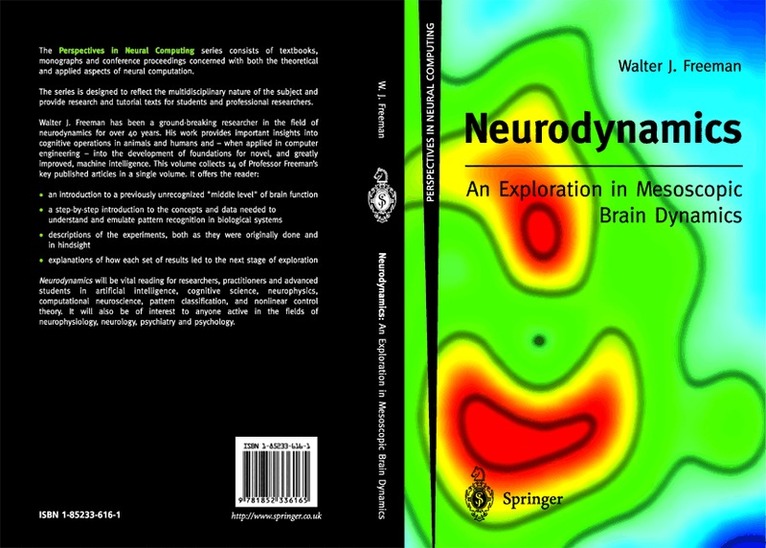
    Neurodynamics: An Exploration in Mesoscopic Brain Dynamics

    AvWalter Freeman

    Häftad, Engelska, 2000

    Del i serien Perspectives in Neural Computing

    1 451 kr

    Beställningsvara. Skickas inom 10-15 vardagar. Fri frakt över 249 kr.

    Fler format och utgåvor

    E-bok

    1 780 kr

    Beskrivning

    Cortical evoked potentials are of interest primarily as tests of changing neuronal excitabilities accompanying normal brain function. The first three steps in the anal­ ysis of these complex waveforms are proper placement of electrodes for recording, the proper choice of electrical or sensory stimulus parameters, and the establish­ ment of behavioral control. The fourth is development of techniques for reliable measurement. Measurement consists of comparison of an unknown entity with a set of standard scales or dimensions having numerical attributes in preassigned degree. A physical object can be described by the dimensions of size, mass, density, etc. In addition there are dimensions such as location, velocity, weight, hardness, etc. Some of these dimensions can be complex (e. g. size depends on three or more subsidiary coordi­ nates), and some can be interdependent or nonorthogonal (e. g. specification of size and mass may determine density). In each dimension the unit is defined with refer­ ence to a standard physical entity, e. g. a unit of mass or length, and the result of measurement is expressed as an equivalence between the unknown and the sum of a specified number of units of that entity. The dimensions of a complex waveform are elementary waveforms from which that waveform can be built by simple addition. Any finite single-valued function of time is admissible. They are called basis functions (lO, 15), and they can be expressed in numeric as well as geometric form.

    Produktinformation

    • Utgivningsdatum:2000-03-01
    • Mått:155 x 235 x 23 mm
    • Vikt:616 g
    • Format:Häftad
    • Språk:Engelska
    • Serie:Perspectives in Neural Computing
    • Antal sidor:398
    • Upplaga:1
    • Förlag:Springer London Ltd
    • ISBN:9781852336165

    Utforska kategorier

    • Systemvetenskap och AI inom Data och IT
    • Biovetenskap inom Naturvetenskap och teknik
    • Neurologi och klinisk neurofysiologi inom Medicin

    Innehållsförteckning

    • Prologue.- Prologue.- I The dynamics of neural interaction and transmission.- 1. Spatial mapping of evoked brain potentials and EEGs to 27 define population state variables.- 2. Linear models of impulse inputs and linear basis functions for measuring impulse responses.- 3. Rational approximations in the complex plane for Laplace transforms of transcendental linear operators.- 4. Root locus analysis of piecewise linearized models with multiple feedback loops and unilateral or bilateral saturation.- 5. Opening feedback loops with surgery and anesthesia; closing them with noise.- 6. Three degrees of freedom in neural populations: Arousal, learning, and bistability.- 7. Analog computation to model responses based on linear integration, modifiable synapses, and nonlinear trigger zones.- 8. Stability analysis to derive and regulate homeostatic set points for negative feedback loops.- II Designation of contents as meaning, not information.- 9. Multichannel recording to reveal the “code” of the cortex: spatial patterns of amplitude modulation (AM) of mesoscopic carrier waves.- 10. Relations between microscopic and mesoscopic levels shown by calculating pulse probability conditional on EEG amplitude, giving the asymmetric sigmoid function.- 11. Euclidean distance in 64-space and the use of behavioral correlates to optimize filters for gamma AM pattern classification.- 12. Simulating gamma waveforms, AM patterns and 1/f? spectra by means of mesoscopic chaotic neurodynamics.- 13. Tuning curves to optimize temporal segmentation and parameter evaluation of adaptive filters for neocortical EEG.- 14. Stochastic differential equations and random number generators minimize numerical instabilities in digital simulations.- Epilogue: Problems for further development in mesoscopicbrain dynamics.- Epilogue: Problems for further development in mesoscopic brain dynamics.- References.- Author Index.