William Fulke – författare
Visar alla böcker från författaren William Fulke. Handla med fri frakt och snabb leverans.
11 produkter
Confutation of the Rhemish Testament
Av William Fulke, Lord And Co Leavitt
Inbunden, 2022
442 kr
Lägg i varukorg
Confutation of the Rhemish Testament
Av William Fulke, Lord And Co Leavitt
Häftad, 2022
307 kr
Lägg i varukorg
Defence of the Sincere and True Translations of the Holy Scriptures Into the English Tongue
Av Charles Henry Hartshorne, William Fulke
Inbunden, 2023
488 kr
Lägg i varukorg
Defence of the Sincere and True Translations of the Holy Scriptures Into the English Tongue
Av Charles Henry Hartshorne, William Fulke
Häftad, 2023
385 kr
Lägg i varukorg
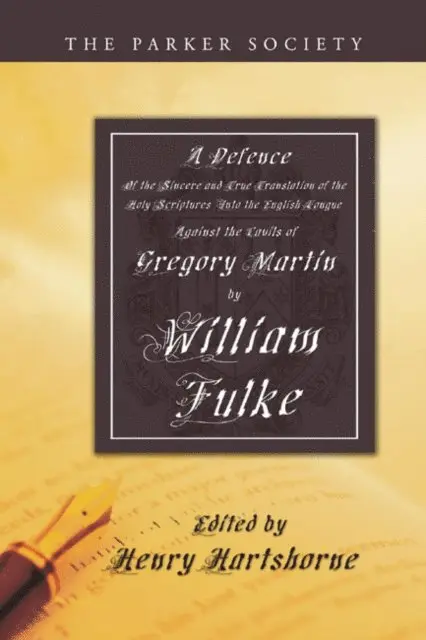
Defence of the Sincere and True Translations of the Holy Scriptures Into the English Tongue
Against the Cavils of Gregory Martin
Av William Fulke, Charles Henry Hartshorne
Inbunden, 2015
595 kr
Lägg i varukorg
Defence of the Sincere and True Translations of the Holy Scriptures Into the English Tongue
Av William Fulke, Charles Hartshorne
Häftad, 2004
479 kr
Lägg i varukorg
Defence of the Sincere and True Translations of the Holy Scriptures into the English Tongue
Av William Fulke, Charles Hartshorne
E-bok, 2004
814 kr
Lägg i varukorg
The Parker Society was the London-based Anglican society that printed in fifty-four volumes the works of the leading English Reformers of the sixteenth century. It was formed in 1840 and disbanded in 1855 when its work was completed. Named after Matthew Parker -- the first Elizabethan Archbishop of …
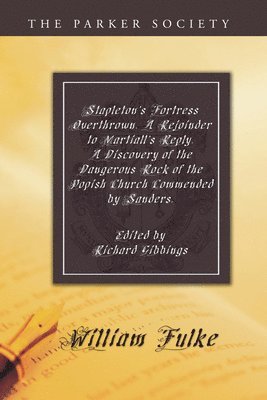
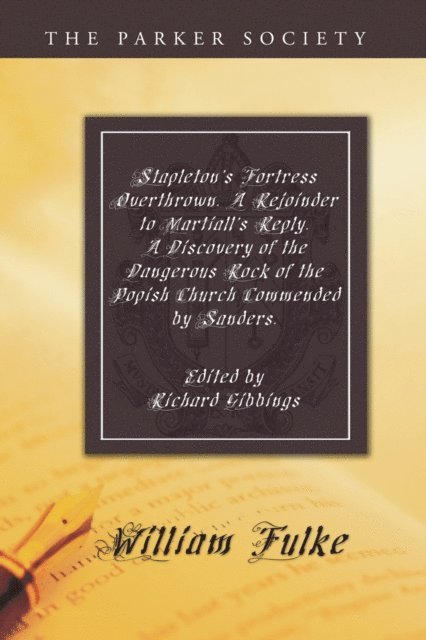
Stapleton's Fortress Overthrown. A Rejoinder to Martiall's Reply. A Discovery of the Dangerous Rock of the Popish Church Commended by Sanders.
Av William Fulke, Richard Gibbings
E-bok, 2009
641 kr
Lägg i varukorg
HistoryThe Parker Society, 'For the Publication of the Works of the Fathers and Early Writers of the Reformed English Church', was formed in 1840 and disbanded in 1855 when its work was completed. Its name is taken from that of Matthew Parker, the first Elizabethan Archbishop of Canterbury, who was …