William W. Warren – författare
Visar alla böcker från författaren William W. Warren. Handla med fri frakt och snabb leverans.
4 produkter
4 produkter
Häftad, Engelska, 2014
931 kr
Skickas inom 3-6 vardagar
This is a long-needed general introduction to the physics and chemistry of the liquid-vapor phase transition of metals. Physicists and physical chemists have made great strides understanding the basic principles involved, and engineers have discovered a wide variety of new uses for fluid metals. Yet there has been no book that brings together the latest ideas and findings in the field or that bridges the conceptual gap between the condensed-matter physics relevant to a dense metallic liquid and the molecular chemistry relevant to a dilute atomic vapor. Friedrich Hensel and William Warren seek to change that here. They draw on cutting-edge research and data from carefully selected fluid-metal systems as they strive to develop a rigorous theoretical approach to predict the thermodynamic behavior of fluid metals over the entire liquid-vapor range. This book will appeal to theoreticians interested in metal-nonmetal transitions or continuous phase transitions in general. It will also be of great value to those who need to understand the practical applications of fluid metals, for example, as a high-temperature working fluid or as a key component of semiconductor manufacturing.Originally published in 1999. The Princeton Legacy Library uses the latest print-on-demand technology to again make available previously out-of-print books from the distinguished backlist of Princeton University Press. These editions preserve the original texts of these important books while presenting them in durable paperback and hardcover editions. The goal of the Princeton Legacy Library is to vastly increase access to the rich scholarly heritage found in the thousands of books published by Princeton University Press since its founding in 1905.
Inbunden, Engelska, 2016
2 397 kr
Skickas inom 3-6 vardagar
This is a long-needed general introduction to the physics and chemistry of the liquid-vapor phase transition of metals. Physicists and physical chemists have made great strides understanding the basic principles involved, and engineers have discovered a wide variety of new uses for fluid metals. Yet there has been no book that brings together the latest ideas and findings in the field or that bridges the conceptual gap between the condensed-matter physics relevant to a dense metallic liquid and the molecular chemistry relevant to a dilute atomic vapor. Friedrich Hensel and William Warren seek to change that here. They draw on cutting-edge research and data from carefully selected fluid-metal systems as they strive to develop a rigorous theoretical approach to predict the thermodynamic behavior of fluid metals over the entire liquid-vapor range. This book will appeal to theoreticians interested in metal-nonmetal transitions or continuous phase transitions in general. It will also be of great value to those who need to understand the practical applications of fluid metals, for example, as a high-temperature working fluid or as a key component of semiconductor manufacturing.Originally published in 1999. The Princeton Legacy Library uses the latest print-on-demand technology to again make available previously out-of-print books from the distinguished backlist of Princeton University Press. These editions preserve the original texts of these important books while presenting them in durable paperback and hardcover editions. The goal of the Princeton Legacy Library is to vastly increase access to the rich scholarly heritage found in the thousands of books published by Princeton University Press since its founding in 1905.
Häftad, Engelska, 2009
297 kr
Skickas inom 3-6 vardagar
E-bok
Engelska, 2009271 kr
Läs direkt efter köp
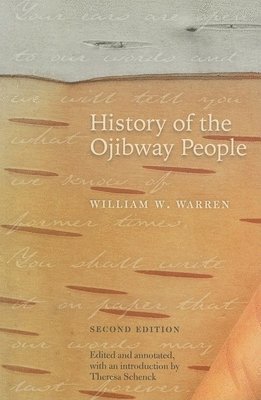
William W. Warren's History of the Ojibway People has long been recognized as a classic source on Ojibwe history and culture. Warren, the son of an Ojibwe woman, wrote his history in the hope of saving traditional stories for posterity even as he presented to the American public a sympathetic view of a people he believed were fast disappearing under the onslaught of a corrupt frontier population. He collected firsthand descriptions and stories from relatives, tribal leaders, and acquaintances and transcribed this oral history in terms that nineteenth-century whites could understand,focusing on warfare, tribal organizations, and political leaders.First published in 1885 by the Minnesota Historical Society, the book has also been criticized by Native and non-Native scholars, many of whom do not take into account Warren's perspective, goals, and limitations. Now, for the first time since its initial publication, it is made available with new annotations researched and written by professor Theresa Schenck. A new introduction by Schenck also gives a clear and concise history of the text and of the author, firmly establishing a place for William Warren in the tradition of American Indian intellectual thought.