Wybe Th. Douma – författare
Visar alla böcker från författaren Wybe Th. Douma. Handla med fri frakt och snabb leverans.
4 produkter
4 produkter
Inbunden, Engelska, 2006
1 003 kr
Skickas inom 10-15 vardagar
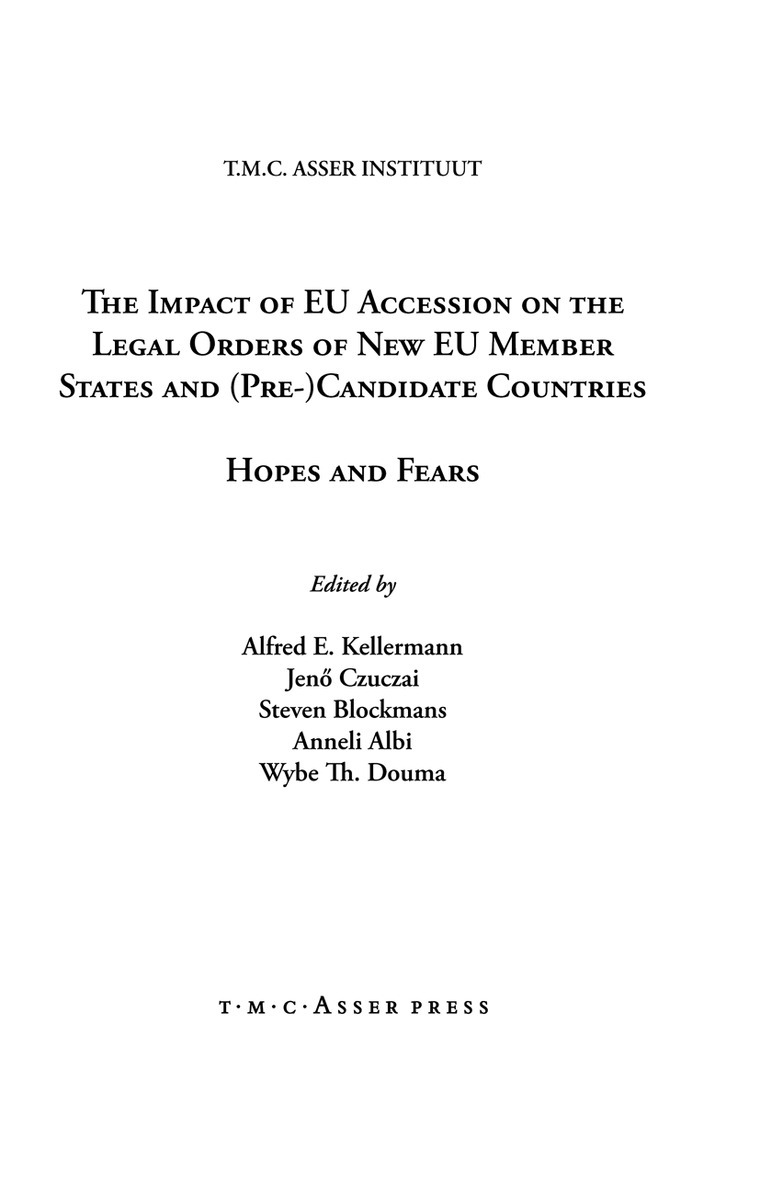
With a Foreword by Jaap de ZwaanOn 1 May 2004, ten countries joined the European Union as Member States. In that same year, five other countries (Bulgaria, Croatia, Romania, Serbia and Montenegro, and Turkey) had or received (pre-)candidate country status. EU accession requires a great number of adaptations in the laws and policies of a country. In order to analyse the impact of these developments and support the countries concerned, the T.M.C. Asser Institute in The Hague initiated a project originally entitled ‘The impact of EU accession for the acceding Member States and (pre-)candidate countries’. The project, which was approved by the Dutch Ministry of Foreign Affairs and financed under the Ministry’s Matra Programme, started at the beginning of 2003 and concluded during the Dutch EU presidency with a final conference in The Hague in October 2004.In preparation for this conference, a group of distinguished experts from the fifteenparticipating countries analysed, according to identical guidelines, the impact of accession on the organization of their national governments, parliaments and judiciaries, as well as on their national constitutions. Their research activities resulted in fifteen country reports offering a multitude of interesting insights, views and experiences. In 2005, the reports were updated by the authors and editors of this book, so that they could be made available to the wider public. As a comparative study of fifteen countries, it is an excellent guide for the preparation of the national legal orders for EU accession, for briefing and training civil servants, judges, practitioners, officials of international organizations and academics, and for post-graduate students.The multi-country research project was carried out by, and under the guidance of, Alfred E. Kellermann, T.M.C. Asser Institute, Jenö Czuczai, European Law Academy Budapest, Steven Blockmans,T.M.C. Asser Institute, and Anneli Albi, University of Kent. They also formed the editing team of the book, which was further complemented by Wybe Th. Douma, T.M.C. Asser Institute.
Inbunden, Engelska, 2007
505 kr
Skickas inom 10-15 vardagar
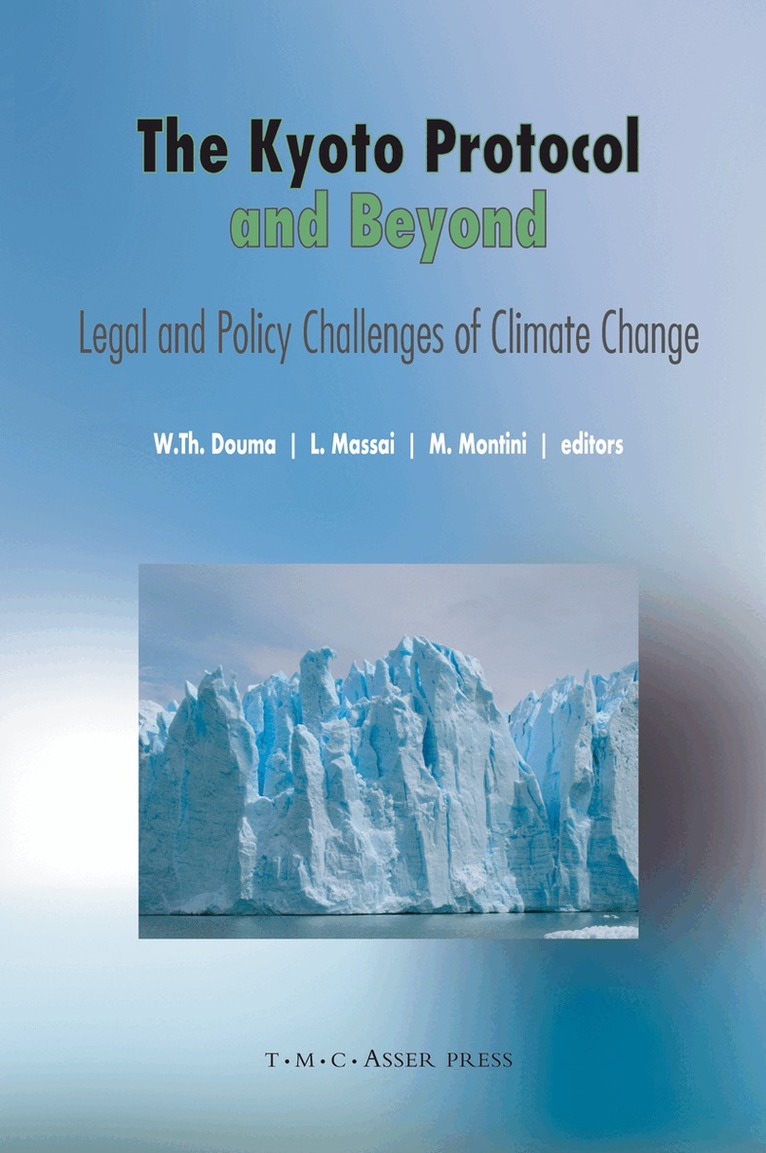
I had the pleasure of participating at the two conferences which form the basis of this book: as a chairman at the 2007 The Hague Conference 'Tackling Climate Change - An appraisal of the Kyoto Protocol and options for the future' and as a speaker at the 2006 Siena Conference' The Kyoto Protocol and beyond: a legal perspective'. I would like to thank my colleagues Wybe Douma, Leonardo Massai and Massimiliano Montini for those opportunities, and although I was, unfortu nately, unable to contribute a paper to this book due to time constraints, I am glad to be able to say a few words on the issue by means of this foreword. The timing of the two conferences was well chosen: the period between the Siena Conference (June 2006) and The Hague Conference (March 2007) encapsu lated perfectly the period of the drafting, the presentation and the approval of the 'Integrated Energy and Climate Change Package', as presented by the European th Commission on the 10 of January 2007 and as approved by the Spring European th th Council of the 8 and 9 of March 2007. The importance of the Commission's package and the Council's conclusions must be strongly emphasized. They set, at the EU level, legally binding targets regarding the reduction of greenhouse gas of energy, and biofuels.
Inbunden, Engelska, 2010
505 kr
Skickas inom 10-15 vardagar
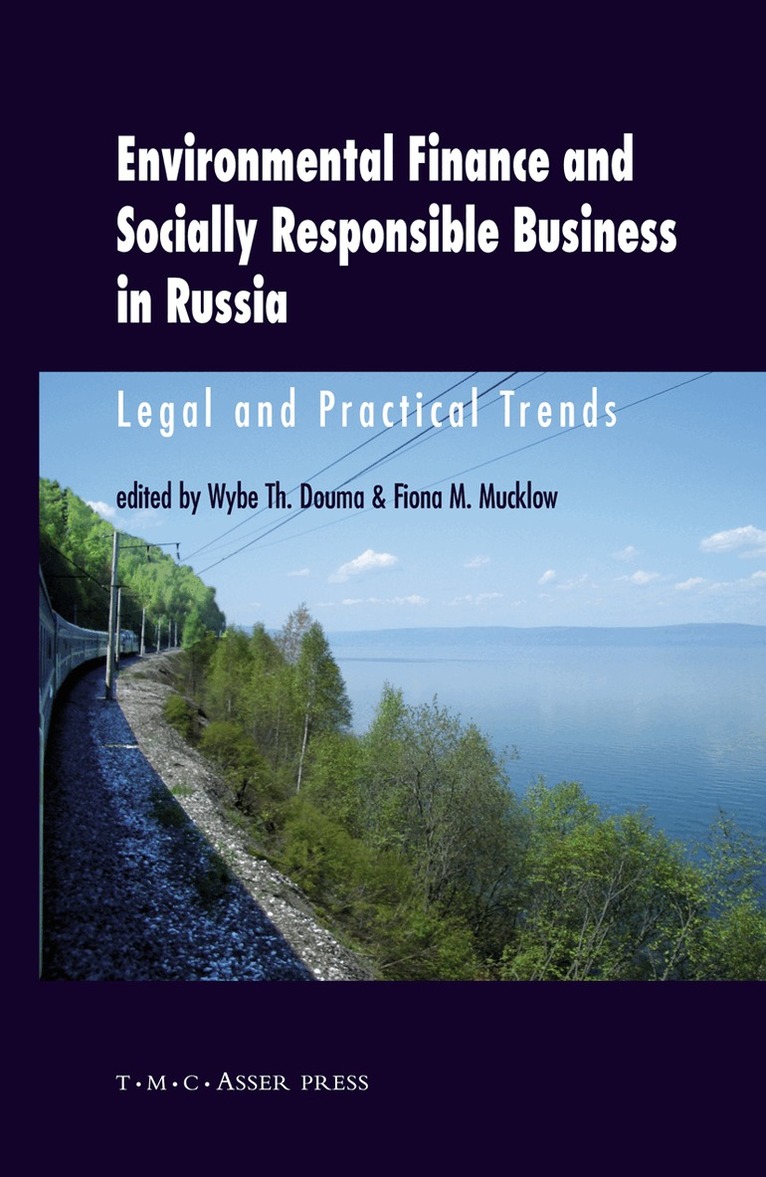
This book focuses on the legal and practical aspects of environmental finance and socially responsible business practices in Russia since the 1990s. Related publications to date tend to give a rather one-sided and negative picture. The authors in this book, however, provide a more positive and balanced outlook. Over half of them are from Russia, and most of the non-Russian authors have worked there extensively. As experts in their respective fields, they discuss a myriad of separate, but interrelated issues from an economic, legal or practical perspective.Topics include environmental law, pollution abatement, climate change and the Kyoto Protocol, renewable energy opportunities, NPAF, TACIS and EBRD projects, corporate social responsibility, environmental management systems, integration of EU environmental standards and adherence to the European Principles of Environmental Protection, environmental education and philanthropy.Giving a valuable introductory insight intothe progress of environmental and socially responsible business practices in Russia, this book is essential reading for investors, academics, practitioners and those interested in sustainable development in Russia.Wybe Th. Douma, is a senior researcher in European Law and International Trade Law at the T.M.C. Asser Instituut. He worked in Russia on several projects, notably as senior legal expert for the first TACIS ’Harmonisation of environmental standards’ project.Fiona M. Mucklow is a research associate at the T.M.C. Asser Instituut and an English solicitor with extensive expertise in finance law and international environmental law in Russia.
Häftad, Engelska, 2014
505 kr
Skickas inom 10-15 vardagar
I had the pleasure of participating at the two conferences which form the basis of this book: as a chairman at the 2007 The Hague Conference 'Tackling Climate Change - An appraisal of the Kyoto Protocol and options for the future' and as a speaker at the 2006 Siena Conference' The Kyoto Protocol and beyond: a legal perspective'. I would like to thank my colleagues Wybe Douma, Leonardo Massai and Massimiliano Montini for those opportunities, and although I was, unfortu nately, unable to contribute a paper to this book due to time constraints, I am glad to be able to say a few words on the issue by means of this foreword. The timing of the two conferences was well chosen: the period between the Siena Conference (June 2006) and The Hague Conference (March 2007) encapsu lated perfectly the period of the drafting, the presentation and the approval of the 'Integrated Energy and Climate Change Package', as presented by the European th Commission on the 10 of January 2007 and as approved by the Spring European th th Council of the 8 and 9 of March 2007. The importance of the Commission's package and the Council's conclusions must be strongly emphasized. They set, at the EU level, legally binding targets regarding the reduction of greenhouse gas of energy, and biofuels.