Xuefeng Guo - Böcker
Visar alla böcker från författaren Xuefeng Guo. Handla med fri frakt och snabb leverans.
3 produkter
3 produkter
2 115 kr
Skickas inom 10-15 vardagar
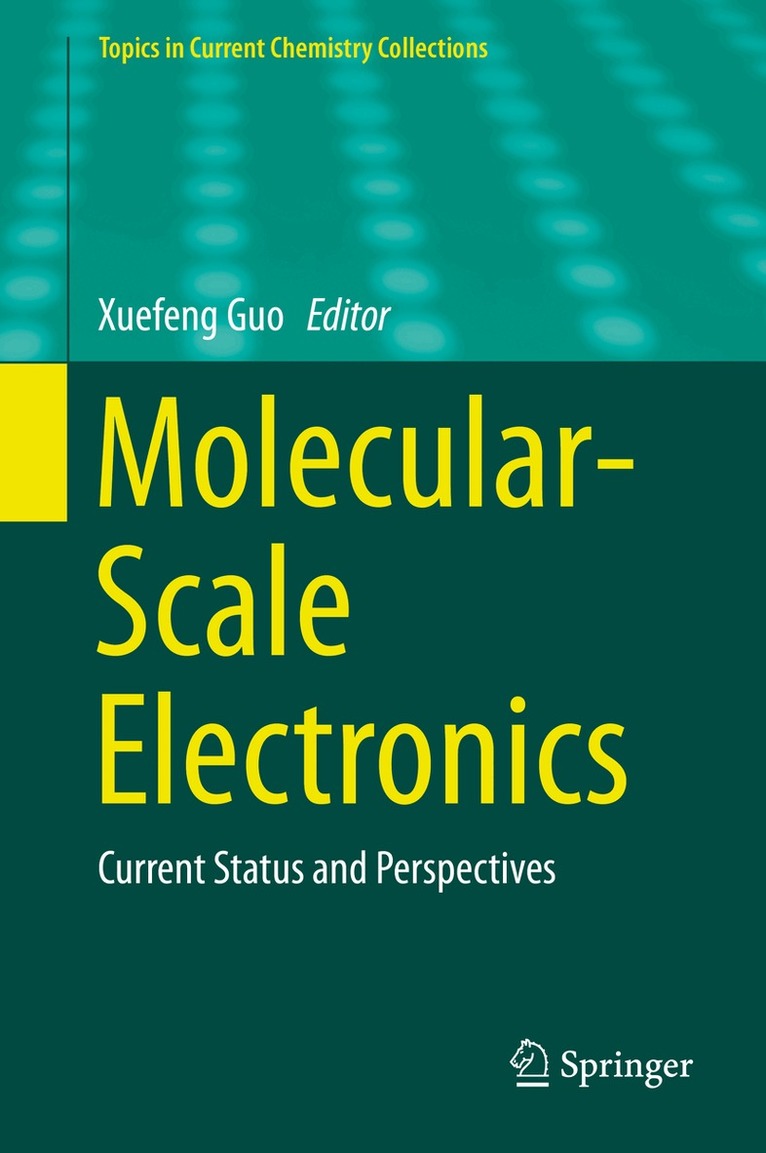
The series Topics in Current Chemistry Collections presents critical reviews from the journal Topics in Current Chemistry organized in topical volumes. The scope of coverage is all areas of chemical science including the interfaces with related disciplines such as biology, medicine and materials science. The goal of each thematic volume is to give the non-specialist reader, whether in academia or industry, a comprehensive insight into an area where new research is emerging which is of interest to a larger scientific audience.Each review within the volume critically surveys one aspect of that topic and places it within the context of the volume as a whole. The most significant developments of the last 5 to 10 years are presented using selected examples to illustrate the principles discussed. The coverage is not intended to be an exhaustive summary of the field or include large quantities of data, but should rather be conceptual, concentrating on the methodological thinking that will allow the non-specialist reader to understand the information presented. Contributions also offer an outlook on potential future developments in the field.
1 540 kr
Skickas inom 11-20 vardagar
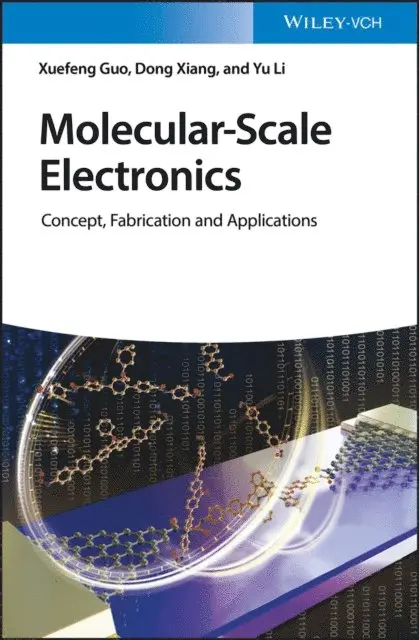
Provides in-depth knowledge on molecular electronics and emphasizes the techniques for designing molecular junctions with controlled functionalities This comprehensive book covers the major advances with the most general applicability in the field of molecular electronic devices. It emphasizes new insights into the development of efficient platform methodologies for building such reliable devices with desired functionalities through the combination of programmed bottom-up self-assembly and sophisticated top-down device fabrication. It also helps to develop an understanding of the device fabrication processes and the characteristics of the resulting electrode-molecule interface. Beginning with an introduction to the subject, Molecular-Scale Electronics: Concept, Fabrication and Applications offers full chapter coverage on topics such as: Metal Electrodes for Molecular Electronics; Carbon Electrodes for Molecular Electronics; Other Electrodes for Molecular Electronics; Novel Phenomena in Single-Molecule Junctions; and Supramolecular Interactions in Single-Molecule Junctions. Other chapters discuss Theoretical Aspects for Electron Transport through Molecular Junctions; Characterization Techniques for Molecular Electronics; and Integrating Molecular Functionalities into Electrical Circuits. The book finishes with a summary of the primary challenges facing the field and offers an outlook at its future. * Summarizes a number of different approaches for forming molecular-scale junctions and discusses various experimental techniques for examining these nanoscale circuits in detail * Gives overview of characterization techniques and theoretical simulations for molecular electronics * Highlights the major contributions and new concepts of integrating molecular functionalities into electrical circuits * Provides a critical discussion of limitations and main challenges that still exist for the development of molecular electronics * Suited for readers studying or doing research in the broad fields of Nano/molecular electronics and other device-related fields Molecular-Scale Electronics is an excellent book for materials scientists, electrochemists, electronics engineers, physical chemists, polymer chemists, and solid-state chemists. It will also benefit physicists, semiconductor physicists, engineering scientists, and surface chemists.
1 573 kr
Skickas inom 5-8 vardagar
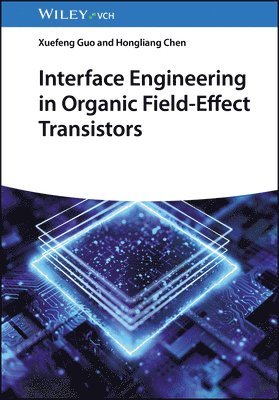
Interface Engineering in Organic Field-Effect Transistors Systematic summary of advances in developing effective methodologies of interface engineering in organic field-effect transistors, from models to experimental techniquesInterface Engineering in Organic Field-Effect Transistors covers the state of the art in organic field-effect transistors and reviews charge transport at the interfaces, device design concepts, and device fabrication processes, and gives an outlook on the development of future optoelectronic devices.This book starts with an overview of the commonly adopted methods to obtain various semiconductor/semiconductor interfaces and charge transport mechanisms at these heterogeneous interfaces. Then, it covers the modification at the semiconductor/electrode interfaces, through which to tune the work function of electrodes as well as reveal charge injection mechanisms at the interfaces.Charge transport physics at the semiconductor/dielectric interface is discussed in detail. The book describes the remarkable effect of SAM modification on the semiconductor film morphology and thus the electrical performance. In particular, valuable analyses of charge trapping/detrapping engineering at the interface to realize new functions are summarized.Finally, the sensing mechanisms that occur at the semiconductor/environment interfaces of OFETs and the unique detection methods capable of interfacing organic electronics with biology are discussed.Specific sample topics covered in Interface Engineering in Organic Field-Effect Transistors include: Noncovalent modification methods, charge insertion layer at the electrode surface, dielectric surface passivation methods, and covalent modification methodsCharge transport mechanism in bulk semiconductors, influence of additives on materials’ nucleation and morphology, solvent additives, and nucleation agentsNanoconfinement effect, enhancing the performance through semiconductor heterojunctions, planar bilayer heterostructure, ambipolar charge-transfer complex, and supramolecular arrangement of heterojunctionsDielectric effect in OFETs, dielectric modification to tune semiconductor morphology, surface energy control, microstructure design, solution shearing, eliminating interfacial traps, and SAM/SiO2 dielectricsA timely resource providing the latest developments in the field and emphasizing new insights for building reliable organic electronic devices, Interface Engineering in Organic Field-Effect Transistors is essential for researchers, scientists, and other interface-related professionals in the fields of organic electronics, nanoelectronics, surface science, solar cells, and sensors.