Yoshinori Watanabe – författare
Visar alla böcker från författaren Yoshinori Watanabe. Handla med fri frakt och snabb leverans.
9 produkter
Soft CLIL and English Language Teaching
Understanding Japanese Policy, Practice and Implications
Av Makoto Ikeda, Shinichi Izumi m. fl.
Inbunden, 2021
2586 kr
Lägg i varukorg
Content and Language Integrated Learning (CLIL) is a transformative and powerful approach to language education and has had a significant impact on educational pedagogy in recent years. Despite burgeoning literature on the efficacy and implementation of CLIL, there remains a gap between CLIL and …
Soft CLIL and English Language Teaching
Understanding Japanese Policy, Practice and Implications
Av Makoto Ikeda, Shinichi Izumi m. fl.
Häftad, 2023
627 kr
Lägg i varukorg
Content and Language Integrated Learning (CLIL) is a transformative and powerful approach to language education and has had a significant impact on educational pedagogy in recent years. Despite burgeoning literature on the efficacy and implementation of CLIL, there remains a gap between CLIL and …
Soft CLIL and English Language Teaching
Understanding Japanese Policy, Practice and Implications
Av Matthew Davis, Richard Pinner m. fl.
E-bok, 2021
657 kr
Lägg i varukorg
Content and Language Integrated Learning (CLIL) is a transformative and powerful approach to language education and has had a significant impact on educational pedagogy in recent years. Despite burgeoning literature on the efficacy and implementation of CLIL, there remains a gap between CLIL and …
Soft CLIL and English Language Teaching
Understanding Japanese Policy, Practice and Implications
Av Matthew Davis, Richard Pinner m. fl.
E-bok, 2021
657 kr
Lägg i varukorg
Content and Language Integrated Learning (CLIL) is a transformative and powerful approach to language education and has had a significant impact on educational pedagogy in recent years. Despite burgeoning literature on the efficacy and implementation of CLIL, there remains a gap between CLIL and …
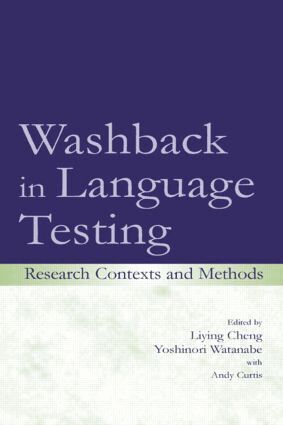
Washback in Language Testing
Research Contexts and Methods
Av Liying Cheng, Yoshinori Watanabe m. fl.
Inbunden, 2003
2441 kr
Lägg i varukorg
Washback refers to the influence of language testing on teaching and learning. This volume, at the important intersection of language testing and teaching practices, presents theoretical, methodological, and practical guidance for current and future washback studies. In the field of language …
Washback in Language Testing
Research Contexts and Methods
Av Liying Cheng, Yoshinori Watanabe m. fl.
Häftad, 2003
601 kr
Lägg i varukorg
Washback refers to the influence of language testing on teaching and learning. This volume, at the important intersection of language testing and teaching practices, presents theoretical, methodological, and practical guidance for current and future washback studies. In the field of language …
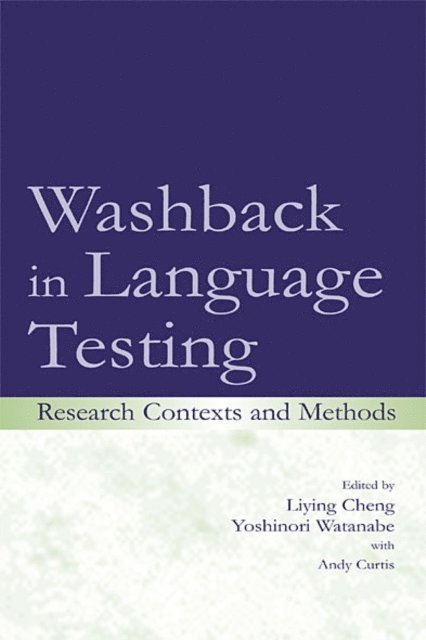
Washback in Language Testing
Research Contexts and Methods
Av WITH Andy Curtis, Yoshinori Watanabe m. fl.
E-bok, 2004
707 kr
Lägg i varukorg
Washback refers to the influence of language testing on teaching and learning. This volume, at the important intersection of language testing and teaching practices, presents theoretical, methodological, and practical guidance for current and future washback studies. In the field of language …
Washback in Language Testing
Research Contexts and Methods
Av WITH Andy Curtis, Yoshinori Watanabe m. fl.
E-bok, 2004
707 kr
Lägg i varukorg
Washback refers to the influence of language testing on teaching and learning. This volume, at the important intersection of language testing and teaching practices, presents theoretical, methodological, and practical guidance for current and future washback studies. In the field of language …
Washback in Language Testing
Research Contexts and Methods
Av WITH Andy Curtis, Yoshinori Watanabe m. fl.
E-bok, 2004
322 kr
Tillfälligt slut
Washback refers to the influence of language testing on teaching and learning. This volume, at the important intersection of language testing and teaching practices, presents theoretical, methodological, and practical guidance for current and future washback studies. In the field of language …