Yue Dong – författare
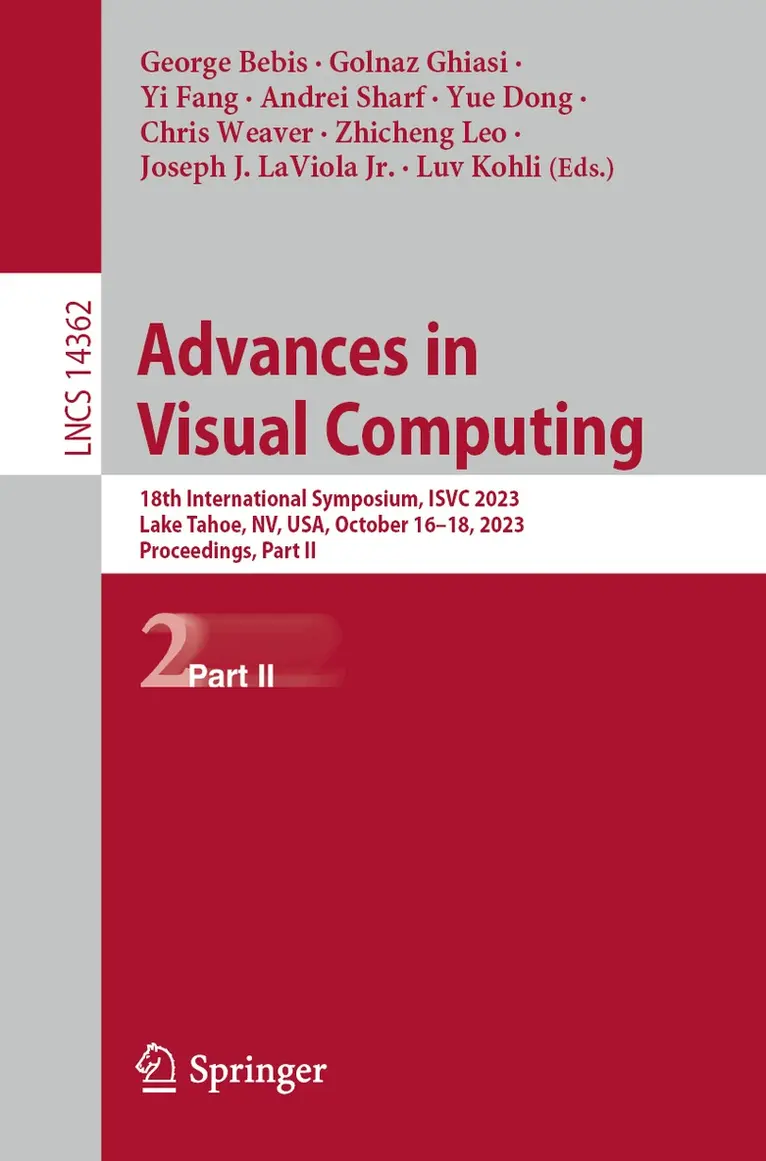
Advances in Visual Computing
18th International Symposium, ISVC 2023, Lake Tahoe, NV, USA, October 16–18, 2023, Proceedings, Part II
896 kr
Skickas inom 5-8 vardagar
1 101 kr
Läs direkt efter köp
This volume LNCS 14361 and 14362 constitutes the refereed proceedings of the, 16th International Symposium, ISVC 2023, in October 2023, held at Lake Tahoe, NV, USA.
The 42 full papers and 13 poster papers were carefully reviewed and selected from 120 submissions. A total of 25 papers were also accepted for oral presentation in special tracks from 34 submissions. The following topical sections followed as:
Part 1: ST: Biomedical Image Analysis Techniques for Cancer Detection, Diagnosis and Management; Visualization; Video Analysis and Event Recognition; ST: Innovations in Computer Vision & Machine Learning for Critical & Civil Infrastructures; ST: Generalization in Visual Machine Learning; Computer Graphics; Medical Image Analysis; Biometrics; Autonomous Anomaly Detection in Images; ST: Artificial Intelligence in Aerial and Orbital Imagery; ST: Data Gathering, Curation, and Generation for Computer Vision and Robotics in Precision Agriculture.Part 2: Virtual Reality; Segmentation; Applications; Object Detection and Recognition; Deep Learning; Poster.
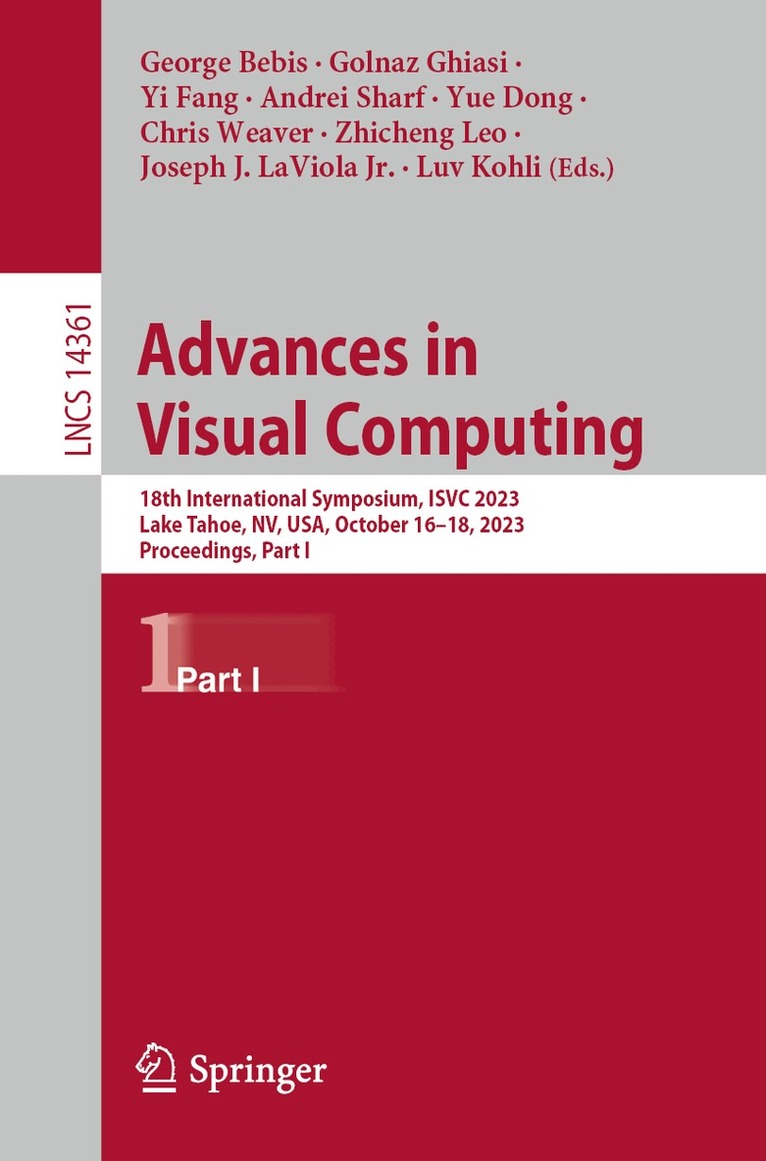
Advances in Visual Computing
18th International Symposium, ISVC 2023, Lake Tahoe, NV, USA, October 16–18, 2023, Proceedings, Part I
1 118 kr
Skickas inom 5-8 vardagar
1 328 kr
Läs direkt efter köp
This volume LNCS 14361 and 14362 constitutes the refereed proceedings of the, 16th International Symposium, ISVC 2023, in October 2023, held at Lake Tahoe, NV, USA.
The 42 full papers and 13 poster papers were carefully reviewed and selected from 120 submissions. A total of 25 papers were also accepted for oral presentation in special tracks from 34 submissions. The following topical sections followed as:
Part 1: ST: Biomedical Image Analysis Techniques for Cancer Detection, Diagnosis and Management; Visualization; Video Analysis and Event Recognition; ST: Innovations in Computer Vision & Machine Learning for Critical & Civil Infrastructures; ST: Generalization in Visual Machine Learning; Computer Graphics; Medical Image Analysis; Biometrics; Autonomous Anomaly Detection in Images; ST: Artificial Intelligence in Aerial and Orbital Imagery; ST: Data Gathering, Curation, and Generation for Computer Vision and Robotics in Precision Agriculture.
Part 2: Virtual Reality; Segmentation; Applications; Object Detection and Recognition; Deep Learning; Poster.
1 336 kr
Skickas
1 787 kr
Läs direkt efter köp
Reference on achieving contactless manipulation of soft robots, detailing high level concepts and perspectives and technical skills of soft robots
Untethered Miniature Soft Robots: Materials, Fabrications, and Applications introduces the emerging field of miniature soft robots and summarizes the recent rapid development in the field to date, describing different types of functional materials to build miniature soft robots, such as silicone elastomer, carbon-based materials, hydrogels, liquid crystal polymer, flexible ferrofluid, and liquid metal, and covering the material properties, fabrication strategies, and functionalities in soft robots together with their underlying mechanisms.
The book discusses magnetically, thermally, optically, and chemically actuated soft robots in depth, explores the many specific applications of miniature soft robots in biomedical, environmental, and electrical fields and summarizes the development of miniature soft robots based on soft matter, fabrication strategies, locomotion principles, sensing and actuation mechanisms.
In closing, the text summarizes the opportunities and challenges faced by miniature soft robots, providing expert insight into the possible futures of this field.
Written by four highly qualified academics, Untethered Miniature Soft Robots covers sample topics such as:
Soft elastomer-based robots with programmable magnetization profiles and untethered soft robots based on template-aiding Working mechanisms of carbon-based materials, covering light-induced expansion and shrinkage, and humidity-induced deformation Designing microscale building blocks, modular assembly of building blocks based on Denavit-Hartenberg (DH) matrix, and inverse and forward design of modular morphing systems Material designs of magnetic liquid crystal elastomers (LCE) systems, multiple-stimuli responsiveness of magnetic LCE systems, and adaptive locomotion of magnetic LCE-based robots Controllable deformation and motion behaviors, as well as applications of ferrofluids droplet robots (FDRs), including cargo capturing, object sorting, liquid pumping/mixing, and liquid skin.Providing highly detailed and up-to-date coverage of the topic, Untethered Miniature Soft Robots serves as an invaluable and highly comprehensive reference for researchers working in this promising field across a variety of disciplines, including materials scientists, mechanical and electronics engineers, polymer chemists, and biochemists.
1 787 kr
Läs direkt efter köp
Reference on achieving contactless manipulation of soft robots, detailing high level concepts and perspectives and technical skills of soft robots
Untethered Miniature Soft Robots: Materials, Fabrications, and Applications introduces the emerging field of miniature soft robots and summarizes the recent rapid development in the field to date, describing different types of functional materials to build miniature soft robots, such as silicone elastomer, carbon-based materials, hydrogels, liquid crystal polymer, flexible ferrofluid, and liquid metal, and covering the material properties, fabrication strategies, and functionalities in soft robots together with their underlying mechanisms.
The book discusses magnetically, thermally, optically, and chemically actuated soft robots in depth, explores the many specific applications of miniature soft robots in biomedical, environmental, and electrical fields and summarizes the development of miniature soft robots based on soft matter, fabrication strategies, locomotion principles, sensing and actuation mechanisms.
In closing, the text summarizes the opportunities and challenges faced by miniature soft robots, providing expert insight into the possible futures of this field.
Written by four highly qualified academics, Untethered Miniature Soft Robots covers sample topics such as:
Soft elastomer-based robots with programmable magnetization profiles and untethered soft robots based on template-aiding Working mechanisms of carbon-based materials, covering light-induced expansion and shrinkage, and humidity-induced deformation Designing microscale building blocks, modular assembly of building blocks based on Denavit-Hartenberg (DH) matrix, and inverse and forward design of modular morphing systems Material designs of magnetic liquid crystal elastomers (LCE) systems, multiple-stimuli responsiveness of magnetic LCE systems, and adaptive locomotion of magnetic LCE-based robots Controllable deformation and motion behaviors, as well as applications of ferrofluids droplet robots (FDRs), including cargo capturing, object sorting, liquid pumping/mixing, and liquid skin.Providing highly detailed and up-to-date coverage of the topic, Untethered Miniature Soft Robots serves as an invaluable and highly comprehensive reference for researchers working in this promising field across a variety of disciplines, including materials scientists, mechanical and electronics engineers, polymer chemists, and biochemists.
1 124 kr
Skickas inom 10-15 vardagar
1 420 kr
Läs direkt efter köp
A principal aim of computer graphics is to generate images that look as real as photographs. Realistic computer graphics imagery has however proven to be quite challenging to produce, since the appearance of materials arises from complicated physical processes that are difficult to analytically model and simulate, and image-based modeling of real material samples is often impractical due to the high-dimensional space of appearance data that needs to be acquired.
This book presents a general framework based on the inherent coherency in the appearance data of materials to make image-based appearance modeling more tractable. We observe that this coherence manifests itself as low-dimensional structure in the appearance data, and by identifying this structure we can take advantage of it to simplify the major processes in the appearance modeling pipeline. This framework consists of two key components, namely the coherence structure and the accompanying reconstruction method to fully recover the low-dimensional appearance data from sparse measurements. Our investigation of appearance coherency has led to three major forms of low-dimensional coherence structure and three types of coherency-based reconstruction upon which our framework is built.
This coherence-based approach can be comprehensively applied to all the major elements of image-based appearance modeling, from data acquisition of real material samples to user-assisted modeling from a photograph, from synthesis of volumes to editing of material properties, and from efficient rendering algorithms to physical fabrication of objects. In this book we present several techniques built on this coherency framework to handle various appearance modeling tasks both for surface reflections and subsurface scattering, the two primary physical components that generate material appearance. We believe that coherency-based appearance modeling will make it easier and more feasible for practitioners to bring computer graphics imagery to life.
This book is aimed towards readers with an interest in computer graphics. In particular, researchers, practitioners and students will benefit from this book by learning about the underlying coherence in appearance structure and how it can be utilized to improve appearance modeling. The specific techniques presented in our manuscript can be of value to anyone who wishes to elevate the realism of their computer graphics imagery. For understanding this book, an elementary background in computer graphics is assumed, such as from an introductory college course or from practical experience with computer graphics.
1 124 kr
Skickas inom 10-15 vardagar
495 kr
Skickas inom 10-15 vardagar
611 kr
Läs direkt efter köp
This book mainly provides the current status of water pollution faced by China under rapid changing environment and the actions that have been taken for prevention and treatment of water pollution. It points out that the water pollution situation is severe. Facing water pollution, China’s experiences include several aspects on source control and pollution interception, internal nutrient removal of sediment, ecological restoration, and water transfer policy. There exists both the opportunity and challenge for the prevention and control of water pollution in China. The book contains numerous charts and diagrams which further illustrating China’s paths to clean water.