Yuichi Shionoya - Böcker
Visar alla böcker från författaren Yuichi Shionoya. Handla med fri frakt och snabb leverans.
11 produkter
11 produkter
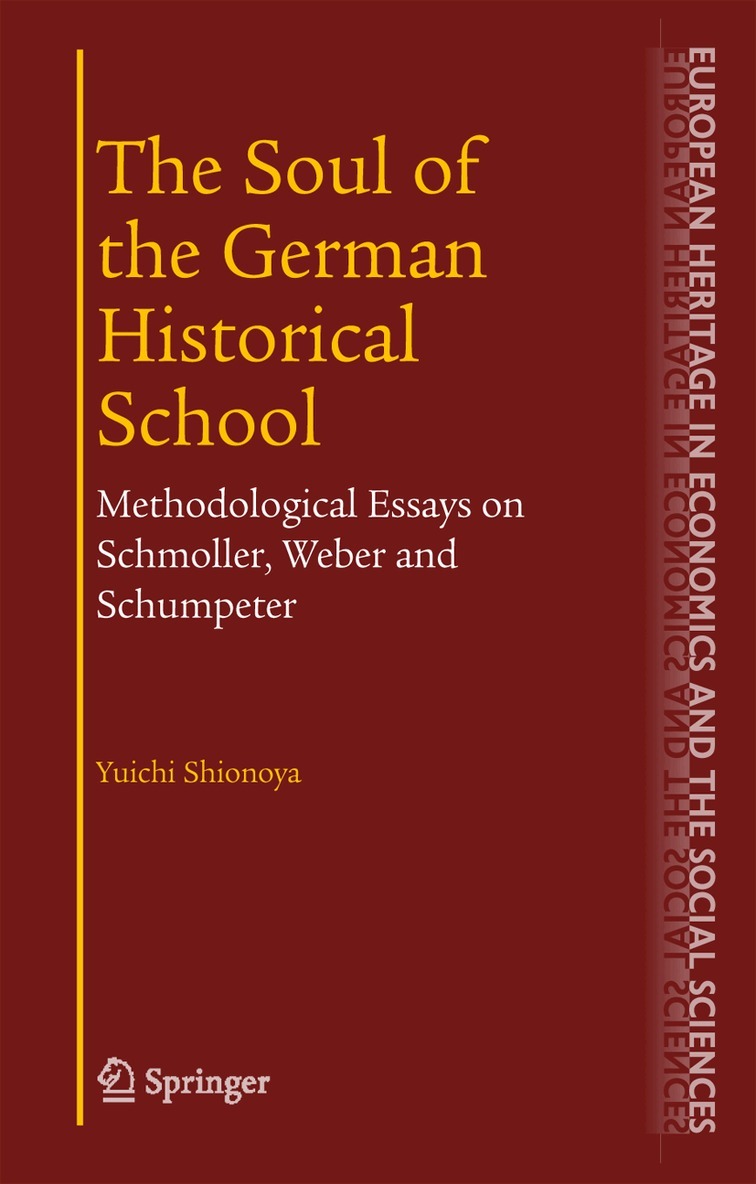
Soul of the German Historical School
Methodological Essays on Schmoller, Weber and Schumpeter
Inbunden, Engelska, 2005
1 624 kr
Skickas inom 10-15 vardagar
This volume is a collection of my essays on Gustav von Schmoller (1838– 1917), Max Weber (1864–1920), and Joseph Alois Schumpeter (1883–1950), published during the past fifteen years. These three intellectual giants are connected with the German Historical School of Economics in different ways. In the history of economics, the German Historical School has been described as a heterodox group of economic researchers who flourished in the Germ- speaking world throughout the nineteenth century. The definition of a “school” is always problematic. Even if the core of a certain idea were identified in the continuous and discontinuous process of the filiation and ramification of thought, it is still possible to trace its predecessors, successors, and sympathizers in different directions, creating an amorphous entity of a school. It is beyond question, however, that Schmoller was the leader of the younger German Historical School, the genuine school with a sociological 1 reality. Schmoller was indeed the towering figure of the Historical School at its zenith.
2 290 kr
Skickas inom 10-15 vardagar
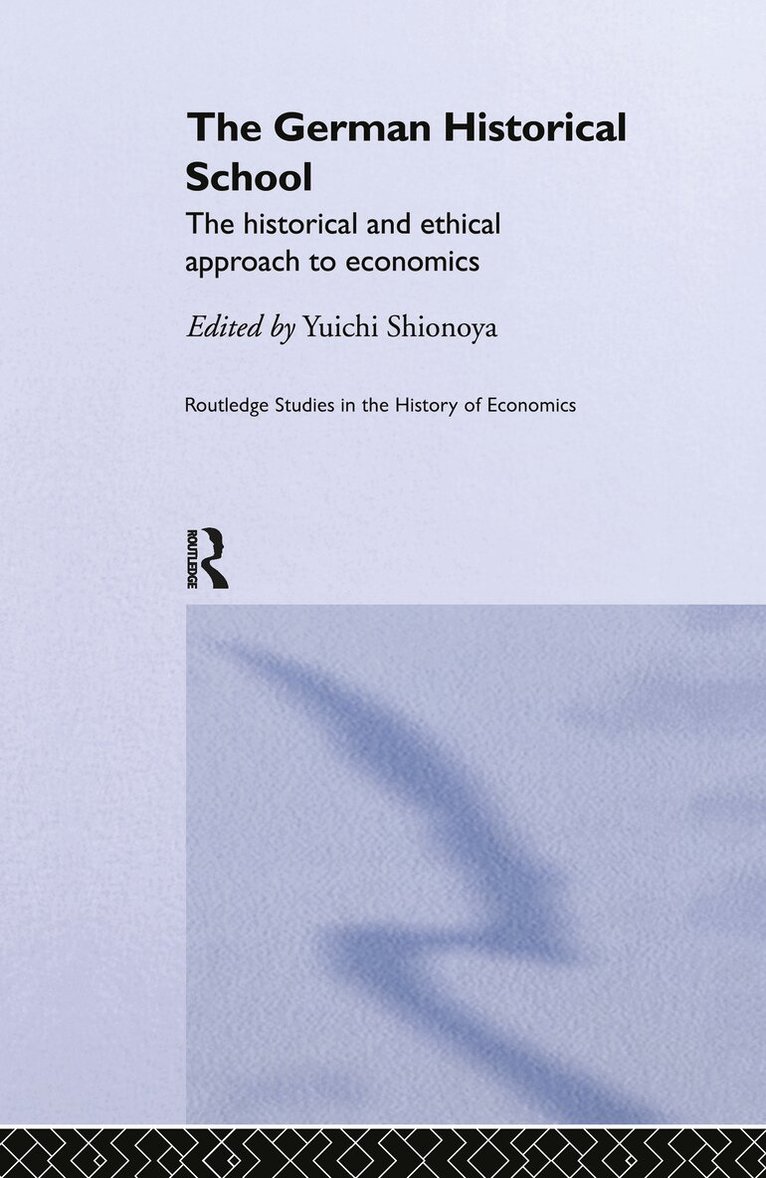
With the increasing acceptance of evolutionary and institutional thinking among economists, general interest in the German Historical School has risen steadily during the last decade. This book traces the development and transformation of the School, covering its leading figures such as Adam Muller, Wilhelm Roscher, Karl Knies and Lujo Brentano.
685 kr
Skickas inom 7-10 vardagar
This book is a comprehensive investigation of the work of Joseph Alois Schumpeter (1883-1950), one of the great economists of the twentieth century. In this study, Yuichi Shionoya highlights Schumpeter's methodological views and emphasizes his ideal of a universal social science. Taking on board all aspects of his work, he reconstructs a system which encompasses theory (economic statics, economic dynamics, economic sociology) and metatheory (philosophy of science, history and sociology of science). The originality of Schumpeter's work - which the author calls the two-structure approach to the evolution of mind and society - is examined in the light of the intellectual field in Germany and Austria in the early twentieth century. This book is a major contribution to the history of economic thought.
1 499 kr
Skickas inom 7-10 vardagar
This book is a comprehensive investigation of the work of Joseph Alois Schumpeter (1883-1950), one of the great economists of the twentieth century. In this study, Yuichi Shionoya highlights Schumpeter's methodological views and emphasizes his ideal of a universal social science. Taking on board all aspects of his work, he reconstructs a system which encompasses theory (economic statics, economic dynamics, economic sociology) and metatheory (philosophy of science, history and sociology of science). The originality of Schumpeter's work - which the author calls the two-structure approach to the evolution of mind and society - is examined in the light of the intellectual field in Germany and Austria in the early twentieth century. This book is a major contribution to the history of economic thought.
775 kr
Skickas inom 10-15 vardagar
With the increasing acceptance of evolutionary and institutional thinking among economists, general interest in the German Historical School has risen steadily during the last decade. This book traces the development and transformation of the School, covering its leading figures such as Adam Muller, Wilhelm Roscher, Karl Knies and Lujo Brentano.
Soul of the German Historical School
Methodological Essays on Schmoller, Weber and Schumpeter
Häftad, Engelska, 2010
1 632 kr
Skickas inom 10-15 vardagar
This volume brings together 11 articles on Gustav von Schmoller, Max Weber, and Joseph Schumpeter. It aims to identify the methodological essence of the German Historical School (GHS) that flourished between the 1840s and the 1930s. Schmoller was a leader of the GHS, and Weber and Schumpeter, while not formally regarded as members of the GHS, are its spiritual successors in that they developed methodologies that helped resolve the controversy in method between history and theory, and in that they each practiced unique economic sociology designed as a synthesis of history and theory. Yuichi Shionoya, the former president of Hitotsubashi University, brings a unique Japanese perspective to this historically significant and reemerging topic. The book will be of particular interest to students and scholars of economic history, economic sociology, evolutionary economics, and institutional economics.
Marshall and Schumpeter on Evolution
Economic Sociology of Capitalist Development
Inbunden, Engelska, 2009
2 038 kr
Skickas inom 7-10 vardagar
Traditionally it was understood that while Marshall was the synthesizer of neoclassical economics, Schumpeter challenged the dynamic conception of the economy in place of the static structure of economics. While historians of economic thought rarely discuss the work of Alfred Marshall and Joseph Schumpeter jointly, the contributors to this book do exactly this from the perspective of evolutionary thought. This unique and original work contends that, despite the differences between Marshallian and Schumpeterian thinking, they both present formidable challenges to a broad type of social science beyond economics, particularly under the influence of the German historical school. In a departure from the received view on the nature of the works of Marshall and Schumpeter, the contributors explore their themes in terms of an evolutionary vision and method of evolution; social science and evolution; conceptions of evolution; and evolution and capitalism.This timely resource will provide a stimulus not only to Marshall and Schumpeter scholarship within the history of economic thought but also to the recent efforts of economists to explore a research field beyond mainstream equilibrium economics. It will therefore prove a fascinating read for academics, students and researchers of evolutionary and heterodox economics and historians of economic thought.
2 236 kr
Skickas inom 7-10 vardagar
What is the purpose of the economy? To answer this intriguing and fundamental question, this book provides a systematic approach to economic ethics and constructs a relationship between the economy and morality; it expounds theoretical and practical issues of economic philosophy along two dimensions: values and institutions. On the dimension of values, Yuichi Shionoya explores the connections between the economy and morality by reconstructing a coherent system of ethics that coordinates the 'good, right, and virtue'. Based on this system of ethics, the book goes on to discuss the dimension of institutions and presents the philosophy of the welfare state, consisting of a tripartite contemporary institution of 'capitalism, democracy, and social security'. Economy and Morality is a remarkable contribution to economic ethics exploring key philosophical issues including efficiency versus justice and liberty versus excellence. Its unique emphasis is the economics of virtue, which is concerned with the virtuous utilization of economic resources for human development, and applied to the reform of the welfare state.Economists, philosophers and scholars of social policy and the welfare state will all find this book of great interest - part of its appeal lying in its interdisciplinary approach to contemporary economic, political and social systems based on the synthesis of moral values.
1 577 kr
Skickas inom 10-15 vardagar
This book is the result of the first SEEP (Studies in Economic Ethics and Philosophy) conference that was held in Asia. First, the Western tradition is reinterpreted and restated by the two editors with their diversified perspective of virtue ethics and communicative ethics. Then, new approaches such as "critical realism", "reciprocal delivery", "evolutionary thought" and "cultural studies" are applied to understand ethical problems in economics. Further, in contrast to the reassessment of Scottish moral philosophy and German Romanticism, Chinese, Japanese, and Korean ethical thinking is examined under the modern perspective. This book does not miss the reflections on current problems around the penetration of corruption and the primacy of shareholders' value in the field of business.
1 577 kr
Skickas inom 10-15 vardagar
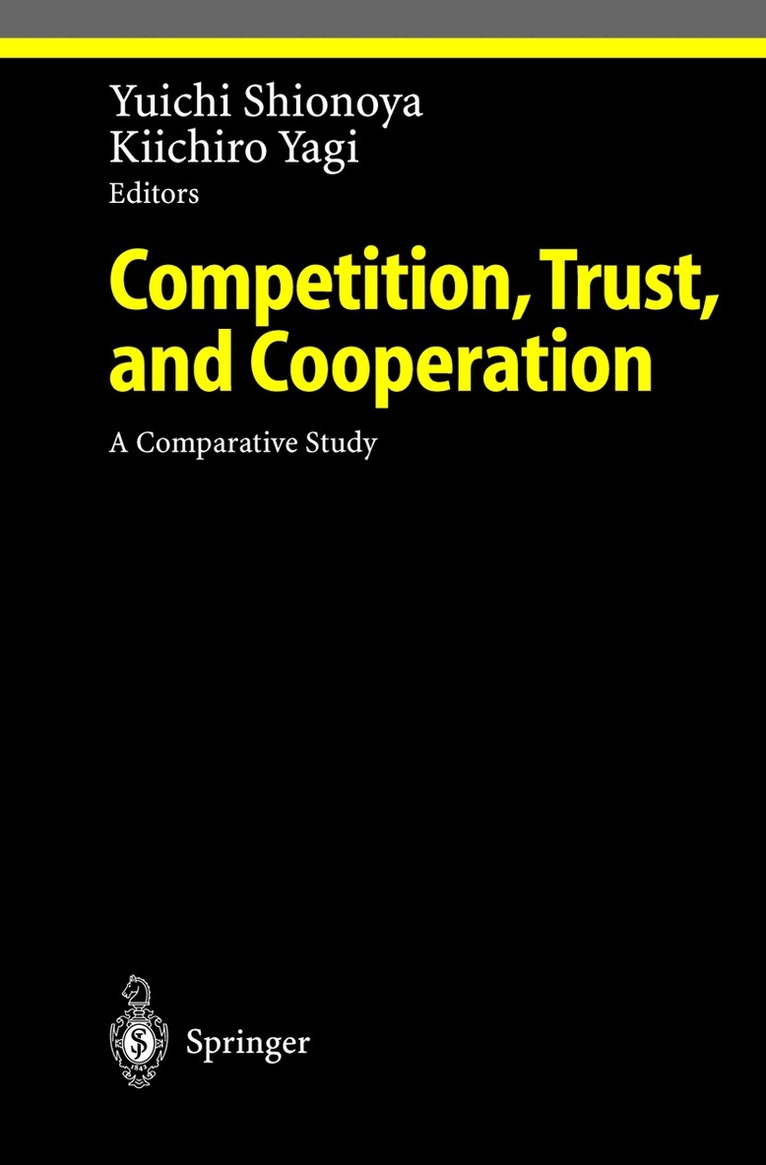
It was at the fifth SEEP-Conference on Economic Ethics and philosophy in autumn 1997 that the organizational work of the seventh conference in 1999 was entrusted to the editors of this volume. Prof. Peter Koslowski, series editor of The Studies in Economic Ethics and Philosophy, SEEP, expressed the hope that the SEEP-Conference be held in the Far-East for the fist time would bring a new comparative aspect to economic ethics and philosophy. Further, the agenda of economic ethics seemed to increase its significance also in Japan and other Asian countries especially due to the spread of corruption in the government and business under the financial crisis that attacked these nations in the late 1990s. Though we chose "Com petition, Trust, and Cooperation" as the general theme of the conference, this should include the collusion, distrust, and corruption as the opposite side of the medal. The conference was held on March 10-12, 1999 at the Kansai Seminar House of the Nippon Christian Academy, Kyoto, Japan. Fourteen papers were submitted to the conference. In addition to twelve papers that are printed in this volume, Prof. Ruisheng Wang (Capital Normal University, Beijing) read his paper on ethical problems in the context of Asian financial crisis and Prof. Agnar Sandmo (Norwegian School of Economics and Busi ness Administration) did the same by his paper on societal aspect of the competition promotion policy.
1 095 kr
Skickas inom 10-15 vardagar
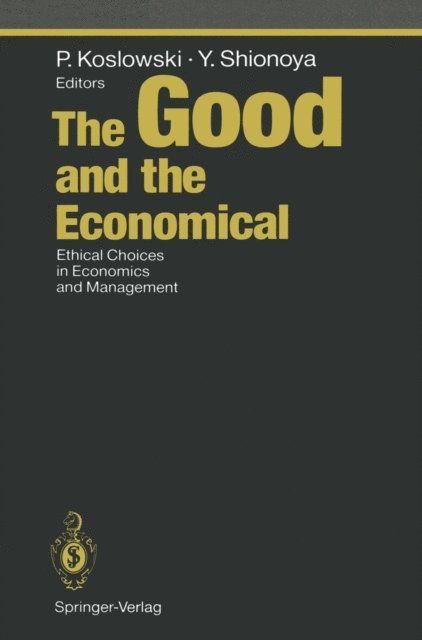
Economics makes the incommensurable commensurable by money prices. On the other hand, there are varieties of goodness like the ethical that seem not to fit into the scale of prices of economics, but cannot be neglected in economizing. Ways of integrating ethics into economics must therefore be found. The aim of this book is the integration of the ethical discourse into the economic discourse about the economical and efficient. It investi§ gates into the structure of goodness. The contribution of this volume to the current debate in economic ethics and business ethics lies in its analysis of the different meanings of the good and in its reflection on the possibilities of implementing ethical goods into the practice of the economist and the manager of the firm. Its essays investigate the role of ethics in social and individual choice. They examine and compare the cultural determinants of the Western and the Japanese economies, their ethical and cultural foundations. They look into the principles of good management. How can the management incorporate human goods and consider the virtues of impartiality and of due consideration to the particular in its business practice? The book develops the idea of an ethical economizing in economics and of an ethical managing in business administration. The business of business is ethical business.