Zeev Volkovich – författare
Visar alla böcker från författaren Zeev Volkovich. Handla med fri frakt och snabb leverans.
6 produkter
6 produkter
Inbunden, Engelska, 2006
1 667 kr
Skickas inom 10-15 vardagar
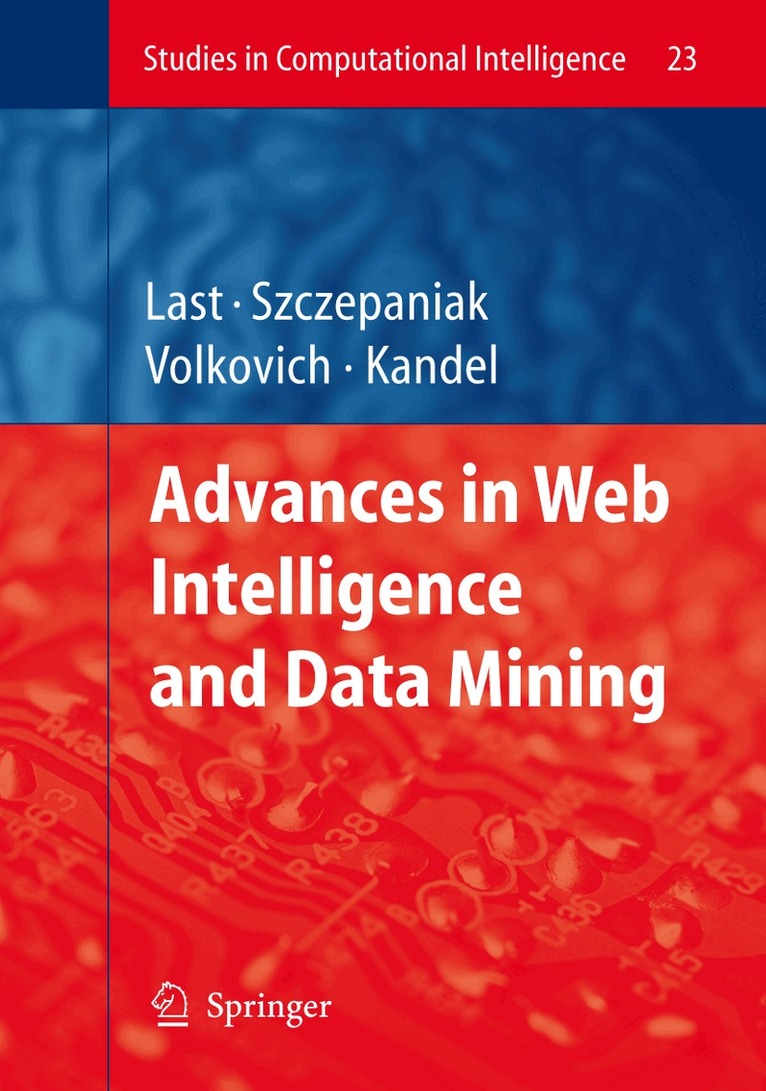
Today, in the middle of the ?rst decade of the 21st century, the Internet has become a major communication medium, where virtually any kind of content can be transferred instantly and reliably between individual users and entire - ganizations located in any part of the globe. The World Wide Web (WWW) has a tremendous e?ect on our daily activities at work and at home. Consequently, more e?ective and e?cient methods and technologies are needed to make the most of the Web’s nearly unlimited potential. The new Web-related research directions include intelligent methods usually associated with the ?elds of c- putational intelligence, soft computing, and data mining. AWIC, the “Atlantic Web Intelligence Conferences” continue to be a forum for exchange of new ideas and novel practical solutions in this new and exciting area. The conference was born as an initiative of the WIC-Poland and the WIC- Spain Research Centers, both belonging to the Web Intelligence Consortium – WIC (http://wi-consortium.org/). Prior to this year, three AWIC conferences have been held: in Madrid, Spain (2003), in Cancun, Mexico (2004), and in L´ od´ z, Poland (2005). AWIC 2006 took place in Beer-Sheva, Israel during June 5–7, 2006, organized locally by Ben-Gurion University of the Negev. The book presents state-of-the-art developments in the ?eld of computati- ally intelligent methods applied to various aspects and ways of Web exploration.
E-bok
PDF, Engelska, 20061 977 kr
Läs direkt efter köp
Today, in the middle of the ?rst decade of the 21st century, the Internet has become a major communication medium, where virtually any kind of content can be transferred instantly and reliably between individual users and entire - ganizations located in any part of the globe. The World Wide Web (WWW) has a tremendous e?ect on our daily activities at work and at home. Consequently, more e?ective and e?cient methods and technologies are needed to make the most of the Web’s nearly unlimited potential. The new Web-related research directions include intelligent methods usually associated with the ?elds of c- putational intelligence, soft computing, and data mining. AWIC, the “Atlantic Web Intelligence Conferences” continue to be a forum for exchange of new ideas and novel practical solutions in this new and exciting area. The conference was born as an initiative of the WIC-Poland and the WIC- Spain Research Centers, both belonging to the Web Intelligence Consortium – WIC (http://wi-consortium.org/). Prior to this year, three AWIC conferences have been held: in Madrid, Spain (2003), in Cancun, Mexico (2004), and in L´ od´ z, Poland (2005). AWIC 2006 took place in Beer-Sheva, Israel during June 5–7, 2006, organized locally by Ben-Gurion University of the Negev. The book presents state-of-the-art developments in the ?eld of computati- ally intelligent methods applied to various aspects and ways of Web exploration.
Del 23 - Studies in Computational Intelligence
Advances in Web Intelligence and Data Mining
Häftad, Engelska, 2010
1 619 kr
Skickas inom 10-15 vardagar
Today, in the middle of the ?rst decade of the 21st century, the Internet has become a major communication medium, where virtually any kind of content can be transferred instantly and reliably between individual users and entire - ganizations located in any part of the globe. The World Wide Web (WWW) has a tremendous e?ect on our daily activities at work and at home. Consequently, more e?ective and e?cient methods and technologies are needed to make the most of the Web’s nearly unlimited potential. The new Web-related research directions include intelligent methods usually associated with the ?elds of c- putational intelligence, soft computing, and data mining. AWIC, the “Atlantic Web Intelligence Conferences” continue to be a forum for exchange of new ideas and novel practical solutions in this new and exciting area. The conference was born as an initiative of the WIC-Poland and the WIC- Spain Research Centers, both belonging to the Web Intelligence Consortium – WIC (http://wi-consortium.org/). Prior to this year, three AWIC conferences have been held: in Madrid, Spain (2003), in Cancun, Mexico (2004), and in L´ od´ z, Poland (2005). AWIC 2006 took place in Beer-Sheva, Israel during June 5–7, 2006, organized locally by Ben-Gurion University of the Negev. The book presents state-of-the-art developments in the ?eld of computati- ally intelligent methods applied to various aspects and ways of Web exploration.
Del 286 - Studies in Computational Intelligence
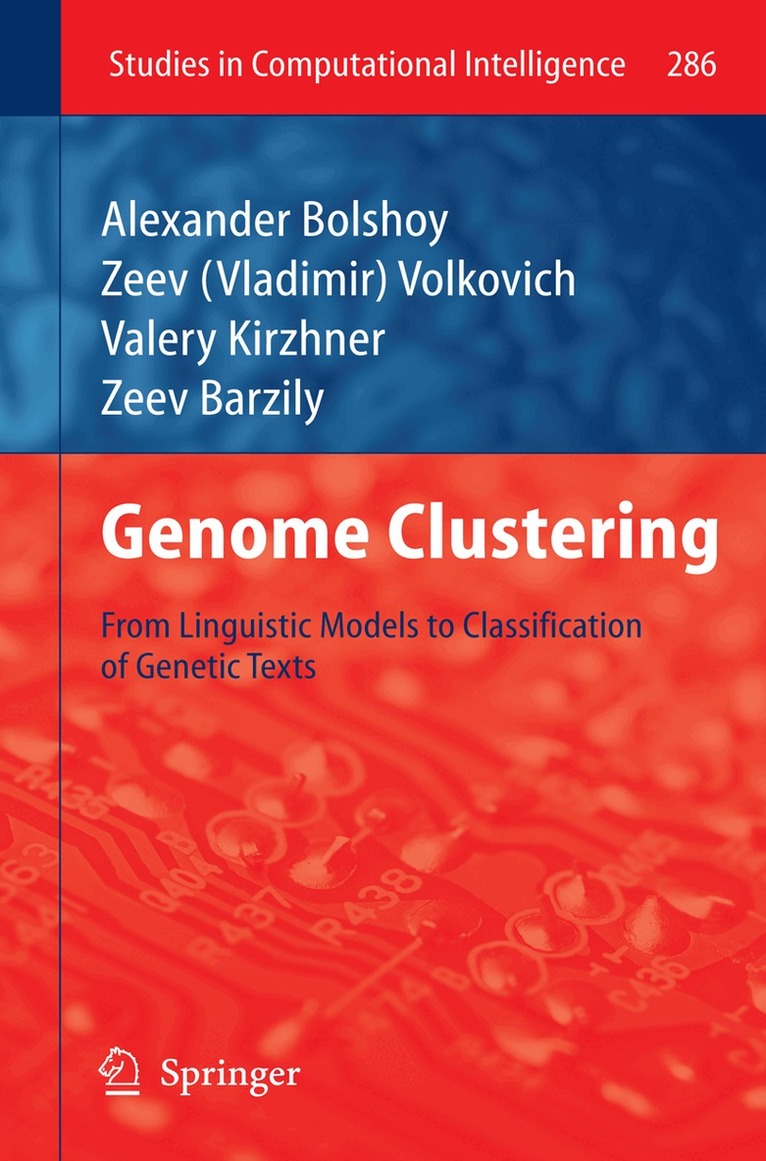
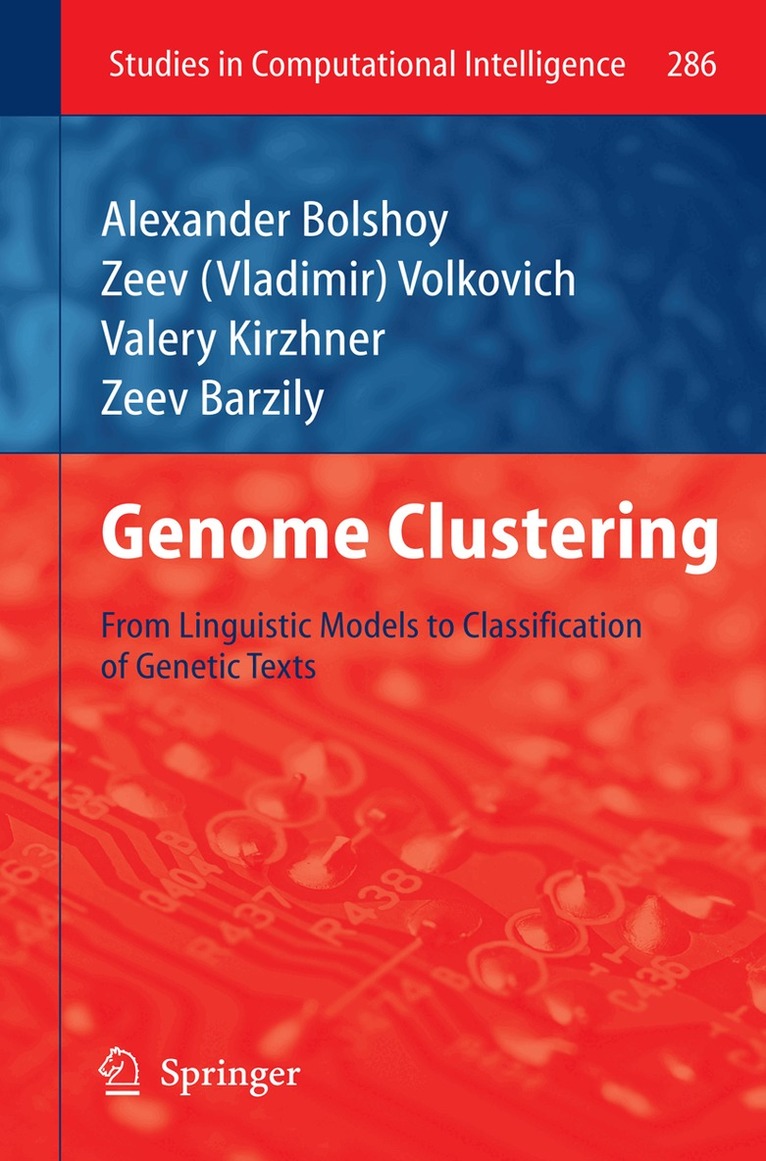
Genome Clustering
From Linguistic Models to Classification of Genetic Texts
Inbunden, Engelska, 2010
1 082 kr
Skickas inom 10-15 vardagar
Knighting in sequence biology Edward N. Trifonov Genome classification, construction of phylogenetic trees, became today a major approach in studying evolutionary relatedness of various species in their vast - versity. Although the modern genome clustering delivers the trees which are very similar to those generated by classical means, and basic terminology is the same, the phenotypic traits and habitats are not anymore the playground for the classi- cation. The sequence space is the playground now. The phenotypic traits are - placed by sequence characteristics, “words”, in particular. Matter-of-factually, the phenotype and genotype merged, to confusion of both classical and modern p- logeneticists. Accordingly, a completely new vocabulary of stringology, information theory and applied mathematics took over. And a new brand of scientists emerged – those who do know the math and, simultaneously, (do?) know biology. The book is written by the authors of this new brand. There is no way to test their literacy in biology, as no biologist by training would even try to enter into the elite circle of those who masters their almost occult language. But the army of - formaticians, formal linguists, mathematicians humbly (or aggressively) longing to join modern biology, got an excellent introduction to the field of genome cl- tering, written by the team of their kin.
E-bok
PDF, Engelska, 20101 379 kr
Läs direkt efter köp
Knighting in sequence biology Edward N. Trifonov Genome classification, construction of phylogenetic trees, became today a major approach in studying evolutionary relatedness of various species in their vast - versity. Although the modern genome clustering delivers the trees which are very similar to those generated by classical means, and basic terminology is the same, the phenotypic traits and habitats are not anymore the playground for the classi- cation. The sequence space is the playground now. The phenotypic traits are - placed by sequence characteristics, “words”, in particular. Matter-of-factually, the phenotype and genotype merged, to confusion of both classical and modern p- logeneticists. Accordingly, a completely new vocabulary of stringology, information theory and applied mathematics took over. And a new brand of scientists emerged – those who do know the math and, simultaneously, (do?) know biology. The book is written by the authors of this new brand. There is no way to test their literacy in biology, as no biologist by training would even try to enter into the elite circle of those who masters their almost occult language. But the army of - formaticians, formal linguists, mathematicians humbly (or aggressively) longing to join modern biology, got an excellent introduction to the field of genome cl- tering, written by the team of their kin.
Del 286 - Studies in Computational Intelligence
Genome Clustering
From Linguistic Models to Classification of Genetic Texts
Häftad, Engelska, 2012
1 082 kr
Skickas inom 10-15 vardagar
Knighting in sequence biology Edward N. Trifonov Genome classification, construction of phylogenetic trees, became today a major approach in studying evolutionary relatedness of various species in their vast - versity. Although the modern genome clustering delivers the trees which are very similar to those generated by classical means, and basic terminology is the same, the phenotypic traits and habitats are not anymore the playground for the classi- cation. The sequence space is the playground now. The phenotypic traits are - placed by sequence characteristics, “words”, in particular. Matter-of-factually, the phenotype and genotype merged, to confusion of both classical and modern p- logeneticists. Accordingly, a completely new vocabulary of stringology, information theory and applied mathematics took over. And a new brand of scientists emerged – those who do know the math and, simultaneously, (do?) know biology. The book is written by the authors of this new brand. There is no way to test their literacy in biology, as no biologist by training would even try to enter into the elite circle of those who masters their almost occult language. But the army of - formaticians, formal linguists, mathematicians humbly (or aggressively) longing to join modern biology, got an excellent introduction to the field of genome cl- tering, written by the team of their kin.