Zhi Zong – författare
Visar alla böcker från författaren Zhi Zong. Handla med fri frakt och snabb leverans.
5 produkter
5 produkter
E-bok
PDF, Engelska, 20061 985 kr
Läs direkt efter köp
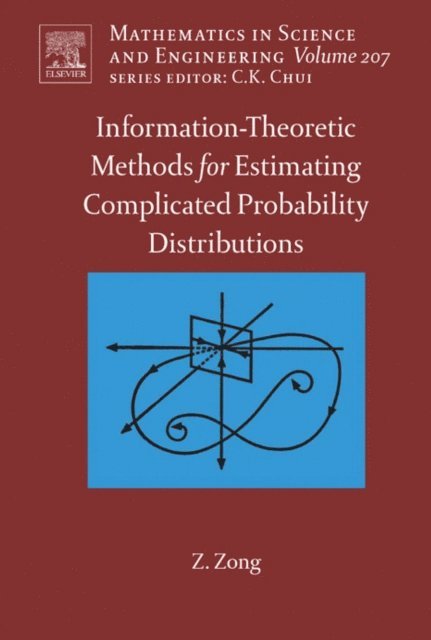
Mixing up various disciplines frequently produces something that are profound and far-reaching. Cybernetics is such an often-quoted example. Mix of information theory, statistics and computing technology proves to be very useful, which leads to the recent development of information-theory based methods for estimating complicated probability distributions.Estimating probability distribution of a random variable is the fundamental task for quite some fields besides statistics, such as reliability, probabilistic risk analysis (PSA), machine learning, pattern recognization, image processing, neural networks and quality control. Simple distribution forms such as Gaussian, exponential or Weibull distributions are often employed to represent the distributions of the random variables under consideration, as we are taught in universities. In engineering, physical and social science applications, however, the distributions of many random variables or random vectors are so complicated that they do not fit the simple distribution forms at al.Exact estimation of the probability distribution of a random variable is very important. Take stock market prediction for example. Gaussian distribution is often used to model the fluctuations of stock prices. If such fluctuations are not normally distributed, and we use the normal distribution to represent them, how could we expect our prediction of stock market is correct? Another case well exemplifying the necessity of exact estimation of probability distributions is reliability engineering. Failure of exact estimation of the probability distributions under consideration may lead to disastrous designs.There have been constant efforts to find appropriate methods to determine complicated distributions based on random samples, but this topic has never been systematically discussed in detail in a book or monograph. The present book is intended to fill the gap and documents the latest research in this subject.Determining a complicated distribution is not simply a multiple of the workload we use to determine a simple distribution, but it turns out to be a much harder task. Two important mathematical tools, function approximation and information theory, that are beyond traditional mathematical statistics, are often used. Several methods constructed based on the two mathematical tools for distribution estimation are detailed in this book. These methods have been applied by the author for several years to many cases. They are superior in the following senses:(1) No prior information of the distribution form to be determined is necessary. It can be determined automatically from the sample;(2) The sample size may be large or small;(3) They are particularly suitable for computers. It is the rapid development of computing technology that makes it possible for fast estimation of complicated distributions. The methods provided herein well demonstrate the significant cross influences between information theory and statistics, and showcase the fallacies of traditional statistics that, however, can be overcome by information theory.Key Features:- Density functions automatically determined from samples- Free of assuming density forms- Computation-effective methods suitable for PC- density functions automatically determined from samples- Free of assuming density forms- Computation-effective methods suitable for PC
E-bok
Engelska, 20091 282 kr
Läs direkt efter köp
Modern Tools to Perform Numerical DifferentiationThe original direct differential quadrature (DQ) method has been known to fail for problems with strong nonlinearity and material discontinuity as well as for problems involving singularity, irregularity, and multiple scales. But now researchers in applied mathematics, computational mechanics, and en
Häftad, Engelska, 2017
1 116 kr
Skickas inom 10-15 vardagar
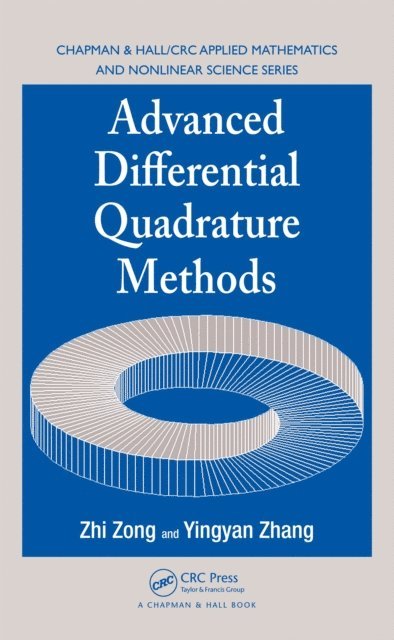
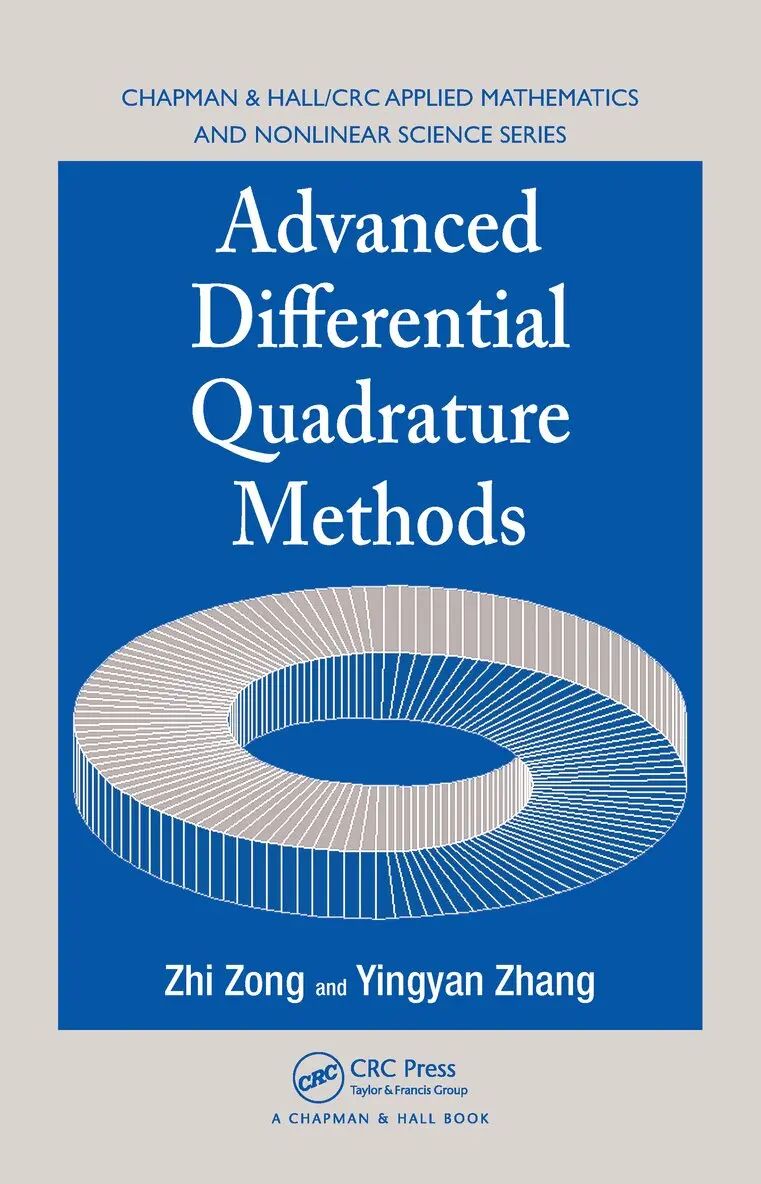
Modern Tools to Perform Numerical DifferentiationThe original direct differential quadrature (DQ) method has been known to fail for problems with strong nonlinearity and material discontinuity as well as for problems involving singularity, irregularity, and multiple scales. But now researchers in applied mathematics, computational mechanics, and engineering have developed a range of innovative DQ-based methods to overcome these shortcomings. Advanced Differential Quadrature Methods explores new DQ methods and uses these methods to solve problems beyond the capabilities of the direct DQ method.After a basic introduction to the direct DQ method, the book presents a number of DQ methods, including complex DQ, triangular DQ, multi-scale DQ, variable order DQ, multi-domain DQ, and localized DQ. It also provides a mathematical compendium that summarizes Gauss elimination, the Runge–Kutta method, complex analysis, and more. The final chapter contains three codes written in the FORTRAN language, enabling readers to quickly acquire hands-on experience with DQ methods.Focusing on leading-edge DQ methods, this book helps readers understand the majority of journal papers on the subject. In addition to gaining insight into the dynamic changes that have recently occurred in the field, readers will quickly master the use of DQ methods to solve complex problems.
E-bok
PDF, Engelska, 20091 282 kr
Läs direkt efter köp
Modern Tools to Perform Numerical DifferentiationThe original direct differential quadrature (DQ) method has been known to fail for problems with strong nonlinearity and material discontinuity as well as for problems involving singularity, irregularity, and multiple scales. But now researchers in applied mathematics, computational mechanics, and en
Inbunden, Engelska, 2009
2 185 kr
Tillfälligt slut
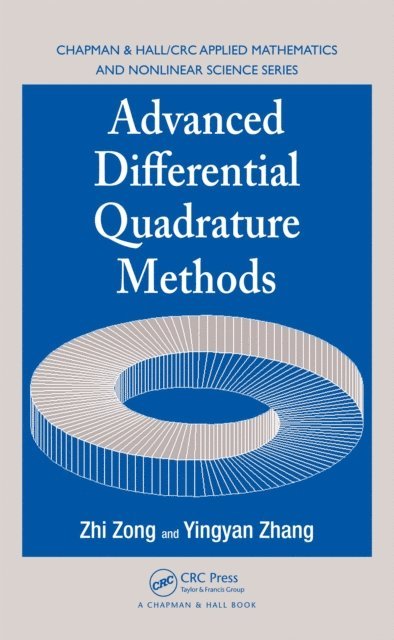
Modern Tools to Perform Numerical DifferentiationThe original direct differential quadrature (DQ) method has been known to fail for problems with strong nonlinearity and material discontinuity as well as for problems involving singularity, irregularity, and multiple scales. But now researchers in applied mathematics, computational mechanics, and engineering have developed a range of innovative DQ-based methods to overcome these shortcomings. Advanced Differential Quadrature Methods explores new DQ methods and uses these methods to solve problems beyond the capabilities of the direct DQ method.After a basic introduction to the direct DQ method, the book presents a number of DQ methods, including complex DQ, triangular DQ, multi-scale DQ, variable order DQ, multi-domain DQ, and localized DQ. It also provides a mathematical compendium that summarizes Gauss elimination, the Runge–Kutta method, complex analysis, and more. The final chapter contains three codes written in the FORTRAN language, enabling readers to quickly acquire hands-on experience with DQ methods.Focusing on leading-edge DQ methods, this book helps readers understand the majority of journal papers on the subject. In addition to gaining insight into the dynamic changes that have recently occurred in the field, readers will quickly master the use of DQ methods to solve complex problems.