Zienkowski Jan Zienkowski – författare
Visar alla böcker från författaren Zienkowski Jan Zienkowski. Handla med fri frakt och snabb leverans.
2 produkter
2 produkter
53 kr
Läs direkt efter köp
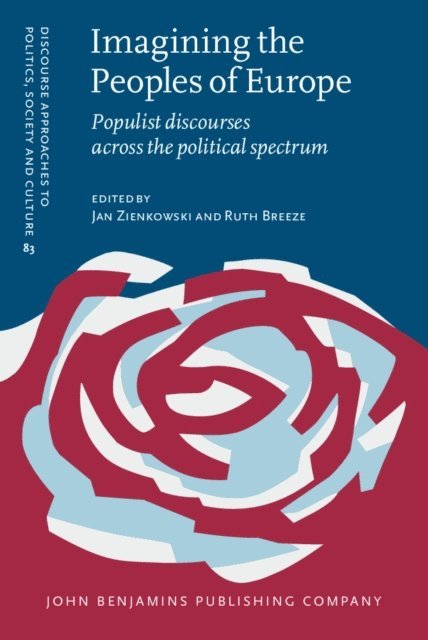
The political landscape in Europe is currently going through a phase of rapid change. New actors and movements that claim to represent ''the will of the people'' are attracting considerable public attention, with dramatic consequences for election outcomes. This volume explores the new political order with a particular focus on discursive constructions of ''the people'' and the category of populism across the spectrum. It shows how a unitary representation of ''the people'' is a central element in a vast range of very diverse political discourses today, acting to anchor identities and project antagonisms in a multitude of settings. The chapters in this book explore commonality and contrast in representations of ‘the people’ in both radical and mainstream political movements, looking in depth at recent political discourses in the European sphere. The authors draw on approaches ranging from Essex-style discourse theory over critical discourse studies, corpus analysis and linguistic pragmatics, to investigate how historically situated categories such as the people and populism become fixed through local linguistic, textual and narrative practices as well as through wider ideological and discursive patterns.This title is in pledging for Knowledge Unlatched Select 2023
E-bok
PDF, Engelska, 2011519 kr
Läs direkt efter köp
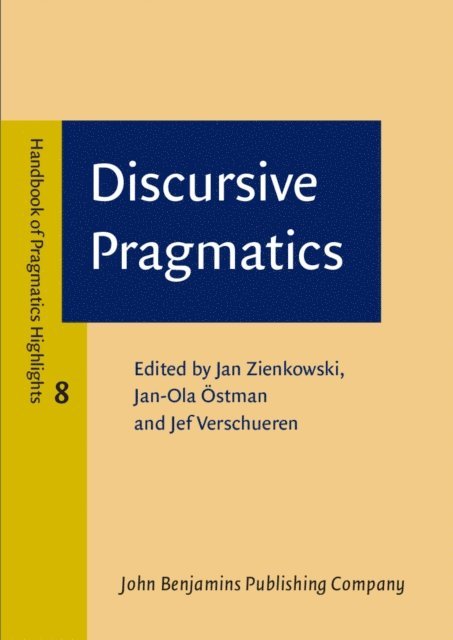
The ten volumes of Handbook of Pragmatics Highlights focus on the most salient topics in the field of pragmatics, thus dividing its wide interdisciplinary spectrum in a transparent and manageable way. While the other volumes select specific philosophical, cognitive, grammatical, social, cultural, variational, or interactional angles, this 8th volume focuses on theories and phenomena at the level of discourse, but leaving aside conversational interaction. It provides the reader with pragmatics-oriented information on discourse analysis, critical discourse analysis and critical linguistics, as well as text linguistics and appraisal theory, while introducing other specific approaches to discourse through concepts such as polyphony, intertextuality, genre, and énonciation. Furthermore, topics such as public discourse, narrative, figures of speech, cohesion and coherence, pragmatic markers, manipulation, and humor, are all dealt with in separate chapters. The binding idea, explained in the introduction, is that ´discursive pragmatics´ may serve as a platform for a diversity of perspectives on discourse, as they have emerged not only in the language sciences but also in the humanities and social sciences in general.