200 kr
Skickas inom 5-8 vardagar
200 kr
Skickas inom 5-8 vardagar
248 kr
Skickas inom 5-8 vardagar
279 kr
Skickas inom 5-8 vardagar
307 kr
Skickas inom 5-8 vardagar
280 kr
Skickas inom 5-8 vardagar
The central purpose of this book is to help teachers organise ideas through the use of graphic organisers. Over 35 such word-diagrams are: organised into a system to help select the right tool for the job; described for rapid understanding of their strengths; and explained for step-by-step construction.Over 50 teachers each have a double-page spread in which they reveal how they use them in their teaching — across the full age range and span of subjects. A further section of the book demonstrates how to use these word-diagrams most effectively by partnering them with other teaching strategies, such as retrieval practice, writing, speaking and listening, teacher explanations, advance organisers, scaffolding, remote learning and more.The pages are illustrated to the same quality and quantity in Oliver’s previous book, Dual Coding with Teachers, its natural companion. A must-have textbook for every teacher that transcends contemporary ideological allegiances and fads.
105 kr
Skickas inom 5-8 vardagar
307 kr
Skickas inom 5-8 vardagar
Teaching is complex. But there are simple ideas we can enact to help our teaching be more effective. This book contains over 400 such ideas.The ideas come from two sources. First, from the wonderful guests on my Tips for Teachers podcast - education heavyweights such as Dylan Wiliam, Daisy Christodoulou and Tom Sherrington, as well as talented teachers who are not household names but have so much wisdom to share. Then there's what I have learned from working with amazing teachers and students in hundreds of schools around the world.Inside you will find 22 ideas to enhance mini-whiteboard use, 15 ideas to improve the start of your lesson, 14 ideas to help make Silent Teacher effective, seven ways to respond if a student says they don't know, and lots, lots more.Each idea can be implemented the very next time you step into a classroom. So, whatever your level of experience, subject or phase, there are plenty of ideas in this book to help take your teaching to the next level.Book contentsChapter 1: How to use this bookTip 1. How to use this book to improve your teachingTip 2. How to give yourself the best chance of making a lasting changeChapter 2: Habits and routines Why are habits and routines important? Tip 3. Eight ideas to help introduce a routineTip 4. Beware of the Valley of Latent PotentialTip 5. Two ideas to help a routine stickTip 6. Develop a set of high-value activity structuresTip 7. Six ideas to help establish positive norms in your classroomTip 8. Four types of words to consider removing from your teaching vocabularyChapter 3: The means of participationA challengeTip 9. Front-load the means of participationTip 10. Ten ideas to improve Cold CallTip 11. Eight reasons to strive for mass participation more frequentlyTip 12. Twenty-two ideas to improve the use of mini-whiteboardsTip 13. Five ideas to improve the use of voting systems Tip 14. Nine ideas to improve Call and ResponseTip 15. Fifteen ideas to improve Partner TalkTip 16. Six ideas to improve group workTip 17. Use the means of participation holy trinityTip 18. Never rely on a mental noteTip 19. The best tool for the long term might not be the best tool for nowChapter 4: Checking for understandingTip 20. Think of questions as a check for misunderstandingTip 21. Use the temptation to ask for self-report as a cue to ask a better questionTip 22. Lengthen wait times after asking a questionTip 23. Lengthen wait times after an answerTip 24. Ten types of questions to ask when checking for understandingTip 25. Try these three frameworks for learner-generated examplesTip 26. Three ways to use diagnostic questions to check for understandingTip 27. Provide scaffolds for verbal responsesTip 28. Six key times to check for understandingTip 29. Ten ideas to improve Exit TicketsTip 30. Pick the student least likely to knowTip 31. Start with whoever got 8 out of 10Tip 32. Ten ideas to help create a culture of errorTip 33. Three ideas to encourage students to ask questionsChapter 5: Responsive teachingTip 34. Trick your students to test if they really understandTip 35. Never round-upTip 36. Six ideas if a student says 'I don't know'Tip 37. What to do when some students understand and some don'tTip 38. What to do when some students still don't understandTip 39. How students can own and record classroom discussionsTip 40. Share students' work with the rest of the classChapter 6: PlanningTip 41. Seven ideas to improve a scheme of workTip 42. Six ideas to help start the planning processTip 43. Plan to do less, but betterTip 44. Ask yourself: 'What are my students likely to be thinking about?'Tip 45. Write out ideal student responsesTip 46. Four ideas to help you plan for and respond to errorsTip 47. Two ideas to help teachers engage in Deep Work Tip 48. Aim to close the loop when sending an emailChapter 7: Prior knowledgeTip 49. Plan relevant prior knowledgeTip 50. Prioritise relevant prior knowledgeTip 51. Assess relevant prior knowledgeTip 52. Respond to prior knowledge assessmentTip 53. Assess relevant prior knowledge for each idea, not for the whole sequenceChapter 8: Explanations, modelling and worked examplesTip 54. Five ideas to show students why what we are learning today mattersTip 55. Use related examples and non-examples to explain technical languageTip 56. Fourteen ideas to improve the explanation of a conceptTip 57. Teach decision making separatelyTip 58. Five ideas to improve our choice of examplesTip 59. Model techniques liveTip 60. Use a teacher worked-examples bookTip 61. Use student worked-examples booksTip 62. Make use of the power of Example-Problem PairsTip 63. Fourteen ideas to improve Silent TeacherTip 64. Use self-explanation prompts to help develop your students' understanding Tip 65. Six ideas to improve 'copy down the worked example'Tip 66. Vary the means of participation for the We DoTip 67. Three errors to avoid with the Your Turn questionsTip 68. Reflect after a worked exampleTip 69. Beware of seductive detailsChapter 9: Student practiceTip 70. Eight ideas to improve student practice timeTip 71. How to harness the hidden power of interleavingTip 72. Consider using Intelligent PracticeTip 73. Consider using 'no-number' questionsTip 74. Nine ideas to help you observe student work with a purposeTip 75. Occasionally let students do work in someone else's bookChapter 10: Memory and retrievalRetrieval opportunitiesTip 76. Show your students the Forgetting CurveTip 77. Show your students the path to high storage and retrieval strengthTip 78. Show your students the limits of working memoryTip 79. Show your students how long-term memory helps thinkingTip 80. Show your students that being familiar with something is not the same as knowing itTip 81. Ensure you provide retrieval opportunities for all contentTip 82. When designing retrieval opportunities, aim for 80%Tip 83. Vary the types of retrieval questions you askTip 84. Consider providing prompts and cues during retrieval opportunitiesTip 85. Get your students to assign confidence scores to their answersTip 86. Make corrections quizzableTip 87. Twenty-one ideas to improve your Low-Stakes QuizzesTip 88. Fifteen ideas to improve the Do NowTip 89. Consider using Trello to help organise the disorganisedChapter 11: Homework, marking and feedbackTip 90. Make homework feed into lessonsTip 91. Eight ideas to improve homeworkTip 92. Two things to check if homework or test scores are a surprise Tip 93. Be careful how you respond to 'silly' mistakesTip 94. Turn feedback into detective workTip 95. Consider recording verbal feedbackTip 96. Twelve ideas to improve whole-class feedbackChapter 12: Improving as a teacherTip 97. Find the expertise within your teamTip 98. Five different people to learn fromTip 99. Revisit education books and podcast episodesTip 100. Four things to consider when trying something newTip 101. Five ideas to help tackle the negativity radioTip 102. Consider slowing down your careerTip 103. Sixteen ideas to improve the delivery of CPD Tip 104. Micro tipsTip 105. If you want more tips...
349 kr
Skickas inom 5-8 vardagar
Direct Instruction (DI) is a powerful instructional approach designed to ensure that students master critical skills and content required for more advanced learning. Although DI has existed since the late 1960s, there are many common misconceptions about the approach, its potential to enhance student learning and the way its proper implementation facilitates students' academic success. This book provides a systematic explanation of the Direct Instruction methodology and DI program design as it outlines a roadmap for teachers and school leaders on how to implement DI successfully. Divided into three main sections, the first section describes DI as a coherent and complete teaching-and-learning system that contrasts DI with lower case "di" or explicit instruction, which focuses on effective instructional delivery techniques. The second section provides a step-by-step guide to implementing DI. The third section is devoted to cautions about implementing DI. This section reinforces the notion that the physical possession of the DI curricula does not by itself lead to student success. Those who adopt DI need to ensure that it is implemented with fidelity for the benefit of their students who are reliant on them to provide them with the means to achieve their academic potential so they may lead healthy, productive lives.
307 kr
Skickas inom 5-8 vardagar
The mark of a great coach is a constant desire to learn and grow. A hunger to use whatever can make them better.The best-selling author of Teach Like a Champion and Reading Reconsidered brings his considerable knowledge about the science of classroom teaching to the sports coaching world to create championship caliber coaches on the court and field.What great classroom teachers do is relevant to coaches in profound ways. After all, coaches are at their core teachers.Lemov knows that coaches face many of the same challenges found in the classroom, so the science of learning applies equally to them. Unfortunately, coaches and organizations have a mixed level of understanding of the research and study of the science of learning. Sometimes coaches and organizations build their teaching on myths and platitudes more than science. Sometimes there isn’t any science applied at all.While there are thousands of books and websites a coach can consult to better understand technical and tactical aspects of the game, there is nothing for a coach to consult that explicitly examines the teaching problems on the field, the court, the rink, and the diamond. Until now.Intended to offer lessons and guidance that are applicable to coaches of any sporting endeavor including everyone from parent volunteers to professional coaches and private trainers, Lemov brings the powerful science of learning to the arena of sports coaching to create the next generation of championship caliber coaches.
178 kr
Skickas inom 5-8 vardagar
265 kr
Skickas inom 5-8 vardagar
184 kr
Skickas inom 5-8 vardagar
199 kr
Skickas inom 5-8 vardagar
This book reaffirms the enduring importance of effective explanations at a time when "teacher talk" is often undervalued. Drawing on the science of learning, Zach Groshell explores essential techniques for showing, telling, demonstrating, modeling, and presenting so that even the most complex concepts become accessible to all learners.Engage with the art and science of "breaking it down" to discover how a direct and explicit approach to teaching can significantly impact classroom success.
200 kr
Skickas inom 5-8 vardagar
Bandura's theory of self-efficacy is one of the most important discoveries in modern psychology that has transformed how we understand human behaviour. Through years of research across different disciplines, we now know that our self-efficacy is a central concept in how we behave and is critical in determining the capacity that students have to shape their own lives. The belief that our behaviour can yield a positive result within a specific domain explains many experiences that teachers face in the classroom - why, in the face of good teaching, students still don't attempt the work; why, in some lessons, students are seen to work harder than in others; why some students struggle to bounce back from failure and why student behaviour can still present a challenge. Dr Neil Gilbride CPsychol guides the reader in how we can take action to raise student self-efficacy and, subsequently, the agency that students feel in taking control of their lives and studies. Specifically, the book will explore the application of self-efficacy to three key areas - how we design our instruction, how we design practice and how we influence the behaviour of our pupils within our settings. The book interweaves insights from research with how it might look in the classroom. Succinct summaries and case studies from a range of practitioners will enable all readers to raise the self-efficacy of their students in their own classrooms and beyond.
534 kr
Skickas inom 5-8 vardagar
276 kr
Skickas inom 5-8 vardagar
Teaching science is no simple task. Science teachers must wrestle with highly abstract and demanding concepts, ideas which have taken humanity's greatest minds thousands of years to formulate and refine. Communicating these great and awesome theories involves careful forethought and planning. We need to deliver crystal clear explanations, guide students as they develop their embryonic knowledge and then release them to develop their thinking independently, all the while curating and tending to their long-term understanding as it develops over time.In Teaching Secondary Science: A Complete Guide, Adam breaks down the complex art of teaching science into its component parts, providing a concrete and comprehensive set of evidence-informed steps to nurturing brilliant science students. Adam hopes that you find this book interesting, but his main aim is for you to find it useful. Useful when it comes to sketching out your curriculum, useful when preparing your explanations, useful for mapping out how you will check student understanding and useful for all other aspects of science teaching. This is a truly complete guide, and science teachers of any experience will find it packed with ideas that are new, challenging, interesting and, most importantly, useful.
415 kr
Skickas inom 5-8 vardagar
321 kr
Skickas inom 5-8 vardagar
417 kr
Skickas inom 5-8 vardagar
417 kr
Skickas inom 5-8 vardagar
180 kr
Skickas inom 5-8 vardagar
571 kr
Skickas
205 kr
Skickas inom 5-8 vardagar
457 kr
Skickas inom 5-8 vardagar
149 kr
Skickas inom 5-8 vardagar
267 kr
Skickas inom 5-8 vardagar
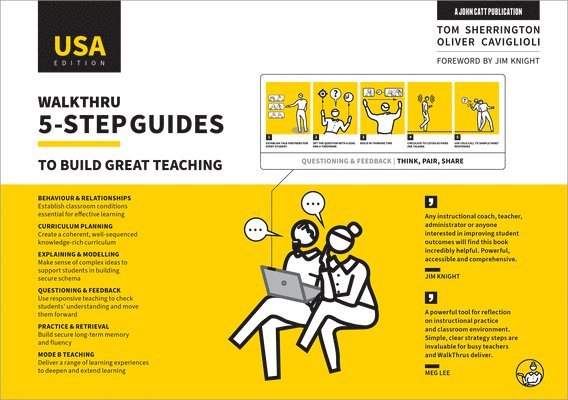
The Teaching WalkThrus series of books have sold more than 250,000 copies worldwide. Now, WalkThru creators Tom Sherrington and Oliver Caviglioli have curated a selection of essential five-step teaching techniques aimed at US schools and educators.The five-step instructional coaching guides are explained by Sherrington's concise direction and Caviglioli's signature iconography and cover all the key areas of teaching: behaviour and relationships; curriculum planning; explaining and modelling; questioning and feedback; practice and retrieval; and Mode B teaching.The featured WalkThrus have been selected from the original trilogy of books and adapted especially for the US.The WalkThrus books are supported by an online PD toolkit, which is now used by 3,000 organisations in 40 countries.
239 kr
Skickas inom 5-8 vardagar
184 kr
Skickas inom 5-8 vardagar
Imagine having to draw dots each time we wanted to do a sum like 3+4. Or having to sound out every word we read, no matter how many times we've seen it before. Having well-consolidated memories for how to do these things can help us avoid these difficulties, which is why consolidation should be a key goal of effective teaching. Helping students consolidate knowledge is a crucial stepping stone in allowing them to navigate problems and develop their knowledge.Building on the hugely influential paper by John Dunlosky, Amarbeer Singh Gill looks at ways teachers can use recommendations from 'Strengthening the Student Toolbox' to consolidate knowledge and enhance the learning that takes place in their classrooms. Each strategy is looked at in detail, delving into the conditions needed to help the strategies work, how they might look in classrooms, things to be mindful of when translating research into practice, and case studies from current teachers who describe how they've used these strategies.By harnessing the power of these strategies we can make it more likely that our students will succeed not just whilst they're in our classrooms, but also well beyond by giving them the tools they need for lifelong learning.
173 kr
Skickas inom 5-8 vardagar
399 kr
Skickas inom 5-8 vardagar