1 333 kr
Läs direkt efter köp
1 333 kr
Läs direkt efter köp
1 333 kr
Läs direkt efter köp
369 kr
Läs direkt efter köp
381 kr
Läs direkt efter köp
983 kr
Läs direkt efter köp
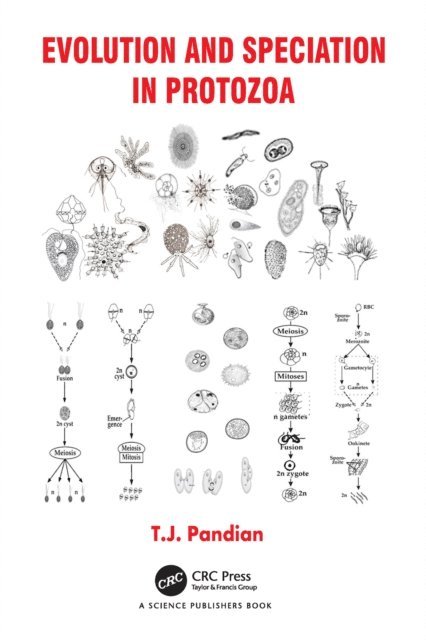
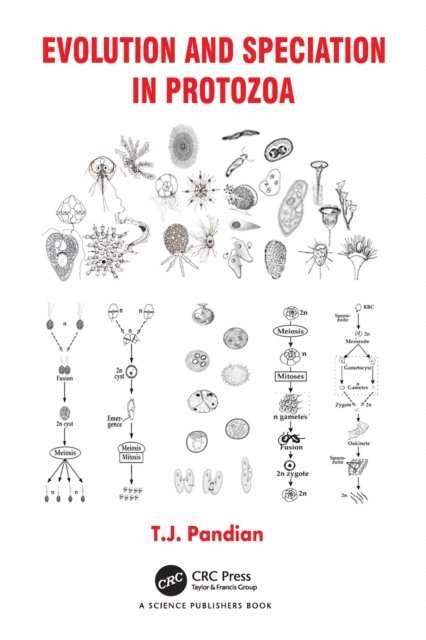
The polyphyletic Protozoa have explored the possibility of performing almost all metazoan functions with a few subcellular organelles. Their unicellularity and structural simplicity have (i) limited diversity to 32,950 species, (ii) restricted spatial distribution to aquatic habitats (94%, against 15% in Metazoa), (iii) demonstrated the ubiquitous dominance of clonality, (iv) reduced sexualization in 50% species, (v) facilitated the use of vegetative gametes in 40% species and (vi) secondary loss of sex in 10% species. With the fastest multiplication rates, i.e. once every 6-60 hours, they occur in high densities of 105-106 cell/ml. Their diverse and complicated life cycles are described in 30 types. Being risky, the cycle involves two hosts in < 2,000 parasitic species and injective transmission mode by sanguivorous insects and ticks in < 300 species. Their radial symmetry has accelerated diversity more than in radially symmetric less speciose Porifera (8,553 species), Cnidaria (10,856) and Echinodermata (7,000). In them, diversity is decelerated in the following descending order: symmetry > clonality > hermaphroditism > motility. Motility ranges from 2-3 μm for Rhizopoda to 400-2,000 μm for Ciliophora. Not surprisingly, 6,800 species of arcellinids, filosians and formainifers are testated or shelled. Within 1,229 sessile species, the peritrichid and suctorian ciliates are better adapted to coloniality. Unlike those of many Metazoa, the protozoan cyst is a dynamic stage, in which clonal or sexual reproduction occurs. Over 81% protozoans encyst, as it ensures (i) 90% survival during unfavorable conditions (against 15 in 12% non-encysted protozoans), (ii) genome transfer through generations, (iii) dispersal into new habitats and (iv) transmission to new hosts. Their mean body size ranges from 2 μm to 2 mm – a range over 1,000-times – only 8% aquatic metazoans cover a similar size range. In comparison to 77% macrophagy in Metazoa, only 46% protozoans are macrophagous predators. Within motile microphagy, protozoans filter 3-2 times smaller food particle at 50% cheaper clearance cost. This efficiency has expanded microphagy to 15% in protozoans, against 3% in Metazoa. Hence, their turnover rate in trophic dynamics is twice faster than that of metazoans. Foraminifers serve as ecological sensitive indicators in petroleum exploration and rise in sea level. For the first time, incidences of clonality and meiosis as well as symbiosis and parasitism have been shown to hint at the origin and evolution of different protozoan taxonomic groups during the geological past.
910 kr
Läs direkt efter köp
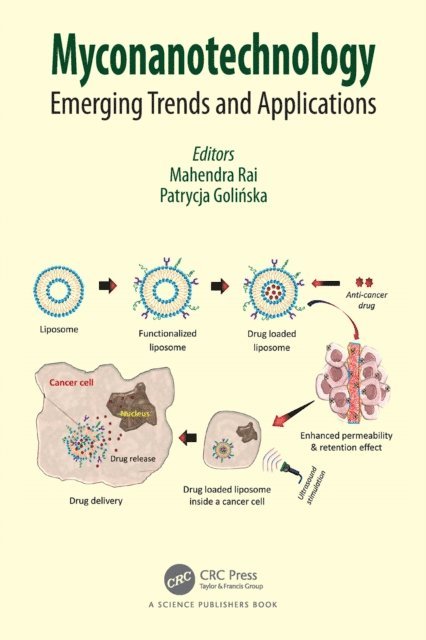
Myconanotechnology is a highly interdisciplinary science emerging at a fast pace and has garnered the attention of nanotechnologists, mycologists, biomedical experts, and agriculture scientists, among others. For the last decade, there has been tremendous progress in this field owing to its wider and more effective applications. In this book, the authors have attempted to discuss different evolving trends in medicine, food, agriculture, veterinary, environment, and textiles.
Globally contributed by eminent authors and experts, the present book contains valuable chapters on the diverse aspects of Myconanotechnology and thus would be essential reading for academicians.
This book will cater to the need of postgraduate and research students in fungal biology, microbiology, chemistry, nanotechnology, biotechnology, and pharmacology.
890 kr
Läs direkt efter köp
Myconanotechnology is a highly interdisciplinary science emerging at a fast pace and has garnered the attention of nanotechnologists, mycologists, biomedical experts, and agriculture scientists, among others. For the last decade, there has been tremendous progress in this field owing to its wider and more effective applications. In this book, the authors have attempted to discuss different evolving trends in medicine, food, agriculture, veterinary, environment, and textiles.
Globally contributed by eminent authors and experts, the present book contains valuable chapters on the diverse aspects of Myconanotechnology and thus would be essential reading for academicians.
This book will cater to the need of postgraduate and research students in fungal biology, microbiology, chemistry, nanotechnology, biotechnology, and pharmacology.
1 108 kr
Läs direkt efter köp
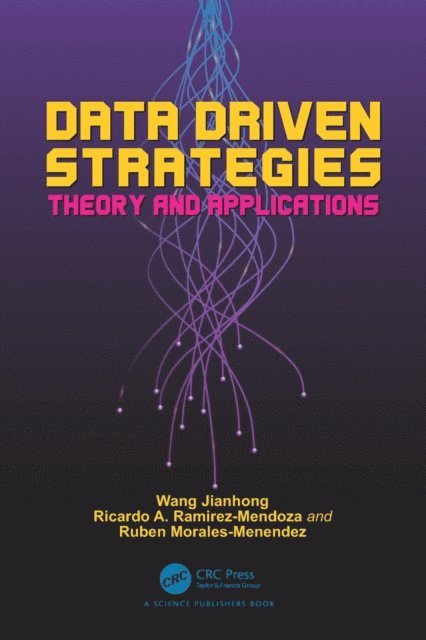
A key challenge in science and engineering is to provide a quantitative description of the systems under investigation, leveraging the noisy data collected. Such a description may be a complete mathematical model or a mechanism to return controllers corresponding to new, unseen inputs. Recent advances in the theories are described in detail, along with their applications in engineering. The book aims to develop model-free system analysis and control strategies, i.e., data-driven control from theoretical analysis and engineering applications based only on measured data. The study aims to develop system identification, and combination in advanced control theory, i.e., data-driven control strategy as system and controller are generated from measured data directly. The book reviews the development of system identification and its combination in advanced control theory, i.e., data-driven control strategy, as they all depend on measured data. Firstly, data-driven identification is developed for the closed-loop, nonlinear system and model validation, i.e., obtaining model descriptions from measured data. Secondly, the data-driven idea is combined with some control strategies to be considered data-driven control strategies, such as data-driven model predictive control, data-driven iterative tuning control, and data-driven subspace predictive control. Thirdly data-driven identification and data-driven control strategies are applied to interested engineering. In this context, the book provides algorithms to perform state estimation of dynamical systems from noisy data and some convex optimization algorithms through identification and control problems.
1 084 kr
Läs direkt efter köp
A key challenge in science and engineering is to provide a quantitative description of the systems under investigation, leveraging the noisy data collected. Such a description may be a complete mathematical model or a mechanism to return controllers corresponding to new, unseen inputs. Recent advances in the theories are described in detail, along with their applications in engineering. The book aims to develop model-free system analysis and control strategies, i.e., data-driven control from theoretical analysis and engineering applications based only on measured data. The study aims to develop system identification, and combination in advanced control theory, i.e., data-driven control strategy as system and controller are generated from measured data directly. The book reviews the development of system identification and its combination in advanced control theory, i.e., data-driven control strategy, as they all depend on measured data. Firstly, data-driven identification is developed for the closed-loop, nonlinear system and model validation, i.e., obtaining model descriptions from measured data. Secondly, the data-driven idea is combined with some control strategies to be considered data-driven control strategies, such as data-driven model predictive control, data-driven iterative tuning control, and data-driven subspace predictive control. Thirdly data-driven identification and data-driven control strategies are applied to interested engineering. In this context, the book provides algorithms to perform state estimation of dynamical systems from noisy data and some convex optimization algorithms through identification and control problems.
1 088 kr
Läs direkt efter köp
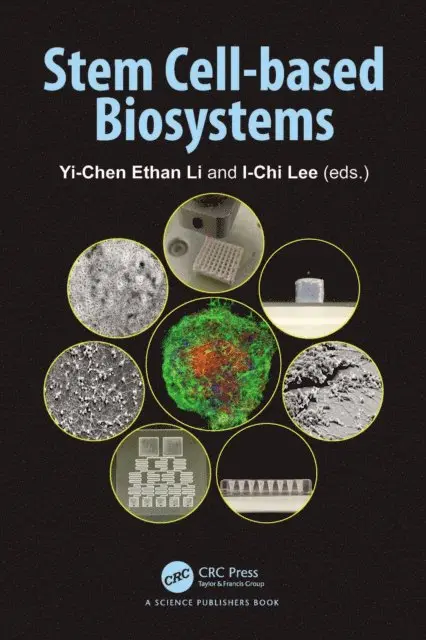
Stem cell science has emerged as a novel discipline in biomedical research over the past decade. With advancements in this field, stem cells have demonstrated versatile applications ranging from basic research to clinical case studies. Recognizing the demand for knowledge in stem cell applications, this book aims to provide comprehensive information on stem cell technology and its application in biosystems. It covers fundamental culture methods, advanced stem cell-based biosystems, and clinical case studies of stem cell therapy. This book is intended for individuals with an interest in stem cell science, offering valuable insights into this rapidly evolving field.
569 kr
Skickas inom 10-15 vardagar
569 kr
Skickas inom 10-15 vardagar
575 kr
Tillfälligt slut