• Fri frakt över 249 kr
  • •
  • Snabba leveranser
  • •
  • Billiga böcker
Kundservice

Du är på sajten för privatpersoner.

Företag, bibliotek eller offentlig verksamhet?

Du handlar på classic.bokus.com, där alla dina funktioner finns intakta.
Till classic.bokus.com
Bokus logotyp. Gå till startsidan.
  • Erbjudanden
  • Student
  • Topplistor
  • Barn & ungdom
  • Bokus Play
  • E-böcker
  • Ljudböcker
  • Pocketböcker
  • Spel och pussel

5% studentrabatt – använd koden KURSBOK27 →

Sidfot

Mina sidor

    Hjälp

    • Kundservice
    • Vanliga frågor och svar
    • Frakt och leverans
    • Retur vid ångerrätt
    • Reklamera vara
    • Betalning
    • Köpvillkor
    • Allmänna villkor
    • Information om webbplatsens tillgänglighet

    Om Bokus

    • Om oss
    • Pressrum
    • För studenter
    • För företag
    • För bibliotek och offentlig verksamhet
    • För leverantörer
    • Hållbarhet

    Populärt

    • Aktuella erbjudanden
    • Presentkort
    • Studentlitteratur
    • Nya böcker
    • Topplistor
    • Signerade böcker
    • Engelska böcker

    Inspiration

    • Boktips
    • BookTok
    • Barnbokskaraktärer
    • Populära författare
    Logotyp för Bokus
    Följ oss på Facebook (extern länk)Följ oss på Instagram (extern länk)Följ oss på YouTube (extern länk)Följ oss på TikTok (extern länk)
    bokus @ CookiesAnpassa cookiesIntegritetspolicyKöpvillkor
    Till Citymail hemsida (extern länk)Till Budbee hemsida (extern länk)Till Postnord hemsida (extern länk)Till Schenker hemsida (extern länk)Till Early Bird hemsida (extern länk)Till Walleys hemsida (extern länk)
    1. Medicin
    2. Medicin: allmänt
    3. Samhällsmedicin och preventiv medicin
    4. Epidemiologi och medicinsk statistik

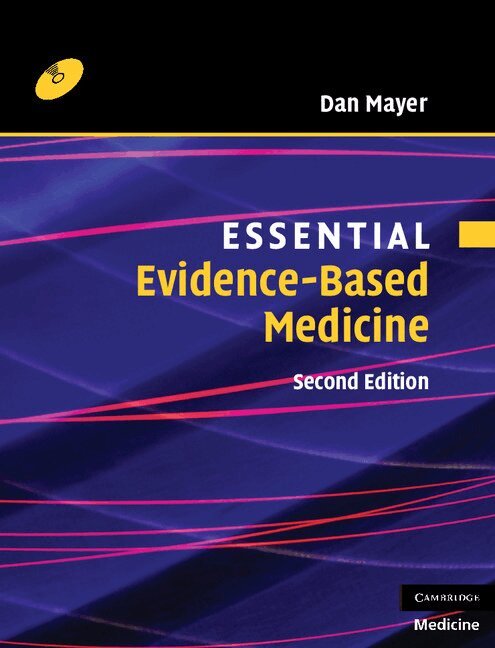
    Essential Evidence-based Medicine with CD-ROM

    AvDan Mayer

    Cambridge University Press

    2009

    834 kr

    Beställningsvara. Skickas inom 7-10 vardagar. Fri frakt över 249 kr.

    Beskrivning

    Essential Evidence-Based Medicine teaches the principles of research study methodology and design so that the reader can become better at critically analysing scientific and clinical studies. It describes the basic elements needed to understand biostatistics and epidemiology as applied to health care studies, and how to become a more discriminating reader of the medical literature by adopting the skills of critical appraisal. This new edition is extensively edited and updated, and includes two entirely new chapters on critical appraisal of qualitative research and communicating risks and evidence to patients. The text is geared towards the new learner, and assumes little clinical experience, starting with the basic principles of critical appraisal. A CD-ROM accompanies the book to enable students to test their learning through a series of questions, with answers provided. This is an ideal introductory text for medical students, health sciences students and a wide range of other healthcare professionals.

    Produktinformation

    • Märke:Cambridge University Press
    • Utgivningsdatum:2009-11-19
    • Höjd:192 x 247 x 29 mm
    • Vikt:1 300 g
    • Språk:Engelska
    • Antal sidor:445
    • Upplaga:2
    • Förlag:Cambridge University Press
    • EAN:9780521712415

    Utforska kategorier

    • Epidemiologi och medicinsk statistik inom Medicin

    Mer om författaren

    Dan Mayer is Professor of Emergency Medicine, Albany Medical College, New York, USA.

    Recensioner i media

    'This is the best book on evidence-based medicine and the foundations for the evidence that I have ever come across. It is very easy to read, and each chapter can be read as a standalone explanation of a particular concept. I highly recommend this for the personal libraries of students, residents and attending physicians.' Doody's Book Reviews

    Innehållsförteckning

    • Preface; Acknowledgements; 1. A brief history of medicine and statistics; 2. What is evidence-based medicine?; 3. Causation; 4. The medical literature: an overview; 5. Searching the medical literature Sandi Pirozzo and Elizabeth Irish; 6. Study design and strength of evidence; 7. Instruments and measurements: precision and validity; 8. Sources of bias; 9. Review of basic statistics; 10. Hypothesis testing; 11. Type I errors and number needed to treat; 12. Negative studies and Type II errors; 13. Risk assessment; 14. Multivariate analysis; 15. Randomized clinical trials (RCTs); 16. Scientific integrity and the responsible conduct of research John E. Kaplan; 17. Applicability and strength of evidence; 18. Communicating evidence to patients Laura J. Zakowski, Shobhina G. Chheda and Christing S. Seibert; 19. Critical appraisal of qualitative research studies Steven R. Simon; 20. An overview of decision making in medicine; 21. Sources of error in the clinical encounter; 22. The use of diagnostic tests; 23. Utility and characteristics of diagnostic tests: likelihood ratios, sensitivity and specificity; 24. Bayes' theorem, predictive values, post-test probabilities, and interval likelihood ratios; 25. Comparing tests and using ROC curves; 26. Incremental gain and the threshold approach to diagnostic testing; 27. Sources of bias and critical appraisal of studies of diagnostic tests; 28. Screening tests; 29. Practice guidelines and clinical prediction rules; 30. Decision analysis and quantifying patient values; 31. Cost-effectiveness analysis; 32. Outcome analysis; 33. Meta-analysis and systematic reviews; Appendix 1. Levels of evidence and grades of recommendations; Appendix 2. Overview of critical appraisal; Appendix 3. Formulas; Appendix 4. Commonly used statistical tests; Appendix 5. Proof of Bayes' theorem; Appendix 6. Using balance sheets to calculate thresholds; Glossary; Bibliography; Index.