• Fri frakt över 249 kr
  • •
  • Snabba leveranser
  • •
  • Billiga böcker
Kundservice

Du är på sajten för privatpersoner.

Företag, bibliotek eller offentlig verksamhet?

Du handlar på classic.bokus.com, där alla dina funktioner finns intakta.
Till classic.bokus.com
Bokus logotyp. Gå till startsidan.
  • Erbjudanden
  • Nyheter
  • Student
  • Topplistor
  • Barn & ungdom
  • Bokus Play
  • E-böcker
  • Pocketböcker
  • Spel & pussel

10% rabatt på allt med kod: NYSTART10 →

Sidfot

Mina sidor

    Hjälp

    • Kundservice
    • Vanliga frågor och svar
    • Frakt och leverans
    • Retur vid ångerrätt
    • Reklamera vara
    • Betalning
    • Köpvillkor
    • Allmänna villkor
    • Information om webbplatsens tillgänglighet

    Om Bokus

    • Om oss
    • Pressrum
    • För studenter
    • För företag
    • För bibliotek och offentlig verksamhet
    • För leverantörer
    • Hållbarhet

    Populärt

    • Aktuella erbjudanden
    • Presentkort
    • Studentlitteratur
    • Nya böcker
    • Topplistor
    • Signerade böcker
    • Engelska böcker

    Inspiration

    • Boktips
    • BookTok
    • Populära bokserier
    • Barnbokskaraktärer
    • Populära författare
    Logotyp för Bokus
    Följ oss på Facebook (extern länk)Följ oss på Instagram (extern länk)Följ oss på YouTube (extern länk)Följ oss på TikTok (extern länk)
    bokus @ CookiesAnpassa cookiesIntegritetspolicyKöpvillkor
    Till Citymail hemsida (extern länk)Till Budbee hemsida (extern länk)Till Postnord hemsida (extern länk)Till Schenker hemsida (extern länk)Till Early Bird hemsida (extern länk)Till Walleys hemsida (extern länk)
    1. Filosofi och religion
    2. Filosofi
    3. Filosofiska discipliner

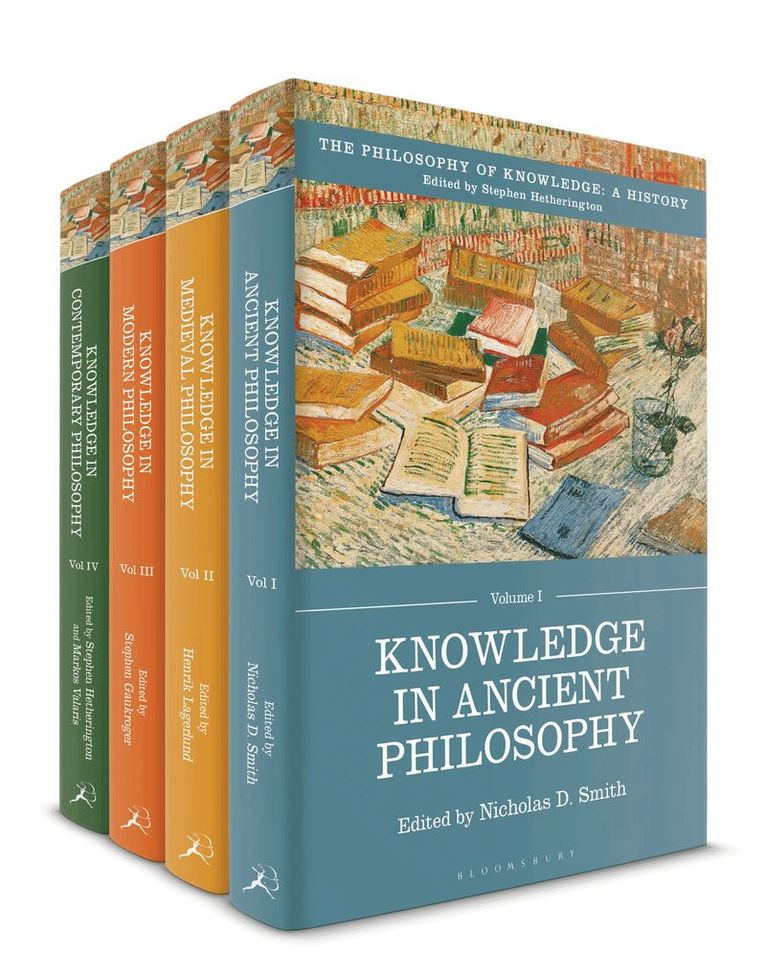
    Philosophy of Knowledge: A History

    AvStephen Hetherington,Nicholas D. Smith

    Bloomsbury Publishing PLC

    2024

    1 460 kr

    Beställningsvara. Skickas inom 5-8 vardagar. Fri frakt över 249 kr.

    Beskrivning

    Within these four volumes, we meet much of whatever epistemology has been and is. Why is this form of historical engagement philosophically important?The Philosophy of Knowledge: A History presents the history of one of Western philosophy’s greatest challenges: understanding the nature of knowledge. To know epistemology’s history is to know better what contemporary epistemology could be and perhaps should be – and what it need not be and perhaps ought not to be. Divided chronologically into four volumes, it follows conceptions of knowledge that have been proposed, defended, replaced, and proposed anew by ancient, medieval, modern and contemporary philosophers.Each volume centers around three key questions: what conceptions of knowledge have been offered? Which have shaped epistemology in particular and philosophy in general? How is knowledge conceived by philosophers now? Together these volumes trace the historical development of knowledge for the first time, covering:- Presocratics, Sophists and treatments of knowledge offered by Socrates and Plato- The influence of Aristotle and Augustine during the Middle Ages- Questions of science and religion in the 17th, 18th and 19th century and the work of Descartes, Hobbes, Kant and Leibniz- Contemporary discussions about scientific, social and self-knowledge and attempts to understand knowledge naturalistically, contextually and normatively.With original insights into the vast sweep of ways in which philosophers have sought to understand knowledge, The Philosophy of Knowledge: A History embraces what is vital and evolving within contemporary epistemology. Overseen by an international team of leading philosophers and featuring 50 specially-commissioned chapters, this is a major collection on one of philosophy’s defining topics.

    Produktinformation

    • Märke:Bloomsbury Publishing PLC
    • Utgivningsdatum:2024-04-18
    • Höjd:158 x 234 x 13 mm
    • Vikt:1 673 g
    • Språk:Engelska
    • Förlag:Bloomsbury Publishing PLC
    • EAN:9781350446649

    Utforska kategorier

    • Filosofiska discipliner inom Filosofi och religion

    Mer om författaren

    Stephen Hetherington is Professor of Philosophy at the University of New South Wales, Australia.Nicholas D. Smith is James F. Miller Professor of Humanities at Lewis & Clark College, USA.Henrik Lagerlund is Associate Professor of Philosophy at the University of Western Ontario, Canada.Stephen Gaukroger is Professor of History of Philosophy and History of Science at the University of Sydney, Australia. Markos Valaris is Lecturer of Philosophy at the University of New South Wales, Australia.

    Recensioner i media

    The Philosophy of Knowledge is a truly remarkable work. In addition to its vast breadth, the set is commendable for the expertise of the contributors and the clarity and rigor of their essays. The set has three chief virtues: it provides a clear understanding of Western epistemology; each individual volume makes for an ideal resource for courses focusing on that period; and the individual essays themselves are perfect complements to primary works of the philosopher(s) addressed. Summing Up: Highly recommended. Lower-division undergraduates through faculty; general readers.

    Innehållsförteckning

    • Volume I: Knowledge in Ancient Philosophy(ed.) Nicholas D. SmithAncient Epistemology: Introduction (Nicholas D. Smith)1. ‘Sophia’ and ‘Episteme’ in the Archaic and Classical Periods (David Wolfsdorf)2. Presocratic Epistemology (Daniel W. Graham)3. Epistemology in the Sophists (Noburu Notomi)4. Socratic Epistemology (Jose Lourenço and Nicholas D. Smith)5. Epistemology in Plato’s Middle Dialogues (Naomi Reshotko)6. Plato’s Later Epistemology (Hugh H. Benson)7. Aristotle on Understanding and Practical Wisdom (Corinne Gartner)8. Aristotle: From Perception to Understanding (Keith McPartland)9. Epicurean Epistemology (Pierre-Marie Morel)10. Stoic Epistemology (Marcelo Boeri)11. Ancient Scepticism (Paul Woodruff)12. Epistemologies in Neoplatonism (Péter Lautner)13. Roman Epistemology (Walter Englert)Volume II: Knowledge in Medieval Philosophy(ed.) Henrik Lagerlund1. Avicenna on Knowledge: Deborah Black (University of Toronto)2. Scientia in the 12th Century: Rafael Najera ( Brown University)3. Averroes on Demonstration: Richard Taylor (Marquette University)4. Grosseteste on Demonstration: John Longeway (formerly of University of Wisconsin, Parkside)5. Aquinas on Knowledge and Demonstration: Alexander Hall (Clayton State University)6. Henry of Ghent and John Duns Scotus on Knowledge7. William Ockham on Knowledge8. Nicholas of Autrecourt on Knowledge: Ghristophe Grellard (University of Paris 1 Panthéon-Sorbonne – not yet confirmed)9. John Buridan on Knowledge: Gyula Klima (Fordham University)10. The Posterior Analytics after Buridan: Henrik Lagerlund (University of Western Ontario)11. Suarez on Knowledge: Benjamin Hill (University of Western Ontario)Volume III: Knowledge in Modern Philosophy(ed.) Stephen Gaukroger1. Bacon: Dana Jalobeanu2. Hobbes and Gassendi: Antonia LoLordo and Stewart Duncan (University of Virginia)3. Descartes: Anik Waldow (University of Sydney)4. Spinoza: Aaron Garrett (Boston University)5. Malebranche and Berkeley: Andrew Pyle6. Leibniz: Justin Smith7. Locke: Peter Anstey (University of Sydney)8. Hume: Margaret Schabas (University of British Columbia)9. Kant: John Zammito (Rice University)10. German Idealism: Dean Moyar11. German Philosophy between Hegel and Frege: Frederick Beiser (Syracuse University)12. Whewell, Mill, and the Birth of the Philosophy of Science: Stephen Gaukroger (University of Sydney)Volume IV: Knowledge in Contemporary Philosophy(eds.) Stephen Hetherington and Markos Valaris1. Pragmatism and Epistemology: Scott Aikin (Vanderbilt University)2. On Our Epistemological Debt to Moore and Russell: Claudio de Almeida (PUCRS, Brazil)3. What Knowledge Is Not: Reflections on Some Uses of the Verb ‘To Know’: Julia Tanney (independent scholar; formerly at University of Kent))4. Naturalistic Descriptions of Knowledge: Kourken Michaelian (University of Otago)5. Knowing the Unobservable: Confirmation and Theoretical Virtue: Stathis Psillos (University of Athens)6. Social Knowledge and Social Norms: Peter J. Graham (University of California, Riverside)7. Knowledge-How and Perceptual Learning: Berit Brogaard (University of Miami)8. Self-Knowledge: Markos Valaris (University of New South Wales)9. Knowledge as Contextual: Michael Blome-Tillmann (McGill University)10. Knowledge and Probability: Weng Hong Tang (National University of Singapore)11. Analysing the Concept of Knowledge: Duncan Pritchard (University of Edinburgh)12. Conceiving of Knowledge in Modal Terms? Stephen Hetherington (University of New South Wales)13. Knowledge and Normativity: Clayton Littlejohn (King’s College London)14. Intellectual Virtue and Knowledge: Heather Battaly (California State University, Fullerton)