• Fri frakt över 249 kr
  • •
  • Snabba leveranser
  • •
  • Billiga böcker
Kundservice

Du är på sajten för privatpersoner.

Företag, bibliotek eller offentlig verksamhet?

Du handlar på classic.bokus.com, där alla dina funktioner finns intakta.
Till classic.bokus.com
Bokus logotyp. Gå till startsidan.
  • Erbjudanden
  • Nyheter
  • Student
  • Topplistor
  • Barn & ungdom
  • Bokus Play
  • E-böcker
  • Pocketböcker
  • Spel & pussel

10% rabatt på allt med kod: NYSTART10 →

Sidfot

Mina sidor

    Hjälp

    • Kundservice
    • Vanliga frågor och svar
    • Frakt och leverans
    • Retur vid ångerrätt
    • Reklamera vara
    • Betalning
    • Köpvillkor
    • Allmänna villkor
    • Information om webbplatsens tillgänglighet

    Om Bokus

    • Om oss
    • Pressrum
    • För studenter
    • För företag
    • För bibliotek och offentlig verksamhet
    • För leverantörer
    • Hållbarhet

    Populärt

    • Aktuella erbjudanden
    • Presentkort
    • Studentlitteratur
    • Nya böcker
    • Topplistor
    • Signerade böcker
    • Engelska böcker

    Inspiration

    • Boktips
    • BookTok
    • Populära bokserier
    • Barnbokskaraktärer
    • Populära författare
    Logotyp för Bokus
    Följ oss på Facebook (extern länk)Följ oss på Instagram (extern länk)Följ oss på YouTube (extern länk)Följ oss på TikTok (extern länk)
    bokus @ CookiesAnpassa cookiesIntegritetspolicyKöpvillkor
    Till Citymail hemsida (extern länk)Till Budbee hemsida (extern länk)Till Postnord hemsida (extern länk)Till Schenker hemsida (extern länk)Till Early Bird hemsida (extern länk)Till Walleys hemsida (extern länk)
    1. Naturvetenskap och teknik
    2. Matematik och naturvetenskap
    3. Fysik
    4. Klassisk mekanik

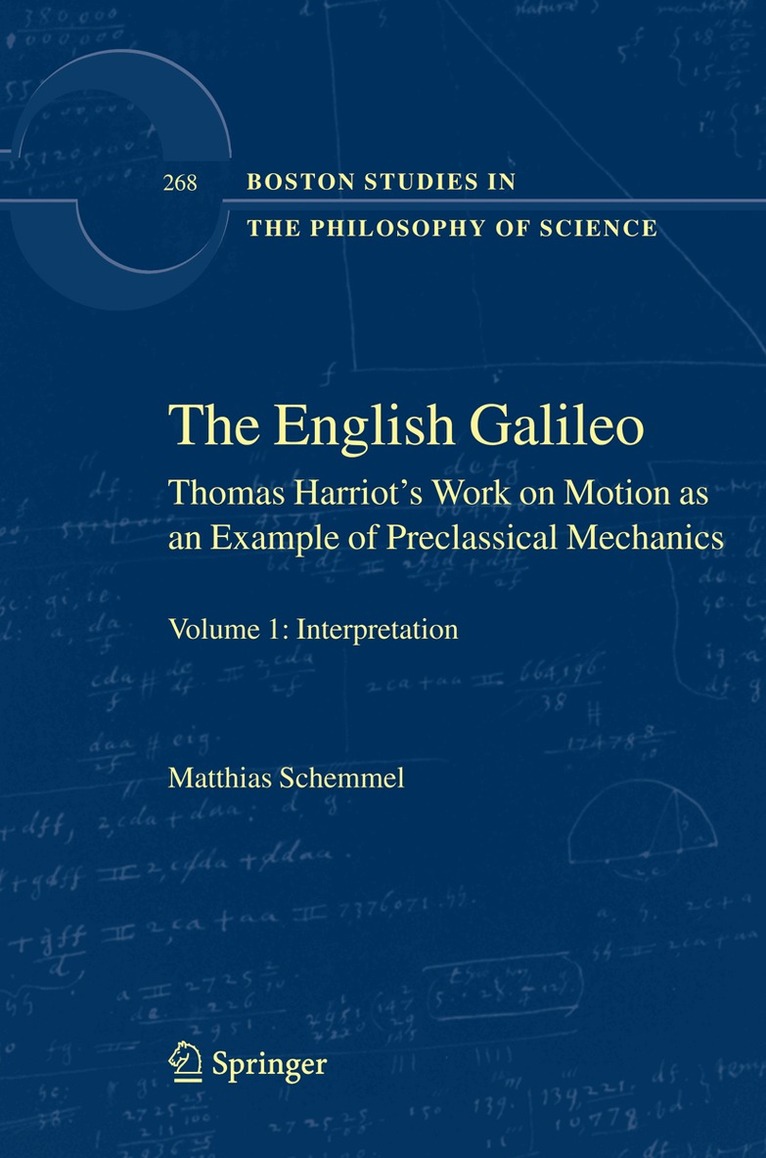
    English Galileo

    Thomas Harriot's Work on Motion as an Example of Preclassical Mechanics

    AvMatthias Schemmel

    Springer-Verlag New York Inc.

    2008

    Del 268 i serien Boston Studies in the Philosophy and History of Science

    2 552 kr

    Beställningsvara. Skickas inom 10-15 vardagar. Fri frakt över 249 kr.

    Fler format och utgåvor

    E-bok

    2 769 kr

    Beskrivning

    The English Galileo—the title of this book draws on the extraordinary prominence of Galileo Galilei in the historiography of the early modern Scienti?c Revolution. At the same time it questions the uniqueness of Galileo (not as a person, of course, but as an early modern phenomenon) by proclaiming another ?gure of his kind: Thomas H- riot. But putting Harriot on a pedestal next to Galileo is not a concern of this book, which is rather motivated by questions of the following kind: How did modern s- ence come about? What were the processes of knowledge and concept transformation that led from premodern to modern science, and, more speci?cally, from preclassical to classical mechanics? Which aspects of these developments rely on the peculiarities of particular historical actors and what aspects re?ect more general characteristics of the knowledge system at the time and its potentials for development? To answer such questions it is obviously necessary to complement the existing studies on Galileo’s science with studies on the work of his lesser-known contemporaries; and it is imp- tant that these studies are carried out in similar detail to make the different prota- nists’ work comparable. Without such comparison—this is the basic assumption of this book—our understanding of the shared knowledge of early modern thinking and the processes of knowledge transformation from which modern science emerged will remain incomplete and biased.

    Produktinformation

    • Märke:Springer-Verlag New York Inc.
    • Utgivningsdatum:2008-09-18
    • Höjd:155 x 235 x 55 mm
    • Vikt:1 533 g
    • Språk:Engelska
    • Serie:Boston Studies in the Philosophy and History of Science
    • Antal sidor:766
    • Upplaga:2008
    • Förlag:Springer-Verlag New York Inc.
    • EAN:9781402054983

    Utforska kategorier

    • Klassisk mekanik inom Naturvetenskap och teknik

    Recensioner i media

    From the reviews: "Schemmel's expositions are extremely clear, and he takes pains to provide careful explanations of Harriot's more complex constructions ... . Historians of early modern natural philosophy or mechanics will find much to reward their efforts in The English Galileo. Schemmel's study should also be applauded for shedding valuable light on an unjustly marginalized figure." (Stephen Clucas, ISIS, Vol. 104 (3), September, 2013) "This book is an ambitious attempt to catalogue and interpret the unpublished manuscripts on mechanics by English mathematician and philosopher, Thomas Harriot ... . Schemmel's contribution to this project focuses on Harriot's attempts to describe bodies in motion, particularly projectiles. ... Readers specialising in the history of mechanics and motion would undoubtedly learn a great deal about Harriot ... ." (Luciano Boschiero, Metascience, Vol. 21, 2012) "The English Galileo offers the first comprehensive study of Harriot's work on motion. More specifically, the book is devoted to the reconstruction, detailed analysis, and interpretation of Harriot's work on projectile motion and the free fall of bodies. ... Matthias Schemmel has considerably enhanced our knowledge not only of Harriot but also of the development of mechanical knowledge. ... Schemmel's work is an outstanding contribution to a better understanding of the rise of a mechanical worldwide. Admirers of Galileo will also become admirers of Harriot." (William R. Shea, Mathematical Reviews, Issue 2012 g) "The title of the book is absolutely justified. The author argues that both Galilei and Harriot worked within a framework that he calls preclassical mechanics. It is a mix of several elements. It consists of parts of old traditions like Aristotelian physics combined with the knowledge of practitioners like gunners. ... Schemmel did a wonderful job and ... this book about the crucial transition from preclassical mechanics to classical mechanics represents the beginning of more work on Harriot." (Teun Koetsier, Zentralblatt MATH, Vol. 1244, 2012) "Matthias Schemmel in his superb edition of Harriot's work on free fall and projectile motion has independently used the same technique of facsimile and commentary. ... The second of his two volumes consists entirely of reproductions of the 180 folios he has selected from Harriot's work on motion under gravity, together with schematic analyses of their contents. ... a fine contribution not only to Harriot scholarship but to a deeper understanding of the development of early modern science and mathematics." (Jackie Stedall, BSHM Bulletin, Vol. 24, 2009)

    Innehållsförteckning

    • Harriot’s Work on Motion in Context.- Thomas Harriot: Practical Mathematician and Pioneer of Modern Science.- Harriot and the Challenge of Projectile Motion.- An Introduction to Harriot’s Manuscripts on Motion.- Major Strands of Harriot’s Work on Motion.- Mathematical Analysis of the Motion of Fall.- Free Fall Experiments and Their Evaluation: The “Weight” of Falling Bodies.- Free Fall Experiments and Their Evaluation: Motion in a Medium.- Graphical Construction of Projectile Trajectories.- Exploration of the Inclined-Plane Conception of Projectile Motion.- Conclusion.- Shared Knowledge and Alternative Solutions in Harriot’s and Galileo’s Work on Motion.- Facsimile and Transcription.- Notes and Conventions.- Thomas Harriot’s Notes on Projectile Motion and the Fall of Bodies.