• Fri frakt över 249 kr
  • •
  • Snabba leveranser
  • •
  • Billiga böcker
Kundservice

Du är på sajten för privatpersoner.

Företag, bibliotek eller offentlig verksamhet?

Du handlar på classic.bokus.com, där alla dina funktioner finns intakta.
Till classic.bokus.com
Bokus logotyp. Gå till startsidan.
  • Erbjudanden
  • Nyheter
  • Student
  • Topplistor
  • Barn & ungdom
  • Bokus Play
  • E-böcker
  • Pocketböcker
  • Spel & pussel

10% rabatt på allt med kod: NYSTART10 →

Sidfot

Mina sidor

    Hjälp

    • Kundservice
    • Vanliga frågor och svar
    • Frakt och leverans
    • Retur vid ångerrätt
    • Reklamera vara
    • Betalning
    • Köpvillkor
    • Allmänna villkor
    • Information om webbplatsens tillgänglighet

    Om Bokus

    • Om oss
    • Pressrum
    • För studenter
    • För företag
    • För bibliotek och offentlig verksamhet
    • För leverantörer
    • Hållbarhet

    Populärt

    • Aktuella erbjudanden
    • Presentkort
    • Studentlitteratur
    • Nya böcker
    • Topplistor
    • Signerade böcker
    • Engelska böcker

    Inspiration

    • Boktips
    • BookTok
    • Populära bokserier
    • Barnbokskaraktärer
    • Populära författare
    Logotyp för Bokus
    Följ oss på Facebook (extern länk)Följ oss på Instagram (extern länk)Följ oss på YouTube (extern länk)Följ oss på TikTok (extern länk)
    bokus @ CookiesAnpassa cookiesIntegritetspolicyKöpvillkor
    Till Citymail hemsida (extern länk)Till Budbee hemsida (extern länk)Till Postnord hemsida (extern länk)Till Schenker hemsida (extern länk)Till Early Bird hemsida (extern länk)Till Walleys hemsida (extern länk)
    1. Data och IT
    2. Tillämpad datateknik

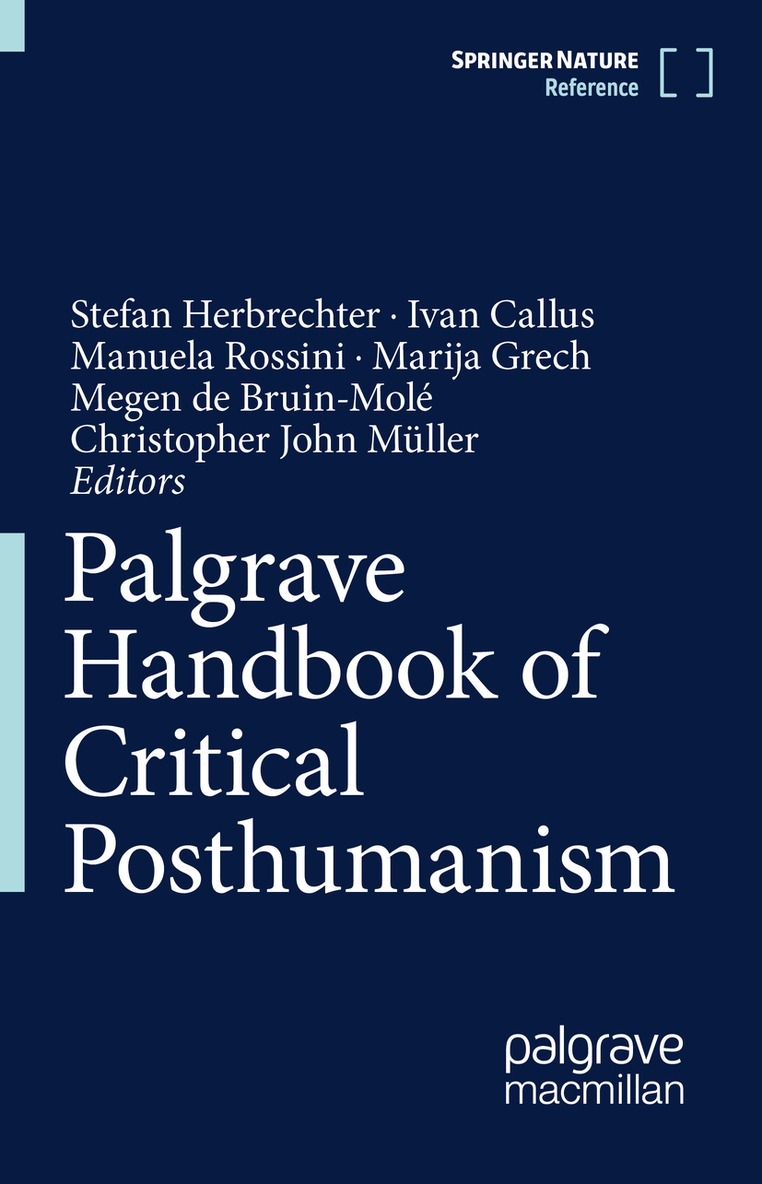
    Palgrave Handbook of Critical Posthumanism

    AvStefan Herbrechter,Ivan Callus

    Springer International Publishing AG

    2022

    Del i serien Palgrave Handbook of Critical Posthumanism

    9 765 kr

    Beställningsvara. Skickas inom 10-15 vardagar. Fri frakt över 249 kr.

    Beskrivning

    Palgrave Handbook of Critical Posthumanism is a major reference work on the paradigm emerging from the challenges to humanism, humanity, and the human posed by the erosion of the traditional demarcations between the human and nonhuman. This handbook surveys and speculates on the ways in which the posthumanist paradigm emerged, transformed, and might further develop across the humanities. With its focus on the posthuman as a figure, on posthumanism as a social discourse, and on posthumanisation as an on-going historical and ontological process, the volume highlights the relationship between the humanities and sciences. The essays engage with posthumanism in connection with subfields like the environmental humanities, health humanities, animal studies, and disability studies. The book also traces the historical representations and understanding of posthumanism across time. Additionally, the contributions address genre and forms such as autobiography, games, art, film, museums, andtopics such as climate change, speciesism, anthropocentrism, and biopolitics to name a few. This handbook considers posthumanism’s impact across disciplines and areas of study.

    Produktinformation

    • Märke:Springer International Publishing AG
    • Utgivningsdatum:2022-11-29
    • Höjd:155 x 235 x 74 mm
    • Vikt:2 660 g
    • Språk:Engelska
    • Serie:Palgrave Handbook of Critical Posthumanism
    • Antal sidor:1 243
    • Förlag:Springer International Publishing AG
    • EAN:9783031049576

    Utforska kategorier

    • Tillämpad datateknik inom Data och IT
    • Litteraturvetenskap inom Skönlitteratur

    Mer om författaren

    Stefan Herbrechter is a writer and research fellow at Coventry University and Privatdozent at Heidelberg University.Ivan Callus is Professor of English at the University of Malta.Manuela Rossini works as a research manager in the central administration of the University of Basel and is associated to its English Department as Executive Director of the European Society for Literature, Science and the Arts (SLSAeu).Marija Grech is a Visiting Senior Lecturer at the Department of English at the University of Malta and a Visiting Fellow of the School of Humanities & Languages at the University of New South Wales, Sydney. Megen de Bruin-Molé (University of Southampton) is a scholar and university lecturer working in the UK.Christopher John Müller is a lecturer in Cultural Studies & Media at Macquarie University, Sydney and an Honorary Research Associate in Critical and Cultural Theory at Cardiff University.

    Innehållsförteckning

    • Introduction: Posthumanism and Critique (Editors).- Part I Posthumanism Across the Ages (ed. Ivan Callus).- Introduction (Ivan Callus & Stefan Herbrechter).- Prehistory, geology and deep time (Kathryn Yusoff; Ivan Callus).- Classical posthumanism (Liz Gloyn; Giulia Maria Chesi & Francesca Spiegel).- Medieval posthumanism (Karl Steel; Jeffrey Cohen; Alan S. Montroso).- Early modern posthumanism (Karen Raber; Carla Freccero).- Enlightenment posthumanism (Edgar Landgraf).- Romanticism and posthumanism (Ron Broglio; Surekha Davies).- Antebellum posthumanism (Cristin Ellis).- Modernism and posthumanism (Ruben Borg).- Postmodernism and posthumanism (Tanja Nusser).- Anthropocene posthumanism (Marija Grech).- Constructions of the future: science fiction, futurism, futurology and speculative futures (Sherryl Vint; Stefan Herbrechter).- Part II Figurations of the Posthuman (ed. Megen de Bruin-Molé).- Introduction (Megen de Bruin-Molé & Stefan Herbrechter).- Human nature andnonhuman, inhuman, ahuman, superhuman… alterity (David Wood).- Endism: apocalypse, dystopia and the “end of man” (Rosalyn Diprose; Florian Mussgnug).- Somatechnics and assemblage (Nikki Sullivan; Anna Tsing; Richard Doyle).- Technics: originary technology, technesis and cultural technologies (Arthur Bradley; Mark Hansen).- Prosthetic bodies: embodiment, cyborgisation, augmentation and enhancement (Margrit Shildrick; Paul Sheehan; Joanna Morra).- Autopoiesis: cybernetics and (new) systems theory (Bruce Clarke; Hannes Bergthaller).- (Post)Nature (Kate Soper; Timothy Clark; Erika Cudworth & Stephen Hobden; Joanna Latimer & Mara Miele).- Nonhuman: animal, vegetal, mineral (Natasha Myers; Lynn Worsham).- Posthuman monsters: hybrids, chimeras, cyborgs, machines… (Kim Tofoletti; Megen de Bruin-Molé).- Digital: data, algorithm, and network (Luciana Parisi; Wendy Chun).- Posthuman genders (Susan Stryker).- Raced figures: whiteness and posthumanism (Sean Guynes).- The Soul of the Matter: religion, non-Western metaphysics, reincarnations, animism, religion (Arne Johan Vetlesen; Anne Weinstone; Elaine Graham).- Subjectivities: non/human agency, entanglement and (new) ontologies (Karen Barad).- Part III Posthumanist Practices (Marija Grech & Christopher Müller).- Introduction (Marija Grech & Christopher Müller).- Language (Vicki Kirby; Christopher Peterson).- Games and gaming: virtuality and hyperreality (Jonathan Boulter; Gordon Calleja; Laurent Milesi).- Photography (Joanna Zylinska).- Film (R. L. Rutsky; Thomas D. Philbeck; Michael Hauskeller).- Sound/Music (David Cecchetto).- Autobiography (Kari Weil; Lynn Turner).- Museum (Deborah Lawler-Dormer; Louise Whiteley; Magdalena Tyżlik-Carver).- Objects: object-oriented-ontology and speculative realism (Ben Woodard).- Biotech, biomedia, bioart, biopolitics (Eugene Thacker; Nicole Shukin; Ruth Chadwick).- Pedagogy  and education (Nathan Snaza; Carol A. Taylor; Jeremy Knox).- Living with animals (Nicole Anderson; HelenaPedersen).- Social Justice and community activism (Joseph Pugliese).- Mattering: (feminist) new materialism (Stacy Alaimo; Iris van der Tuin).- Opposing neurocapitalism (Tiziana Terranova & Giorgio Griziotti; Yann Moulier Boutang & Luc Boltanski).- The work of affect, trauma, memory (Marie-Luise Angerer; Xine Yao; Anthony Miccoli).- Globalization and new colonialism (Achille Mbembe; Peta Hinton; Linda Hutcheon).- Part IV Posthumanities – Institutional and Disciplinary Transformations (ed. Manuela Rossini).- Introduction (Manuela Rossini & Stefan Herbrechter).- Environmental Humanities: extinction, ecology, climate change (Stephanie LeMenager; Serpil Oppermann & Serenella Iovino; Ursula Heise).- Health Humanities (Sarah Chan; Sara Wasson; Manuela Rossini).- (Post)Digital Humanities (Gary Hall).- Neurohumanities (Stefan Besser).- Anthropocene studies (Nigel Clark; Jan Zalasiewicz).- Animal Studies: speciesism and anthropomorphism/-centrism (Cary Wolfe; Anat Pick; Tom Tyler;Susan McHugh).- Disability Studies (Dan Goodley, Rebecca Lawthom & Katherine Runswick Cole).- Critical Science Studies (Astrid Schrader).- (Post)Anthropology and human obsolescence (Christopher Müller).- (Non/Human) Geography (Sarah Whatmore; Debra Benita Shaw; Noel Castree).- Plant philosophy (Michael Marder; Jeffrey T. Nealon; Eduardo Kohn).- Media – social, open, new: remediation (Jussi Parikka; Barbara Braid; Dominic Pettman).- Literature: electronic, graphic, speculative (Joe Tabbi; Pieter Vermeulen).- Art, architecture and posthuman(ist) aesthetics (Carsten Strathausen; Mads Rosendahl Thomsen).- Psychoanalysis and the posthuman (Mari Ruti; Judith Roof & Svitlana Matviyenko).- Law and ethics and (non)human rights (Judith Butler; Bijan Fateh-Moghadam).