• Fri frakt över 249 kr
  • •
  • Snabba leveranser
  • •
  • Billiga böcker
Kundservice

Du är på sajten för privatpersoner.

Företag, bibliotek eller offentlig verksamhet?

Du handlar på classic.bokus.com, där alla dina funktioner finns intakta.
Till classic.bokus.com
Bokus logotyp. Gå till startsidan.
  • Erbjudanden
  • Nyheter
  • Student
  • Topplistor
  • Barn & ungdom
  • Bokus Play
  • E-böcker
  • Pocketböcker
  • Spel & pussel

10% rabatt på allt med kod: NYSTART10 →

Sidfot

Mina sidor

    Hjälp

    • Kundservice
    • Vanliga frågor och svar
    • Frakt och leverans
    • Retur vid ångerrätt
    • Reklamera vara
    • Betalning
    • Köpvillkor
    • Allmänna villkor
    • Information om webbplatsens tillgänglighet

    Om Bokus

    • Om oss
    • Pressrum
    • För studenter
    • För företag
    • För bibliotek och offentlig verksamhet
    • För leverantörer
    • Hållbarhet

    Populärt

    • Aktuella erbjudanden
    • Presentkort
    • Studentlitteratur
    • Nya böcker
    • Topplistor
    • Signerade böcker
    • Engelska böcker

    Inspiration

    • Boktips
    • BookTok
    • Populära bokserier
    • Barnbokskaraktärer
    • Populära författare
    Logotyp för Bokus
    Följ oss på Facebook (extern länk)Följ oss på Instagram (extern länk)Följ oss på YouTube (extern länk)Följ oss på TikTok (extern länk)
    bokus @ CookiesAnpassa cookiesIntegritetspolicyKöpvillkor
    Till Citymail hemsida (extern länk)Till Budbee hemsida (extern länk)Till Postnord hemsida (extern länk)Till Schenker hemsida (extern länk)Till Early Bird hemsida (extern länk)Till Walleys hemsida (extern länk)
    1. Samhälle och politik
    2. Samhälle och kultur
    3. Kultur och medier
    4. Referensverk och tvärvetenskap

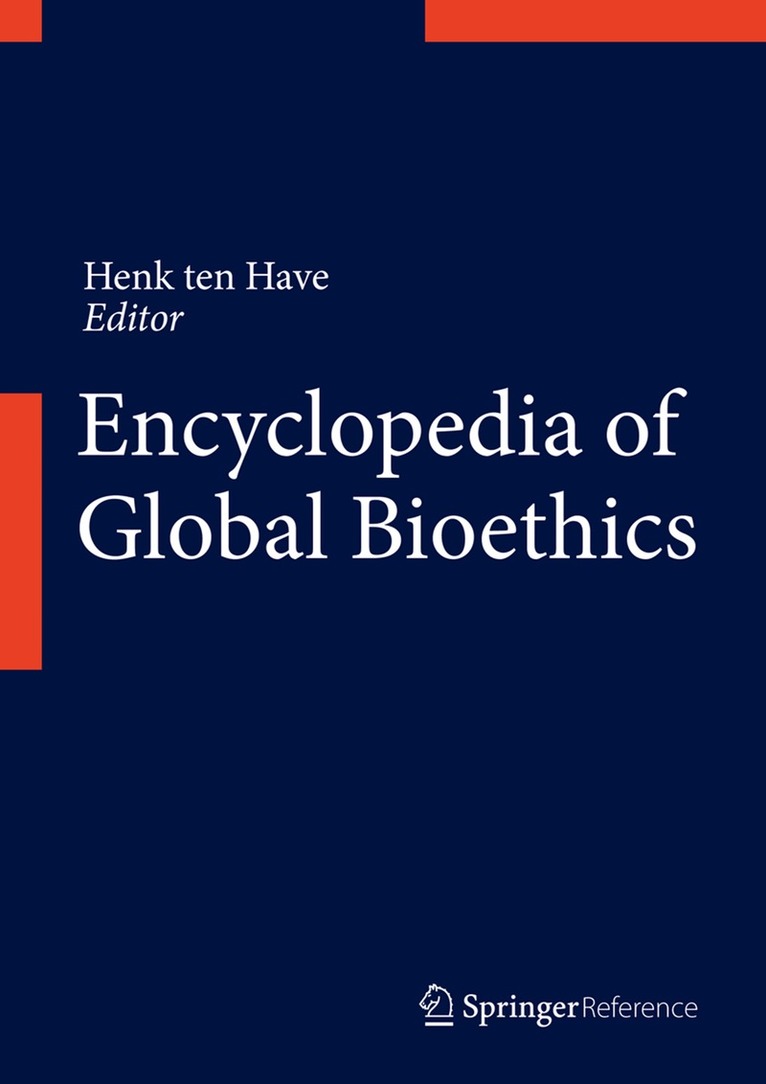
    Encyclopedia of Global Bioethics

    AvHenk ten Have

    Springer International Publishing AG

    2016

    21 642 kr

    Beställningsvara. Skickas inom 10-15 vardagar. Fri frakt över 249 kr.

    Beskrivning

    This work presents the first comprehensive and systematic treatment of all relevant issues and topics in contemporary global bioethics. Now that bioethics has entered into a novel global phase, a wider set of issues, problems and principles is emerging against the backdrop of globalization and in the context of global relations. This new stage in bioethics is furthermore promoted through the ethical framework presented in the UNESCO Universal Declaration on Bioethics and Human Rights adopted in 2005. This Declaration is the first political statement in the field of bioethics that has been adopted unanimously by all Member States of UNESCO. In contrast to other international documents, it formulates a commitment of governments and is part of international law (though not binding as a Convention). It presents a universal framework of ethical principles for the further development of bioethics at a global level. The Encyclopedia of Global Bioethics caters to the need for a comprehensive overview and systematic treatment of all pertinent new topics and issues in the emerging global bioethics debate. It provides descriptions and analysis of a vast range of important new issues from a truly global perspective and with a cross-cultural approach. New issues covered by the Encyclopedia and neglected in more traditional works on bioethics include, but are not limited to, sponsorship of research and education, scientific misconduct and research integrity, exploitation of research participants in resource-poor settings, brain drain and migration of healthcare workers, organ trafficking and transplant tourism, indigenous medicine, biodiversity, commodification of human tissue, benefit sharing, bio industry and food, malnutrition and hunger, human rights and climate change.

    Produktinformation

    • Märke:Springer International Publishing AG
    • Utgivningsdatum:2016-06-29
    • Höjd:178 x 254 x undefined mm
    • Språk:Engelska
    • Antal sidor:3 031
    • Förlag:Springer International Publishing AG
    • EAN:9783319094823

    Utforska kategorier

    • Referensverk och tvärvetenskap inom Samhälle och politik
    • Biovetenskap inom Naturvetenskap och teknik
    • Filosofiska discipliner inom Filosofi och religion

    Mer om författaren

    Henk ten Have studied medicine and philosophy at Leiden University, the Netherlands. He received his medical degree in 1976 from Leiden University and his philosophy degree in 1983. He worked as a researcher in the Pathology Laboratory, University of Leiden (1976-1977), as a practising physician in the Municipal Health Services, City of Rotterdam (1978-1979) and as a Professor of Philosophy in the Faculty of Medicine and Faculty of Health Sciences, University of Limburg, Maastricht (1982-1991). From 1991 he was a Professor of Medical Ethics and the Director of the Department of Ethics, Philosophy and History of Medicine in the University Medical Centre Nijmegen, the Netherlands. In September 2003 he joined UNESCO as Director of the Division of Ethics of Science and Technology. Since July 2010 he is Director of the Center for Healthcare Ethics at Duquesne University in Pittsburgh, USA. QUOTE FROM REVIEWER: “There is probably no bioethicist in the world that has the same global insight in bioethics as Henk ten Have, in terms of neglected/important topics, centers of expertise around the world, qualified contributors in other countries and overall management of a project such as this one” (Jos Welie, review report on the proposal for the Encyclopedia of Global Bioethics).

    Recensioner i media

    "The ten Have's Encyclopaedia represents an enormous advancement with respect to the aggressive, autarchic mainstream bioethics. ... it is certainly an 'Encyclopaedia of a more global bioethics' than any other bioethical or biomedical-ethical encyclopaedia so far." (Amir Muzur, Jahr - European Journal of Bioethics, Vol. 7 (14), 2016)

    Innehållsförteckning

    • Section 1: Introduction: Global bioethics.- Section 2: Abortion.- Abuse.- Access to health care.- Addiction.- Adoption.- Advance directives.- Advance care planning.- Advertising.- Advocacy.- Ageism.- Agricultural ethics.- aids.- Alcohol(ism).- Alternative medicine.- Altruism.- Animals.- Anthropocentrism.- Anthropology and ethics.- Applied ethics.- Artificial insemination.- Artificial organs.- Artificial nutrition and hydration.- Assisted suicide.- Authenticity.- Autonomy.- Behavior modification.- Benefit-sharing.- Benefit and harm.- Biobanking.- Biocentrism.- Biodiversity.- Bioethics.- Biology.- Biometrics.- Biopiracy.- Biopolitics.- Biosafety.- Biosecurity.- Biotechnology.- Bioterrorism..- Birth control.- Body.- Brain death.- Brain drain.- Care ethics.- Capacity building.- Capital punishment.- Casuistry.- Censorship.- Children.- Chronic illness and care.- Circumcision.- Citizenship.- Civil disobedience..- Climate change and health.- Clinical ethics.- Clinical research.- Cloning.- Codes of conduct.- Coercion..- Commercialism.- Committees.- Commodification.- Common good.- Common heritage of humankind.- Communication.- Communitarian ethics.- Compassion.- Competence.- Complicity.- Confidentiality.- Conflict of interest.- Conscience.- Consent.- Corruption.- Cosmopolitanism.- Cultural diversity.- Death.- Death penalty.- Deliberation.- Dementia.- Dental ethics.- Designer babies.- Development.- Disability.- Disasters.- Disease.- Discourse ethics.- Discrimination.- Distributive justice.- DNR (Do not resuscitate policies).- Donation.- Double effect.- Dual use.- Doping.- Drugs.- Education.- Egalitarianism.- Electronic surveillance.- Electronic patient record.- Embryo.- Engineering ethics.- Enhancement.- Environmental ethics.- Epidemics.- Epidemiology.- Equality and equity.- Eugenics.- Euthanasia.- Evaluation ethics.- Evolutionary perspectives in ethics.- Exploitation.- Family medicine.- Fairness.- Feminist ethics.- Fertility control.- Fetal research.- Fetal surgery.- Fetus.- Food ethics.- Food security.- Forensic medicine.- Freedom.- Futility.- Future generation.- Gender.- Genetic counselling.- Genetic modification (GMOs).- Genetic screening.- Gene therapy.- Genomics.- Ghost writing.- Governance.- Global health.- Health.- Health education and promotion.- Health insurance.- Health policy.- Homelessness.- Homosexuality.- Honor codes.- Hospice.- Hospital.- Human dignity.- Human rights.- Human nature.- Humanism.- Humanitarian intervention.- Hunger.- Identity.- Immigration.- Implementation ethics.- Indigenous knowledge.- Indigenous rights.- Infertility.- Information technology.- Insanity.- Integrity.- Intensive care.- International law.- Internet.- Journalism ethics.- Justice.- Law.- Leadership, ethics of.- Legal ethics.- Life.- Lifestyles.- Literature.- Malpractice.- Managed care.- Maternal-fetal relationship.- Media ethics.- Mediation.- Medical humanities.- Medical tourism.- Medicine.- Mental health.- Mental illness.- Mercy.- Migratio.- Military ethics.- Mismanagement.- Mistakes, medical.- Moral pluralism.- Moral relativism.- Moral status.- Narrative ethics.- Natural law.- Nature versus nurture.- Nanotechnology.- Neonatology.- Neuroethics.- Neurotechnology.- Nongovernmental organizations (NGOs).- Non-discrimination.- Nursing ethics.- Obesity.-Occupational therapy..- Occupational safety.- Organ.- Organizational ethics.- Ownership.- Pain.- Palliative care.- Palliative sedation.- Pandemics.- Pastoral care.- Patenting.- Paternalism.- Pediatrics.- Pharmacy ethics.- Placebo.- Plagiarism.- Population ethics.- Poverty.- Precautionary principle.- Prevention.- Principlism.- Prisoners.- Privacy.- Professional ethics.- Professional-patient relationship.- Property rights.- Psychiatry ethics.- Psychosurgery.- Public debate.- Public health.- Publication ethics.- Quality of care.- Quality of life.- Refugees.- Religion and ethics.- Reproductive ethics.- Research ethics.- Research policy.- Resource allocation.- Regenerative medicine.- Respect for autonomy.- Responsibility.- Right to die.- Right to health.- Risk.-Robots.- Safety.- Science and engineering ethics.- Scientific misconduct.- Sexual ethics.- Slippery slope.- Social ethics.- Social work.- Solidarity.- Spirituality.- Sports.- Standards of care.- Stem cells.- stem cells, embryonic.- Stewardship.- Stigmatization.- Strikes.- Substance abuse.- Suffering.- Suicide.- Surrogate decision-making.- Surgery.- Sustainability.- Synthetic biology.- Technology assessment.- Testing.- Tissue engineering.- Torture.- Traditional medicine.- Transhumanism.- Transplantation medicine.- Triage.- Trust.- Truth-telling.- Utopianism.- Vaccination.- Values.- Vegetarianism.- Veterinary ethics.- Violence.- Virtue ethics.- Vulnerability.- Warfare.- Whistle-blowing.- Workplace ethics.- World ethics.-Xenotransplantation.- Section 3: Alphabetic index.