• Fri frakt över 249 kr
  • •
  • Snabba leveranser
  • •
  • Billiga böcker
Kundservice

Du är på sajten för privatpersoner.

Företag, bibliotek eller offentlig verksamhet?

Du handlar på classic.bokus.com, där alla dina funktioner finns intakta.
Till classic.bokus.com
Bokus logotyp. Gå till startsidan.
  • Erbjudanden
  • Nyheter
  • Student
  • Topplistor
  • Barn & ungdom
  • Bokus Play
  • E-böcker
  • Pocketböcker
  • Spel & pussel

10% rabatt på allt med kod: NYSTART10 →

Sidfot

Mina sidor

    Hjälp

    • Kundservice
    • Vanliga frågor och svar
    • Frakt och leverans
    • Retur vid ångerrätt
    • Reklamera vara
    • Betalning
    • Köpvillkor
    • Allmänna villkor
    • Information om webbplatsens tillgänglighet

    Om Bokus

    • Om oss
    • Pressrum
    • För studenter
    • För företag
    • För bibliotek och offentlig verksamhet
    • För leverantörer
    • Hållbarhet

    Populärt

    • Aktuella erbjudanden
    • Presentkort
    • Studentlitteratur
    • Nya böcker
    • Topplistor
    • Signerade böcker
    • Engelska böcker

    Inspiration

    • Boktips
    • BookTok
    • Populära bokserier
    • Barnbokskaraktärer
    • Populära författare
    Logotyp för Bokus
    Följ oss på Facebook (extern länk)Följ oss på Instagram (extern länk)Följ oss på YouTube (extern länk)Följ oss på TikTok (extern länk)
    bokus @ CookiesAnpassa cookiesIntegritetspolicyKöpvillkor
    Till Citymail hemsida (extern länk)Till Budbee hemsida (extern länk)Till Postnord hemsida (extern länk)Till Schenker hemsida (extern länk)Till Early Bird hemsida (extern länk)Till Walleys hemsida (extern länk)
    1. Ekonomi och Ledarskap
    2. Ledarskapsböcker
    3. Ledarskap och motivation

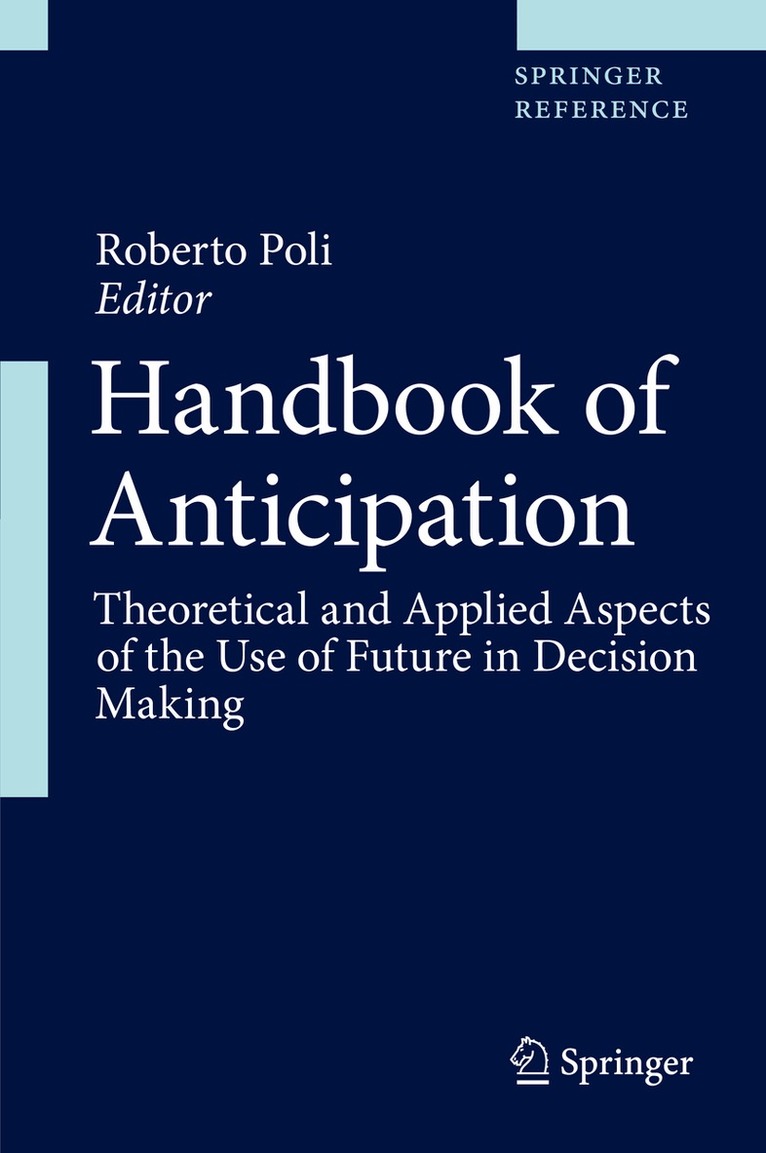
    Handbook of Anticipation

    Theoretical and Applied Aspects of the Use of Future in Decision Making

    AvRoberto Poli

    Springer International Publishing AG

    2019

    8 280 kr

    Beställningsvara. Skickas inom 10-15 vardagar. Fri frakt över 249 kr.

    Beskrivning

    This Handbook presents the state of the art overview of current research on anticipation studies. It develops anticipation from both the theoretical and applied points of view.  Via this comprehensive overview of the research on anticipation, this Handbook makes clear that anticipation is a serious topic of research that can and should be connected to Futures Studies research, perspectives and orientation. The Handbook uses the anticipatory viewpoint as a unifying framework able both to stop the progressive fragmentation of the human and social sciences and begin a process aimed at progressively closer integration, mutual knowledge and dialogue among the human and social sciences. It sets the agenda for the field, helps futures studies to come of age, and contributes to changing the orientation of the human and social sciences from their dominant past-orientation to a new future-orientation.  The Handbook presents research from a variety of fields such as: Biology, ecology, psychology, social sciences, humanities, engineering, and computer science. The editorial board consists of scholars from various sciences, such as futurists, sociologists, economists, statisticians, computer scientists, designers and game builders.

    Produktinformation

    • Märke:Springer International Publishing AG
    • Utgivningsdatum:2019-08-22
    • Höjd:155 x 235 x undefined mm
    • Språk:Engelska
    • Antal sidor:1 753
    • Förlag:Springer International Publishing AG
    • EAN:9783319915531

    Utforska kategorier

    • Ledarskap och motivation inom Ekonomi och Ledarskap
    • Psykologi: jaget, identitet och personlighet inom Psykologi och pedagogik
    • Filosofi inom Filosofi och religion

    Mer om författaren

    Roberto Poli (Ph.D. Utrecht) was awarded the first UNESCO Chair in Anticipatory Systems, is fellow of WAAS – World Academy of Art and Science, and STIAS – Stellenbosch Institute for Advanced Study. Poli is editor-in-chief of Axiomathes (Springer) and editor of the series Categories (De Gruyter) and Anticipation Science (Springer). Poli heads the master’s programme in social foresight. Poli’s research interests include:• Anticipatory systems, i.e., systems able to take decisions according to their possible future development (R. Poli, Introduction to Anticipation Studies, Springer 2017).• Ontology, in both its traditional philosophical understanding and the new, computer-oriented, understanding (Alwis. Ontology for Knowledge Engineers, PhD Thesis, Utrecht, 2001; Theory and Applications of Ontology, 2 vol. Springer 2010).Poli has published 6 books, edited or co-edited more than 20 books or journal special issues, and published more than 250 scientific papers.

    Innehållsförteckning

    • INTRODUCING ANTICIPATION.- Anticipation: An Introduction.- Time and Temporality.- Complex Systems.- Ontological Expansions (includes emergent and their stabilizers).- UNDERSTANDING ANTICIPATION.- Human History.- Counter-factualism as anticipation.- Cultural Study.- Linguistics.- Anticipation in natural languages.- Anticipatory Processes in Sentence Processing.-  Anticipation during language processing and simultaneous interpreting.- Literature.- Anticipation and Narratology.- Science Fiction as Anticipation.- Arts.- Anticipation in music.- Anticipation in the movies.- Philosophy.- Philosophy and the future.- Ethics.- Anticipatory ethics.- Responsible anticipations.- The future orientation of the capability approach.- Religion.- Anticipation and Eschatology.- Pannenberg’s ontology of anticipation.- Rahner’s vision of the future.- Muslim’s theology and the future.- SOCIAL SCIENCES.- Geography.- Preemption, precaution and preparedness: anticipatory action and future geographies, Geopolitics.- Anthropology.- Psychology.- Microgenesis and Perception.- Bottom up and top-down anticipations.- The End of History Illusion.- Future self-continuity.- Non-predictive anticipatory management.- Political Science.- Political anticipation.- Genealogies of the unknown.- Sociology.- Social Acceleration.- Dimensions of social time.- Social futures.- .- Group and Class Anticipations.- Real Utopias.- Utopias as Method.- Radical Democracy and critical futures – anticipation and social movements.- Indigenous Knowledge Systems & Anticipation.- Gender studies / queer theory.- Feminist anticipations.- Queer Theory and anticipatory practice, Judith Halberstam (on ‘queer time’ and ‘queer space’).- Critical Theory - critiques of anticipatory politics and governance.- Critical Theory, receptivity, anticipation and possibility.- Regimes of Anticipation.- Regimes of Anticipation/ Politics of Possibility.- NATURAL SCIENCES.- Physics.- Entropic and synthropic systems.- Quantum Physics.- Backward Causation.- Hyperincursive systems.- Chemistry.- Hypercycles and Feedforward cycles in chemistry.- Biology.- Relational biology.- Evolution and self-organization.- System biology.- Evolutionary ecology of developmental plasticity in plants.- Plant behavior.- Microorganism behavioural, epigenetic and evolutionary processes.- Invertebrates.- Animal anticipation.- THE PART ON HIGHER ORDER ANIMALS IS LACKING.- Ecology.- Anticipation and the management of complex ecological systems.- Anticipation and resilience.- Environmental risk assessment and management.- System ecology.- FORMAL SCIENCES.- Mathematics.-  Anticipation in mathematics.- Artificial and augmented reality.- Anticipatory games.- Logic.- The logic of abduction.- Statistics.- Time Series Analysis.- Robust Modeling.- System science.- Dynamical systems.- Anticipation in MES-Memory Evolutive Systems.- CONTEXTS OF ANTICIPATORY PRACTICE.- Agriculture: Anticipatory agriculture.- Architecture and design.- Anticipating world city risks.- Anticipatory and Smart City.- Advanced design.- System engineering.- Critical infrastructures.- Environmental studies.- Family therapy: Anticipation in family therapy.- Law: Anticipation in Common Law.- Military science.- Auftragstaktik and its practical refinements.- Distinguishing anticipation from planning.- Gaming as an anticipatory method.- Public administration.- Anticipatory Governance.- Anticipatory Intelligence.- Medicine and Health care.- Urban studies and planning.- ENHANCING ANTICIPATION.- Overview of future-based methods.- Assessing anticipation (FMM-Foresight Maturity Model, etc).