• Fri frakt över 249 kr
  • •
  • Snabba leveranser
  • •
  • Billiga böcker
Kundservice

Du är på sajten för privatpersoner.

Företag, bibliotek eller offentlig verksamhet?

Du handlar på classic.bokus.com, där alla dina funktioner finns intakta.
Till classic.bokus.com
Bokus logotyp. Gå till startsidan.
  • Erbjudanden
  • Nyheter
  • Student
  • Topplistor
  • Barn & ungdom
  • Bokus Play
  • E-böcker
  • Pocketböcker
  • Spel & pussel

10% studentrabatt med kod TERM26

Sidfot

Mina sidor

    Hjälp

    • Kundservice
    • Vanliga frågor och svar
    • Frakt och leverans
    • Retur vid ångerrätt
    • Reklamera vara
    • Betalning
    • Köpvillkor
    • Allmänna villkor
    • Information om webbplatsens tillgänglighet

    Om Bokus

    • Om oss
    • Pressrum
    • För studenter
    • För företag
    • För bibliotek och offentlig verksamhet
    • För leverantörer
    • Hållbarhet

    Populärt

    • Aktuella erbjudanden
    • Presentkort
    • Studentlitteratur
    • Nya böcker
    • Topplistor
    • Signerade böcker
    • Engelska böcker

    Inspiration

    • Boktips
    • BookTok
    • Populära bokserier
    • Barnbokskaraktärer
    • Populära författare
    Logotyp för Bokus
    Följ oss på Facebook (extern länk)Följ oss på Instagram (extern länk)Följ oss på YouTube (extern länk)Följ oss på TikTok (extern länk)
    bokus @ CookiesAnpassa cookiesIntegritetspolicyKöpvillkor
    Till Citymail hemsida (extern länk)Till Budbee hemsida (extern länk)Till Postnord hemsida (extern länk)Till Schenker hemsida (extern länk)Till Early Bird hemsida (extern länk)Till Walleys hemsida (extern länk)
    1. Data och IT
    2. Systemvetenskap och AI

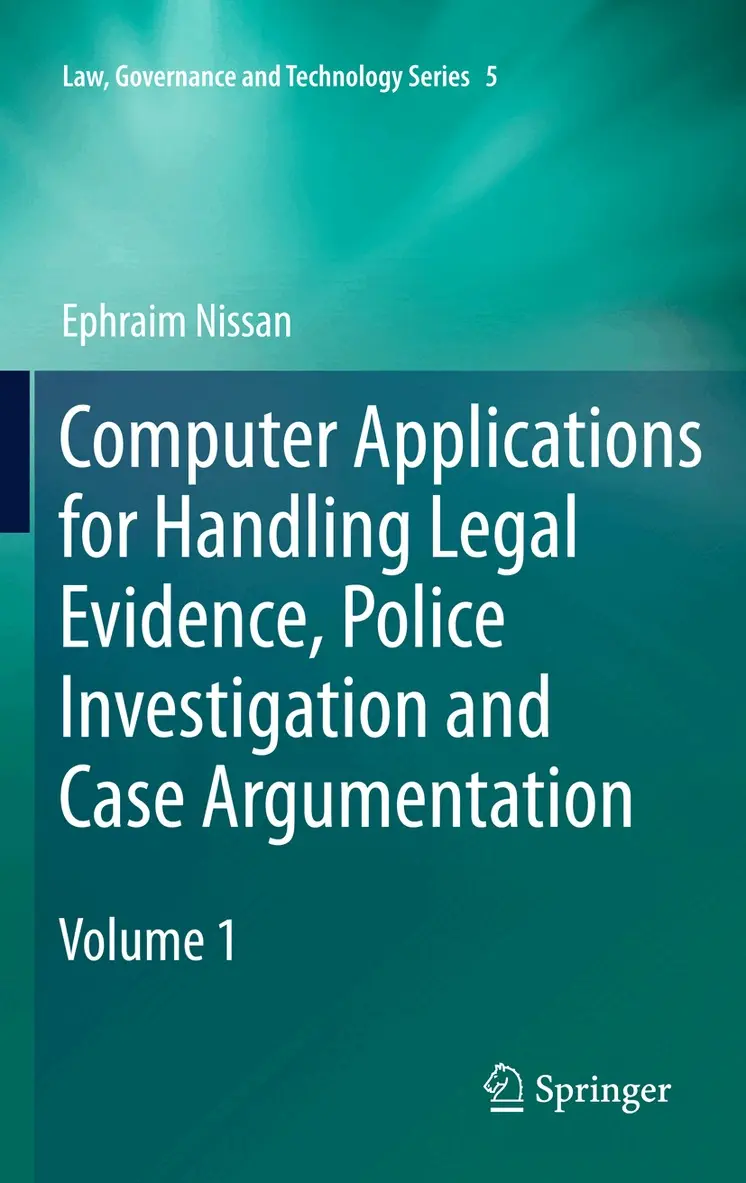
    Computer Applications for Handling Legal Evidence, Police Investigation and Case Argumentation

    AvEphraim Nissan

    Springer

    2016

    Del i serien Law, Governance and Technology Series

    2 553 kr

    Beställningsvara. Skickas inom 10-15 vardagar. Fri frakt över 249 kr.

    Fler format och utgåvor

    Övrigt

    2 553 kr

    E-bok

    2 833 kr

    Beskrivning

    This book provides an overview of computer techniques and tools — especially from artificial intelligence (AI) — for handling legal evidence, police intelligence, crime analysis or detection, and forensic testing, with a sustained discussion of methods for the modelling of reasoning and forming an opinion about the evidence, methods for the modelling of argumentation, and computational approaches to dealing with legal, or any, narratives. By the 2000s, the modelling of reasoning on legal evidence has emerged as a significant area within the well-established field of AI & Law. An overview such as this one has never been attempted before. It offers a panoramic view of topics, techniques and tools. It is more than a survey, as topic after topic, the reader can get a closer view of approaches and techniques. One aim is to introduce practitioners of AI to the modelling legal evidence. Another aim is to introduce legal professionals, as well as the more technically oriented among law enforcement professionals, or researchers in police science, to information technology resources from which their own respective field stands to benefit. Computer scientists must not blunder into design choices resulting in tools objectionable for legal professionals, so it is important to be aware of ongoing controversies. A survey is provided of argumentation tools or methods for reasoning about the evidence. Another class of tools considered here is intended to assist in organisational aspects of managing of the evidence. Moreover, tools appropriate for crime detection, intelligence, and investigation include tools based on link analysis and data mining. Concepts and techniques are introduced, along with case studies. So are areas in the forensic sciences. Special chapters are devoted to VIRTOPSY (a procedure for legal medicine) and FLINTS (a tool for the police). This is both an introductory book (possibly a textbook), and a reference for specialists fromvarious quarters.


    Produktinformation

    • Märke:Springer
    • Utgivningsdatum:2016-08-23
    • Höjd:155 x 235 x 77 mm
    • Vikt:2 131 g
    • Språk:Engelska
    • Serie:Law, Governance and Technology Series
    • Antal sidor:1 340
    • Förlag:Springer
    • EAN:9789402405187

    Utforska kategorier

    • Systemvetenskap och AI inom Data och IT
    • Artificiell intelligens inom Data och IT
    • Tillämpad datateknik inom Data och IT

    Mer om författaren

    Dr. Ephraim Nissan has a long record of research in artificial intelligence (AI), including on AI & Law. He has held research positions at various universities, and since 1994 he is based in London. He has over 320 publications, of which 115 are articles in journals. He also holds an honorary fellowship in the humanities at the University of Manchester. In the late 1980s, his ALIBI model was a seminal project in the area of this book. From 1996, by means of editorial projects, he has had a central role in bootstrapping into existence, as a unified field, the AI modelling of reasoning on legal evidence, and in moving this field into the mainstream of AI & Law scholarship. This effort’s culmination is this book. He has established three scholarly journals, and been a guest-editor about twenty times, of which the topic of six was within AI & Law.

    Recensioner i media

    From the reviews:“The two-volume book will be useful for police officials involved in investigations and information technology specialists responsible for developing applications for forensics and investigation of crime. The book is quite exhaustive and may be useful to students, researchers, police officials, and specialists from various disciplines. The author offers useful insights on the application of information technology to manage legal evidence. … I strongly recommend it as a valuable resource for its intended audience.” (S. V. Nagaraj, Computing Reviews, October, 2013)

    Innehållsförteckning

    • Abstract.- Preface (by John Zeleznikow).- Foreword.- Acknowledgement.- Dedication.- Call for Information.- 1.  A Preliminary Historical Perspective.- 2.  Models of Forming an Opinion.- 3.  Argumentation.- 4.  Computer Assistance for, or Insights into, Organisational Aspects.- 5.  The Narrative Dimension.- 6.  Accounting for Social, Spatial, and Textual Interconnections.- Link Analysis and Data Mining for Criminal Investigation.- 7.  FLINTS, a Tool for Police Investigation and Intelligence Analysis; Richard Leary.- 8.  The Forensic Disciplines: Some Areas of Actual or Potential Application.- 9.   Virtopsy: The Virtual Autopsy; Lars C. Ebert, Thomas Ruder, David Zimmermann, Stefan Zuber, Ursula Buck, Antoine Roggo, Michael Thali, Gary Hatch.- 10.  Concluding Remarks.- Glossary.- Cited  References.- index.