Rhetoric, Knowledge, and Society Series – serie
Visar alla böcker i serien Rhetoric, Knowledge, and Society Series. Handla med fri frakt och snabb leverans.
18 produkter
18 produkter
Häftad, Engelska, 2014
221 kr
Skickas inom 10-15 vardagar
This distinctive monograph examines the dynamic rhetorical processes by which scientists shape, negotiate, and position their work within an interdisciplinary community. Author Ann M. Blakeslee studies the everyday rhetorical practices of a group of condensed matter theoretical physicists, and presents here the first substantial qualitative study of the planning and implementation of discursive practices by a group of scientists. This volume also represents one of the first studies to use situated cognition and learning theory to study how knowledge of a domain's discursive practices is acquired by newcomers. Unlike previous studies of scientists' rhetorical practices, which have focused primarily on the finished or published texts, Blakeslee's involvement with the physicists as they engaged in the composing processes--from jotting down planning notes through publishing a scientific paper--suggests an alternative view of audience based on cooperative interaction between authors and their interlocutors. From this innovative perspective, functional knowledge of audiences comes only by entering into some community of practice, in which readers also become self-defining interlocutors and even participants in joint projects. Blakeslee's research follows the physicists' work into communal, interactive dynamics, looking at their overt attempts to get feedback from members of their audiences, what that feedback was, and how they responded to it. This work addresses and extends a model for audience analysis that consists of two primary operations: getting to know and understand one's interlocutors, and determining how to reach and influence them. In doing so, it offers important insights into the dissemination of scientific information, and thus will be of great interest to scholars and students in the areas of rhetoric of science and technology, composition, rhetorical theory, and scientific writing.
Inbunden, Engelska, 1996
1 380 kr
Skickas inom 10-15 vardagar
Comprised of a study spanning over five years, this text looks at four engineering co-op students as they write at work. Since the contributors have a foot in both worlds -- work and school -- the book should appeal to people who are interested in how students learn to write as well as people who are interested in what writing at work is like. Primarily concerned with whether engineers see their writing as rhetorical or persuasive, the study attempts to describe the students' changing understanding of what it is they do when they write. Two features of engineering practice that have particular impact on the extent to which engineers recognize persuasion are identified: * a reverence for data, and * the hierarchical structure of the organizations in which engineering is most commonly done. Both of these features discourage an open recognition of persuasion. Finally, the study shows that the four co-op students learned most of what they knew about writing at work by engaging in situated practice in the workplace, rather than by attending formal classes.
Häftad, Engelska, 1996
432 kr
Skickas inom 10-15 vardagar
Comprised of a study spanning over five years, this text looks at four engineering co-op students as they write at work. Since the contributors have a foot in both worlds -- work and school -- the book should appeal to people who are interested in how students learn to write as well as people who are interested in what writing at work is like. Primarily concerned with whether engineers see their writing as rhetorical or persuasive, the study attempts to describe the students' changing understanding of what it is they do when they write. Two features of engineering practice that have particular impact on the extent to which engineers recognize persuasion are identified: * a reverence for data, and * the hierarchical structure of the organizations in which engineering is most commonly done. Both of these features discourage an open recognition of persuasion. Finally, the study shows that the four co-op students learned most of what they knew about writing at work by engaging in situated practice in the workplace, rather than by attending formal classes.
Inbunden, Engelska, 1998
2 077 kr
Skickas inom 10-15 vardagar
In the first paragraphs of this volume, the author identifies an "authenticity paradox": that the purported real-worldedness of a learning environment, technique, or task is so rhetorically potent that educators frequently call attention to it in pedagogical conversations to legitimize their undertakings, while at the same time, terms such as "real-world" and "authentic" do not require (and even resist) precise delineation.Using the language of authenticity as a keyhole through which to view contemporary educational theory, Petraglia draws on theories of cognition, education, and knowledge to articulate the interdisciplinarity of "constructivism" and to expose the unsettling combination of constructivism's social scientific and epistemological commitments. He argues that a full-bodied embrace of constructivist theory requires that educators forgo "knowledge as we know it" and recommends a "rhetorical" approach to constructivist instruction that recognizes the cultural, social, and behavioral practices which play an enormous role in defining learners' "real worlds." Applying this critique to the field of educational technology, the author does not merely lament constructivist theory's current shortcomings, but offers a means by which these shortcomings can be engaged and, perhaps, overcome.
Häftad, Engelska, 1998
554 kr
Skickas inom 10-15 vardagar
In the first paragraphs of this volume, the author identifies an "authenticity paradox": that the purported real-worldedness of a learning environment, technique, or task is so rhetorically potent that educators frequently call attention to it in pedagogical conversations to legitimize their undertakings, while at the same time, terms such as "real-world" and "authentic" do not require (and even resist) precise delineation.Using the language of authenticity as a keyhole through which to view contemporary educational theory, Petraglia draws on theories of cognition, education, and knowledge to articulate the interdisciplinarity of "constructivism" and to expose the unsettling combination of constructivism's social scientific and epistemological commitments. He argues that a full-bodied embrace of constructivist theory requires that educators forgo "knowledge as we know it" and recommends a "rhetorical" approach to constructivist instruction that recognizes the cultural, social, and behavioral practices which play an enormous role in defining learners' "real worlds." Applying this critique to the field of educational technology, the author does not merely lament constructivist theory's current shortcomings, but offers a means by which these shortcomings can be engaged and, perhaps, overcome.
Häftad, Engelska, 1998
584 kr
Skickas inom 10-15 vardagar
Scientific Discourse in Sociohistorical Context represents the intersection of knowledge and method, examined from the perspective of three distinct disciplines: linguistics, rhetoric-composition, and history. Herein, Dwight Atkinson describes the written language and rhetoric of the Royal Society of London, based on his analysis of its affiliated journal, The Philosophical Transactions, starting with the 17th century advent of modern empirical science through to the present day. Atkinson adopts two independent approaches to the analysis of written discourse--from the fields of linguistics and rhetoric-composition--and then integrates and interprets his findings in light of the history of the Royal Society and British science. Atkinson's study provides the most complete and particular institutional account of a scientific journal, which in this case is a publication that stands as an icon of scientific publication. He supplies his readers with important material found nowhere else in the historical literature, including details about the operation of the journal and its relation to the society. The work embeds the history of the journal and its editors within the history of the Royal Society and other developments in science and society. The synthesis of historical, linguistic, rhetorical, and cultural analysis makes visible certain complex communicative dynamics that could not previously be seen from a single vantage point. The work presented here reinforces how deep historical examinations of linguistic and rhetorical practices have direct bearing on how and what scholars read and write now. Most significantly, this volume demonstrates how these historical activities need to inform current teaching of and thinking about language.
Inbunden, Engelska, 1997
2 137 kr
Skickas inom 10-15 vardagar
Knowledge is the basic output of the defense technology establishment in the United States; it is what enables the development of weapon systems. From this premise, this volume explores the process of knowledge production in defense technology from the beginnings of the Cold War to the present time. Produced through the process of research and development (R&D), technical knowledge for defense is an economic commodity. It is "fundable" in the sense of having future value. Like other commodities in the futures market, it is purchased before it is produced. But unlike those other commodities, this knowledge is typically produced through the joint efforts of the customer and the vendor. This study highlights two polar aspects of knowledge production: technology development and technology transfer. It centers on the present, shifting concept of defense conversion that is redefining defense technology policy. The book also includes cited documents pertaining to the transactions that engage customers and vendors in the process of knowledge production. The documents constitute a literature of needs and claims, and they reveal two chief properties: problem formulation and tactical positioning. Apart from the substantive yield of these particular documents, the strategy of evidence in this volume has broad implications for further study, suggesting a means of analyzing knowledge production in other large social systems.
Häftad, Engelska, 1997
584 kr
Skickas inom 10-15 vardagar
Knowledge is the basic output of the defense technology establishment in the United States; it is what enables the development of weapon systems. From this premise, this volume explores the process of knowledge production in defense technology from the beginnings of the Cold War to the present time. Produced through the process of research and development (R&D), technical knowledge for defense is an economic commodity. It is "fundable" in the sense of having future value. Like other commodities in the futures market, it is purchased before it is produced. But unlike those other commodities, this knowledge is typically produced through the joint efforts of the customer and the vendor. This study highlights two polar aspects of knowledge production: technology development and technology transfer. It centers on the present, shifting concept of defense conversion that is redefining defense technology policy. The book also includes cited documents pertaining to the transactions that engage customers and vendors in the process of knowledge production. The documents constitute a literature of needs and claims, and they reveal two chief properties: problem formulation and tactical positioning. Apart from the substantive yield of these particular documents, the strategy of evidence in this volume has broad implications for further study, suggesting a means of analyzing knowledge production in other large social systems.
Inbunden, Engelska, 1999
2 201 kr
Skickas inom 10-15 vardagar
Worlds Apart: Acting and Writing in Academic and Workplace Contexts offers a unique examination of writing as it is applied and used in academic and workplace settings. Based on a 7-year multi-site comparative study of writing in different university courses and matched workplaces, this volume presents new perspectives on how writing functions within the activities of various disciplines: law and public administration courses and government institutions; management courses and financial institutions; social-work courses and social-work agencies; and architecture courses and architecture practice. Using detailed ethnography, the authors make comparisons between the two types of settings through an understanding of how writing is operative within the particularities of these settings. Although the research was initially established to further understanding of the relationships between writing in academic and workplace settings, it has evolved to examining writing as it is embedded in both types of settings--where social relationships, available tools, and historical, cultural, temporal, and physical location are all implicated in complex ways in the decisions people make as writers. Readers of this volume will discover that the uniqueness of each setting makes salient different aspects of writers and writing, resulting in complex, and potentially unsettling implications for writing theory and the teaching of writing.
Häftad, Engelska, 1999
800 kr
Skickas inom 10-15 vardagar
Worlds Apart: Acting and Writing in Academic and Workplace Contexts offers a unique examination of writing as it is applied and used in academic and workplace settings. Based on a 7-year multi-site comparative study of writing in different university courses and matched workplaces, this volume presents new perspectives on how writing functions within the activities of various disciplines: law and public administration courses and government institutions; management courses and financial institutions; social-work courses and social-work agencies; and architecture courses and architecture practice. Using detailed ethnography, the authors make comparisons between the two types of settings through an understanding of how writing is operative within the particularities of these settings. Although the research was initially established to further understanding of the relationships between writing in academic and workplace settings, it has evolved to examining writing as it is embedded in both types of settings--where social relationships, available tools, and historical, cultural, temporal, and physical location are all implicated in complex ways in the decisions people make as writers. Readers of this volume will discover that the uniqueness of each setting makes salient different aspects of writers and writing, resulting in complex, and potentially unsettling implications for writing theory and the teaching of writing.
Inbunden, Engelska, 1998
2 137 kr
Skickas inom 10-15 vardagar
Over the past century, the explosive growth of scientific, technical, and cultural disciplines has profoundly affected our daily lives. However, processes of enculturation in sites such as graduate education that have helped to form these disciplines have received very limited research attention. In those sites, graduate students write diverse documents, including course papers, departmental examinations, theses and dissertations, grant and fellowship applications, and disciplinary publications. Thus, writing is one of the central domains of enculturation--an activity through which graduate students and professors display and negotiate disciplinary knowledge, genres, identities, and institutional contexts. This volume explores this intersection of writing and disciplinary enculturation through a series of ethnographic case studies. These case studies provide the most thorough descriptions available today of the lived experience of graduate seminars, combining analysis of classroom talk, students' texts and professor's written responses, institutional contexts, students' representations of their writing and its contexts, and professors' representations of their tasks and their students. Given the complexities that the ethnographic data displayed, the author found that conventional notions of writing as a process of transcription and of disciplines as unified discourse communities were inadequate. As such, this book also offers an in-depth exploration of sociohistoric theory in relation to writing and disciplinary enculturation. Specific case studies introduce, apply, and further elaborate notions of: * writing as literate activity, * authorship as mediated by other people and artifacts, * classroom tasks as speech genres, * enculturation as the interplay of authoritative and internally persuasive discourses, and * disciplinarity as a deeply heterogeneous, laminated, and dialogic process.This blend of research and theory should be of interest to scholars and students in such fields as writing studies, rhetoric, writing across the curriculum, applied linguistics, English for academic purposes, science and technology studies, higher education, and the ethnography of communication.
Inbunden, Engelska, 2000
2 137 kr
Skickas inom 10-15 vardagar
This distinctive monograph examines the dynamic rhetorical processes by which scientists shape, negotiate, and position their work within an interdisciplinary community. Author Ann M. Blakeslee studies the everyday rhetorical practices of a group of condensed matter theoretical physicists, and presents here the first substantial qualitative study of the planning and implementation of discursive practices by a group of scientists. This volume also represents one of the first studies to use situated cognition and learning theory to study how knowledge of a domain's discursive practices is acquired by newcomers. Unlike previous studies of scientists' rhetorical practices, which have focused primarily on the finished or published texts, Blakeslee's involvement with the physicists as they engaged in the composing processes--from jotting down planning notes through publishing a scientific paper--suggests an alternative view of audience based on cooperative interaction between authors and their interlocutors. From this innovative perspective, functional knowledge of audiences comes only by entering into some community of practice, in which readers also become self-defining interlocutors and even participants in joint projects. Blakeslee's research follows the physicists' work into communal, interactive dynamics, looking at their overt attempts to get feedback from members of their audiences, what that feedback was, and how they responded to it. This work addresses and extends a model for audience analysis that consists of two primary operations: getting to know and understand one's interlocutors, and determining how to reach and influence them. In doing so, it offers important insights into the dissemination of scientific information, and thus will be of great interest to scholars and students in the areas of rhetoric of science and technology, composition, rhetorical theory, and scientific writing.
Inbunden, Engelska, 2002
2 137 kr
Skickas inom 10-15 vardagar
An African Athens offers an analysis of a new ecology of rhetoric--the reshaping of a nation into a democracy through rhetorical means. Author Philippe-Joseph Salazar provides a general view of issues as they have taken shape in the apartheid and post-apartheid South African experience, presenting the country as a remarkable stage for playing out the great themes of public deliberation and the rise of postmodern rhetorical democracy. Salazar's intimate vantage point focuses on the striking case of a democracy won at the negotiating table and also won every day in public deliberation. This volume presents a full-scale rhetorical analysis of a democratic transformation in post-Cold War era, and provides a study of the demise of apartheid and post-apartheid from the standpoint of political and public rhetoric and communication. In doing so, it serves as a template for similar enquiries in the rhetorical study of emerging democracies. Intended for readers engaged in the study of political and public rhetoric with an interest in how democracy takes shape, An African Athens highlights South Africa as a test case for global democracy, for rhetoric, and for the relevance of rhetoric studies in a postmodern democracy.
Inbunden, Engelska, 2002
2 137 kr
Skickas inom 10-15 vardagar
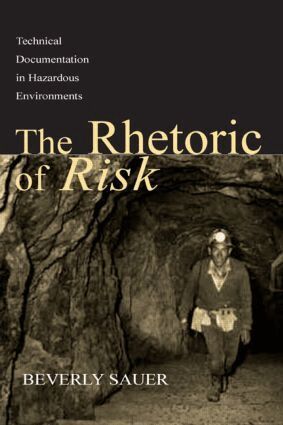
The crash of an Amtrak train near Baltimore, the collapse of the Hyatt hotel in Kansas City, the incident at Three Mile Island, and other large-scale technological disasters have provided powerful examples of the ways that communication practices influence the events and decisions that precipitate a disaster. These examples have raised ethical questions about the responsibility of writers within agencies, epistemological questions about the nature of representation in science, and rhetorical questions about the nature of expertise and experience as grounds for judgments about risk. In The Rhetoric of Risk: Technical Documentation in Hazardous Environments, author Beverly Sauer examines how the dynamic uncertainty of the material environment affects communication in large regulatory industries. Sauer's analysis focuses specifically on mine safety, which provides a rich technical and historical context where problems of rhetorical agency, narrative, and the negotiation of meaning have visible and tragic outcomes. But the questions Sauer asks have larger implication for risk and safety: How does writing function in large regulatory industries? What can we learn from experience? Why is this experience so difficult to capture in writing? What information is lost when agencies rely on written documentation alone? Given the uncertainties, how can we work to improve communication in hazardous and uncertain environments? By exploring how individuals make sense of the material, technical, and institutional indeterminancies of their work in speech and gesture, The Rhetoric of Risk helps communicators rethink their frequently unquestioned assumptions about workplace discourse and the role of writers in hazardous worksites. It is intended for scholars and students in technical writing and communication, rhetoric, risk analysis and risk communication, as well as a wide range of engineering and technical fields concerned with risk, safety, and uncertainty.
Häftad, Engelska, 2002
735 kr
Skickas inom 10-15 vardagar
The crash of an Amtrak train near Baltimore, the collapse of the Hyatt hotel in Kansas City, the incident at Three Mile Island, and other large-scale technological disasters have provided powerful examples of the ways that communication practices influence the events and decisions that precipitate a disaster. These examples have raised ethical questions about the responsibility of writers within agencies, epistemological questions about the nature of representation in science, and rhetorical questions about the nature of expertise and experience as grounds for judgments about risk. In The Rhetoric of Risk: Technical Documentation in Hazardous Environments, author Beverly Sauer examines how the dynamic uncertainty of the material environment affects communication in large regulatory industries. Sauer's analysis focuses specifically on mine safety, which provides a rich technical and historical context where problems of rhetorical agency, narrative, and the negotiation of meaning have visible and tragic outcomes. But the questions Sauer asks have larger implication for risk and safety: How does writing function in large regulatory industries? What can we learn from experience? Why is this experience so difficult to capture in writing? What information is lost when agencies rely on written documentation alone? Given the uncertainties, how can we work to improve communication in hazardous and uncertain environments? By exploring how individuals make sense of the material, technical, and institutional indeterminancies of their work in speech and gesture, The Rhetoric of Risk helps communicators rethink their frequently unquestioned assumptions about workplace discourse and the role of writers in hazardous worksites. It is intended for scholars and students in technical writing and communication, rhetoric, risk analysis and risk communication, as well as a wide range of engineering and technical fields concerned with risk, safety, and uncertainty.
Häftad, Engelska, 1998
782 kr
Skickas inom 10-15 vardagar
Over the past century, the explosive growth of scientific, technical, and cultural disciplines has profoundly affected our daily lives. However, processes of enculturation in sites such as graduate education that have helped to form these disciplines have received very limited research attention. In those sites, graduate students write diverse documents, including course papers, departmental examinations, theses and dissertations, grant and fellowship applications, and disciplinary publications. Thus, writing is one of the central domains of enculturation--an activity through which graduate students and professors display and negotiate disciplinary knowledge, genres, identities, and institutional contexts. This volume explores this intersection of writing and disciplinary enculturation through a series of ethnographic case studies. These case studies provide the most thorough descriptions available today of the lived experience of graduate seminars, combining analysis of classroom talk, students' texts and professor's written responses, institutional contexts, students' representations of their writing and its contexts, and professors' representations of their tasks and their students. Given the complexities that the ethnographic data displayed, the author found that conventional notions of writing as a process of transcription and of disciplines as unified discourse communities were inadequate. As such, this book also offers an in-depth exploration of sociohistoric theory in relation to writing and disciplinary enculturation. Specific case studies introduce, apply, and further elaborate notions of: * writing as literate activity, * authorship as mediated by other people and artifacts, * classroom tasks as speech genres, * enculturation as the interplay of authoritative and internally persuasive discourses, and * disciplinarity as a deeply heterogeneous, laminated, and dialogic process.This blend of research and theory should be of interest to scholars and students in such fields as writing studies, rhetoric, writing across the curriculum, applied linguistics, English for academic purposes, science and technology studies, higher education, and the ethnography of communication.
Häftad, Engelska, 2014
657 kr
Skickas inom 10-15 vardagar
An African Athens offers an analysis of a new ecology of rhetoric--the reshaping of a nation into a democracy through rhetorical means. Author Philippe-Joseph Salazar provides a general view of issues as they have taken shape in the apartheid and post-apartheid South African experience, presenting the country as a remarkable stage for playing out the great themes of public deliberation and the rise of postmodern rhetorical democracy. Salazar's intimate vantage point focuses on the striking case of a democracy won at the negotiating table and also won every day in public deliberation. This volume presents a full-scale rhetorical analysis of a democratic transformation in post-Cold War era, and provides a study of the demise of apartheid and post-apartheid from the standpoint of political and public rhetoric and communication. In doing so, it serves as a template for similar enquiries in the rhetorical study of emerging democracies. Intended for readers engaged in the study of political and public rhetoric with an interest in how democracy takes shape, An African Athens highlights South Africa as a test case for global democracy, for rhetoric, and for the relevance of rhetoric studies in a postmodern democracy.
Inbunden, Engelska, 1998
769 kr
Tillfälligt slut
Scientific Discourse in Sociohistorical Context represents the intersection of knowledge and method, examined from the perspective of three distinct disciplines: linguistics, rhetoric-composition, and history. Herein, Dwight Atkinson describes the written language and rhetoric of the Royal Society of London, based on his analysis of its affiliated journal, The Philosophical Transactions, starting with the 17th century advent of modern empirical science through to the present day. Atkinson adopts two independent approaches to the analysis of written discourse--from the fields of linguistics and rhetoric-composition--and then integrates and interprets his findings in light of the history of the Royal Society and British science. Atkinson's study provides the most complete and particular institutional account of a scientific journal, which in this case is a publication that stands as an icon of scientific publication. He supplies his readers with important material found nowhere else in the historical literature, including details about the operation of the journal and its relation to the society. The work embeds the history of the journal and its editors within the history of the Royal Society and other developments in science and society. The synthesis of historical, linguistic, rhetorical, and cultural analysis makes visible certain complex communicative dynamics that could not previously be seen from a single vantage point. The work presented here reinforces how deep historical examinations of linguistic and rhetorical practices have direct bearing on how and what scholars read and write now. Most significantly, this volume demonstrates how these historical activities need to inform current teaching of and thinking about language.