Cambridge Series on Human-Computer Interaction - Böcker
Visar alla böcker i serien Cambridge Series on Human-Computer Interaction. Handla med fri frakt och snabb leverans.
9 produkter
9 produkter
523 kr
Skickas inom 7-10 vardagar
For people with various forms of physical disability, extreme slowness of communication is commonplace. In the first part of this 1992 book a functional architecture for communication aids is discussed and the idea of automatically supplying the intrinsic redundancy contained in natural communication is explained. The distinctions between adaptive and non-adaptive models of communication are shown and details are given of working predictive text generation systems. One such system is the Reactive Keyboard, and in the second part of the book this is described. It greatly speeds communication by predicting the user's next response, although it does not always predict correctly. The guesses are made on the basis of previous answers and thus can conform to whatever kind of text is entered. This will be of great value to all involved in helping disabled users interact with computers.
Del 1 - Cambridge Series on Human-Computer Interaction
Cognitive Ergonomics and Human-Computer Interaction
Häftad, Engelska, 2011
507 kr
Skickas inom 7-10 vardagar
Originally published in 1989, this book is a distinctive work in the field of human-computer interaction (HCI). Cognitive ergonomics and HCI encompass a wide range of research and development activities in both academic and industrial environments, and this book satisfies a clear need for the dissemination of the knowledge generated by work in progress or completed. The book provides detailed reports of a number of long-term research projects, set within a framework for describing cognitive ergonomics activities and understanding their relationships. It reports in detail on substantial empirical investigations rather than being a summary of specific areas or theoretical speculations. The different contributions are integrated, and have been rigorously edited, within a framework provided by the editors and presented in the first chapter.
Del 3 - Cambridge Series on Human-Computer Interaction
A Theory of Computer Semiotics
Semiotic Approaches to Construction and Assessment of Computer Systems
Inbunden, Engelska, 1991
1 838 kr
Skickas inom 7-10 vardagar
Semiotics is the science of signs: graphical, such as pictures; verbal (writing or sounds); or others such as body gestures and clothes. Computer semiotics studies the special nature of computer-based signs and how they function in use. This 1991 book is based on ten years of empirical research on computer usage in work situations and contains material from a course taught by the author. It introduces basic traditional semiotic concepts and adapts them so that they become useful for analysing and designing computer systems in their symbolic context of work. It presents a novel approach to the subject, rich in examples, in that it is both theoretically systematic and practical. The author refers to and reinterprets techniques already used so that readers can deepen their understanding. In addition, it offers new techniques and a consistent perspective on computer systems that is particularly appropriate for new hardware and software (e.g. hypermedia) whose main functions are presentation and communication. This is a highly important work whose influence will be wide and longlasting.
916 kr
Skickas inom 7-10 vardagar
For people with various forms of physical disability, extreme slowness of communication is commonplace. In the first part of this 1992 book a functional architecture for communication aids is discussed and the idea of automatically supplying the intrinsic redundancy contained in natural communication is explained. The distinctions between adaptive and non-adaptive models of communication are shown and details are given of working predictive text generation systems. One such system is the Reactive Keyboard, and in the second part of the book this is described. It greatly speeds communication by predicting the user's next response, although it does not always predict correctly. The guesses are made on the basis of previous answers and thus can conform to whatever kind of text is entered. This will be of great value to all involved in helping disabled users interact with computers.
Del 6 - Cambridge Series on Human-Computer Interaction
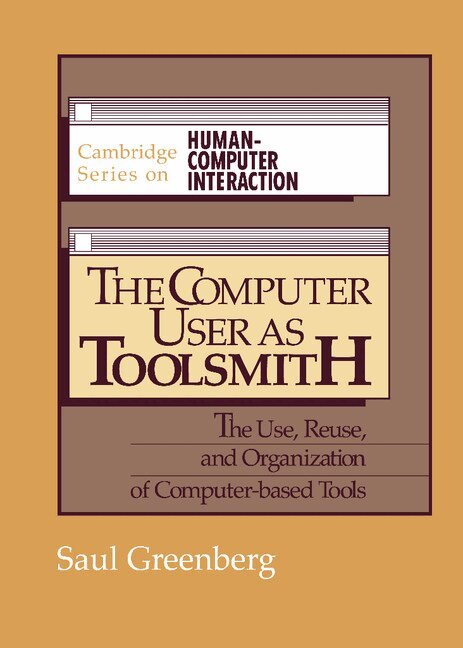
The Computer User as Toolsmith
The Use, Reuse and Organization of Computer-Based Tools
Inbunden, Engelska, 1993
1 038 kr
Skickas inom 7-10 vardagar
Computing environments that furnish a large set of tools (such as editors, mail programs and language processors) are difficult to use, primarily because there is no means of organizing the tools so that they are at hand when needed. Because of the dearth of knowledge of how users behave when issuing commands to general purpose computer systems, user support facilities are ad-hoc designs that do not support natural work habits. The Computer User as Toolsmith, first published in 1993, describes several empirical studies from which the author has developed a computer version of a handyman's workbench that would help users with their online activities. For the practitioner and interface designer, the guidelines and principles offered here are directly applicable to the rational design of new systems and the modernization of old ones. For the researcher and graduate student, the book offers a wealth of analysis and interpretation of data, as well as a survey of research techniques.
Del 4 - Cambridge Series on Human-Computer Interaction
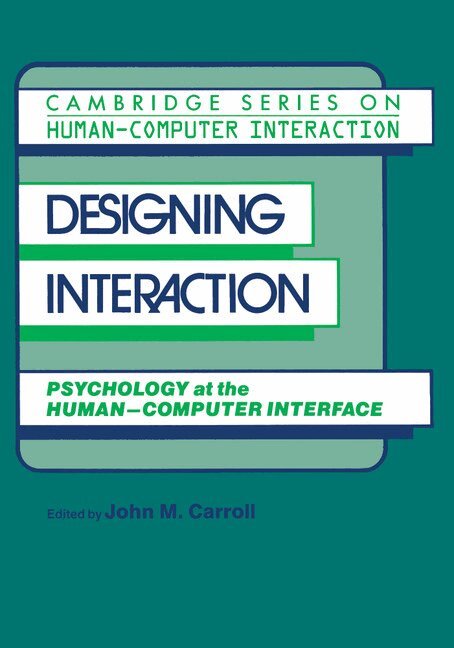
Designing Interaction
Psychology at the Human-Computer Interface
Häftad, Engelska, 1991
645 kr
Skickas inom 7-10 vardagar
Designing Interaction, first published in 1991, presents a broadbased and fundamental re-examination of human-computer interaction as a practical and scientific endeavor. The chapters in this well-integrated, tightly focused book are by psychologists and computer scientists in industry and academia, who examine the relationship between contemporary psychology and human-computer interaction. HCI seeks to produce user interfaces that facilitate and enrich human motivation, action and experience; but to do so deliberately it must also incorporate means of understanding user interfaces in human terms - the province of psychology. Conversely, the design and use of computing equipment provides psychologists with a diverse and challenging empirical field in which to assess their theories and methodologies.
Del 2 - Cambridge Series on Human-Computer Interaction
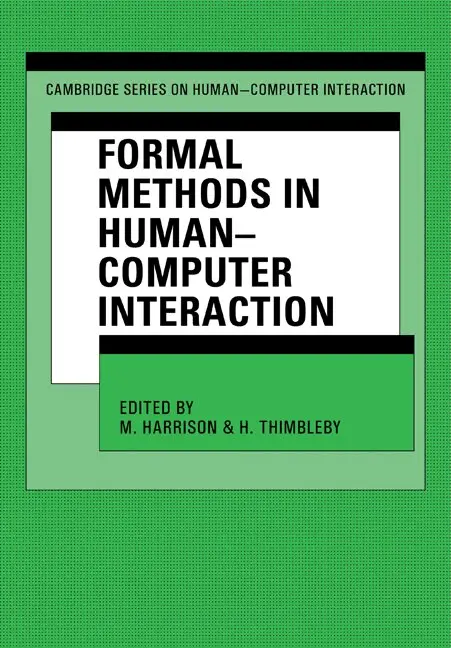
Formal Methods in Human-Computer Interaction
Häftad, Engelska, 2009
618 kr
Skickas inom 7-10 vardagar
First published in 1990, this book discusses the application of formal methods to the human-computer interface. Formal methods - the attempt to provide methods that rigourously and unambiguously describe the behaviour of a computer program or system - is receiving a great deal of attention in human-computer interaction (HCI). Topics such as the specification of a system, the construction of a system from its specification and the abstraction of a specification from an existing system, are clearly of great theoretical and practical interest. The contributors to the work are well-known in the field of HCI and their articles cover much of the work in the area. The book is a series of papers specially commissioned by the editors for the book; it is thus a coherent and important contribution to the area.
Del 3 - Cambridge Series on Human-Computer Interaction
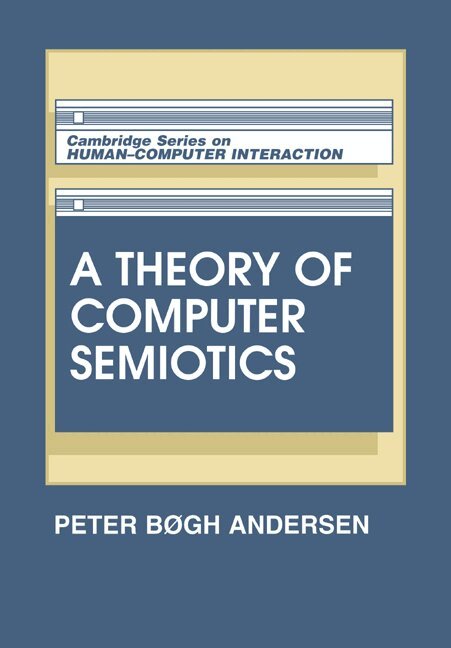
A Theory of Computer Semiotics
Semiotic Approaches to Construction and Assessment of Computer Systems
Häftad, Engelska, 1997
672 kr
Skickas inom 7-10 vardagar
Semiotics is the science of signs: graphical, such as pictures; verbal (writing or sounds); or others such as body gestures and clothes. Computer semiotics studies the special nature of computer-based signs and how they function in use. This 1991 book is based on ten years of empirical research on computer usage in work situations and contains material from a course taught by the author. It introduces basic traditional semiotic concepts and adapts them so that they become useful for analysing and designing computer systems in their symbolic context of work. It presents a novel approach to the subject, rich in examples, in that it is both theoretically systematic and practical. The author refers to and reinterprets techniques already used so that readers can deepen their understanding. In addition, it offers new techniques and a consistent perspective on computer systems that is particularly appropriate for new hardware and software (e.g. hypermedia) whose main functions are presentation and communication. This is a highly important work whose influence will be wide and longlasting.
Del 9 - Cambridge Series on Human-Computer Interaction
Information Seeking in Electronic Environments
Häftad, Engelska, 1997
591 kr
Skickas inom 7-10 vardagar
Significant amounts of our time and energy are devoted to creating, managing, and avoiding information. Computers and telecommunications technology have extended our regard for information and are driving changes in how we learn, work, and play. One result of these developments is that skills and strategies for storing and retrieving information have become more essential and more pervasive in our culture. This book considers how electronic technologies have changed these skills and strategies and augmented the fundamental human activity of information seeking. The author makes a case for creating new interface designs that allow the information seeker to choose what strategy to apply according to their immediate needs. Such systems may be designed by providing information seekers with alternative interface mechanisms for displaying and manipulating multiple levels of representation for information objects. Information Seeking in Electronic Environments is essential reading for researchers and graduate students in information science, human-computer interaction, and education, as well as for designers of information retrieval systems and interfaces for digital libraries and archives.