Elements in Early Christian Literature – serie
Visar alla böcker i serien Elements in Early Christian Literature. Handla med fri frakt och snabb leverans.
24 produkter
24 produkter
Inbunden, Engelska, 2025
853 kr
Skickas inom 7-10 vardagar
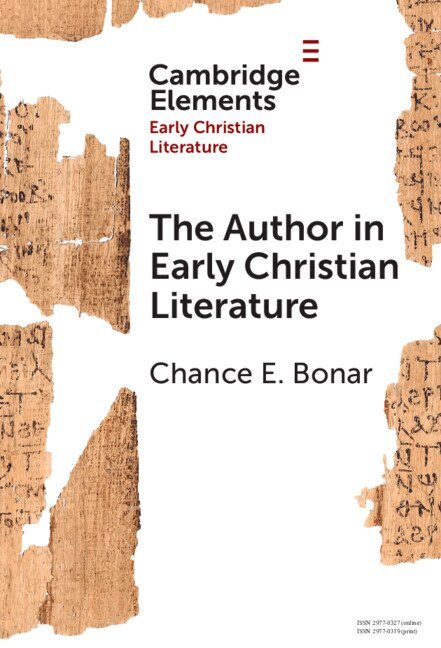
While scholars of ancient Mediterranean literature have focused their efforts heavily on explaining why authors would write pseudonymously or anonymously, less time has been spent exploring why an author would write orthonymously (that is, under their own name). This Element explores how early Christian writers began to care deeply about 'correct' attribution of both Christian and non-Christian literature for their own apologetic purposes, as well as how scholars have overlooked the function that orthonymity plays in some early Christian texts. Orthonymity was not only a decision made by a writer regarding how to attribute one's own writings, but also how to classify other writers' texts based on proper or improper attribution. This Element urges us to examine forms of authorship that are often treated as an unexamined default, as well as to more robustly consider when, how, for whom, and for what purposes an instance of authorial attribution is deemed 'correct.
Häftad, Engelska, 2025
265 kr
Skickas inom 7-10 vardagar
While scholars of ancient Mediterranean literature have focused their efforts heavily on explaining why authors would write pseudonymously or anonymously, less time has been spent exploring why an author would write orthonymously (that is, under their own name). This Element explores how early Christian writers began to care deeply about 'correct' attribution of both Christian and non-Christian literature for their own apologetic purposes, as well as how scholars have overlooked the function that orthonymity plays in some early Christian texts. Orthonymity was not only a decision made by a writer regarding how to attribute one's own writings, but also how to classify other writers' texts based on proper or improper attribution. This Element urges us to examine forms of authorship that are often treated as an unexamined default, as well as to more robustly consider when, how, for whom, and for what purposes an instance of authorial attribution is deemed 'correct.
Inbunden, Engelska, 2026
742 kr
Kommande
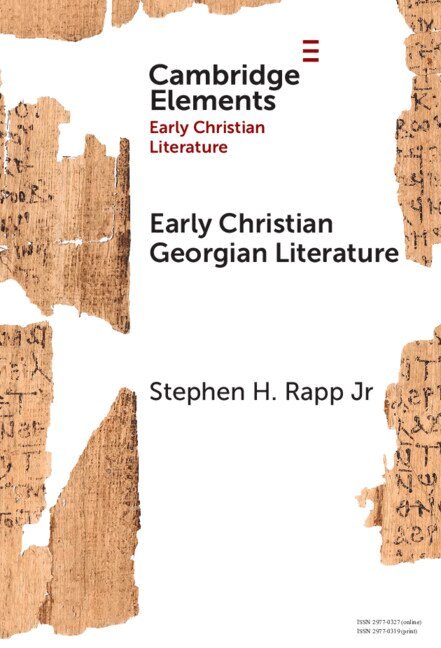
This Element re-evaluates the genesis and early development of Georgian literature. Sparked by the Christian invention of a Georgian script ca. 400 AD, this literature was a product of the Christianization of the Caucasus region. But to what extent was early Georgian literature a Christian one? What were the ecclesiastical, cultural, and linguistic contexts of Georgian literature? And how did Georgia's, and Caucasia's, existing ties to Iranian cultural world affect the evolution of a distinctly Georgian literature?
Häftad, Engelska, 2026
230 kr
Kommande
This Element re-evaluates the genesis and early development of Georgian literature. Sparked by the Christian invention of a Georgian script ca. 400 AD, this literature was a product of the Christianization of the Caucasus region. But to what extent was early Georgian literature a Christian one? What were the ecclesiastical, cultural, and linguistic contexts of Georgian literature? And how did Georgia's, and Caucasia's, existing ties to Iranian cultural world affect the evolution of a distinctly Georgian literature?
Inbunden, Engelska, 2026
742 kr
Kommande
Ancient apologetics is usually treated as a literary genre or a branch of early theology. This Element offers a different account. It argues that many Jewish and Christian texts conventionally labeled 'apologetic' are better understood through a bibliographic and archival lens: They produce authority not only by defending doctrines, but by organizing books, constructing corpora, mobilizing archives, and regulating interpretation. Tracing a trajectory from the Letter of Aristeas to Jerome's De viris illustribus, this Element shows how citation, collection, cataloguing, and textual ordering made traditions appear authoritative. Examining Aristeas, Josephus, Tatian, Justin, Origen, Pamphilus, Eusebius, and Jerome, it argues that apologetics is best understood as a form of curatorial power through which ancient communities learned to think with books. This title is also available as open access on Cambridge Core.
Häftad, Engelska, 2026
230 kr
Kommande
Ancient apologetics is usually treated as a literary genre or a branch of early theology. This Element offers a different account. It argues that many Jewish and Christian texts conventionally labeled 'apologetic' are better understood through a bibliographic and archival lens: They produce authority not only by defending doctrines, but by organizing books, constructing corpora, mobilizing archives, and regulating interpretation. Tracing a trajectory from the Letter of Aristeas to Jerome's De viris illustribus, this Element shows how citation, collection, cataloguing, and textual ordering made traditions appear authoritative. Examining Aristeas, Josephus, Tatian, Justin, Origen, Pamphilus, Eusebius, and Jerome, it argues that apologetics is best understood as a form of curatorial power through which ancient communities learned to think with books. This title is also available as open access on Cambridge Core.
Häftad, Engelska, 2026
267 kr
Skickas inom 7-10 vardagar
This Element explores Tertullian, the first author to write Christian theology in Latin. It focuses on the primary critical issues relevant to understanding his biography and work, with special attention to his presentation of the Jews in the wider context of early Christian literature. This topic offers the opportunity to assess how socio-historical circumstances have influenced the way that scholars, throughout the centuries, have read and understood the image of the Jews in patristic texts, thereby calling attention to the issue of objectivity in academic research. Finally, examples of the diverse treatment of the figure of the Jews in Tertullian's texts are provided to analyse the range of his perspectives, understand where he stands in relation to other Christian authors, and examine how his work reflects the state of Christian identity formation in his time.
Inbunden, Engelska, 2026
853 kr
Skickas inom 7-10 vardagar
This Element explores Tertullian, the first author to write Christian theology in Latin. It focuses on the primary critical issues relevant to understanding his biography and work, with special attention to his presentation of the Jews in the wider context of early Christian literature. This topic offers the opportunity to assess how socio-historical circumstances have influenced the way that scholars, throughout the centuries, have read and understood the image of the Jews in patristic texts, thereby calling attention to the issue of objectivity in academic research. Finally, examples of the diverse treatment of the figure of the Jews in Tertullian's texts are provided to analyse the range of his perspectives, understand where he stands in relation to other Christian authors, and examine how his work reflects the state of Christian identity formation in his time.
Inbunden, Engelska, 2026
742 kr
Skickas inom 7-10 vardagar
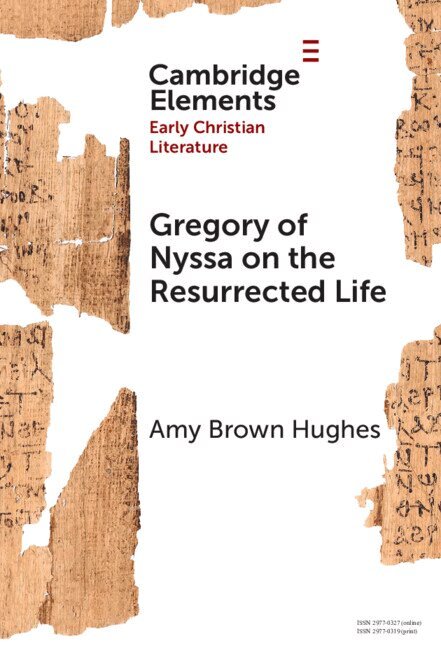
This Element is composed of three sections that explore Gregory of Nyssa's understanding of the resurrected life. First, according to Gregory, Christ establishes the ascent as the way of virtue and all who desire virtue will be sustained and sated by an infinite God. Second, Gregory assumes that the resurrected life affects us now, and not just our souls but our bodies, our relationships, and our neighbors. Finally, the resurrected life includes companions and teachers, such as his sister Macrina, and those who offer us their lives as instruction, model, and guide like Moses or Paul. This Element engages across multiple works to demonstrate that, for Gregory, Christ's resurrected body affects the bodies of all humans who choose to be on the ascent to God. For Gregory, everything was at stake. As a person lives into the resurrection, they become newly connected and beholden to their neighbors, near and far.
Häftad, Engelska, 2026
230 kr
Skickas inom 7-10 vardagar
This Element is composed of three sections that explore Gregory of Nyssa's understanding of the resurrected life. First, according to Gregory, Christ establishes the ascent as the way of virtue and all who desire virtue will be sustained and sated by an infinite God. Second, Gregory assumes that the resurrected life affects us now, and not just our souls but our bodies, our relationships, and our neighbors. Finally, the resurrected life includes companions and teachers, such as his sister Macrina, and those who offer us their lives as instruction, model, and guide like Moses or Paul. This Element engages across multiple works to demonstrate that, for Gregory, Christ's resurrected body affects the bodies of all humans who choose to be on the ascent to God. For Gregory, everything was at stake. As a person lives into the resurrection, they become newly connected and beholden to their neighbors, near and far.
Inbunden, Engelska, 2025
742 kr
Skickas inom 7-10 vardagar
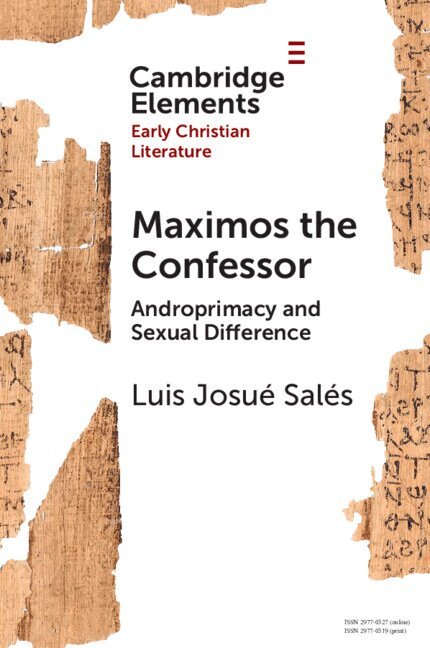
Maximos affirms in various texts (such as Difficulty 41) that sexual differentiation into male and female is inconsistent with the divine intention and will therefore be eschatologically eradicated. His affirmations have elicited a half-dozen conflicting interpretations, such as the metaphorization of these statements, where 'male' refers to drive (thymos) and 'female' to desire (epithymia), which become subordinate to reason (logos). Others maintain that he refers to the resolution of male-female agonistics. Yet others have criticized accounts that mollify the starkness of Maximos' affirmations. This Element goes further in arguing that Maximos tacitly envisions the elimination of sexual difference as sublimation of all sexual difference into male singularity. This Element overviews the exegetical and medical-anthropological precedents that framed Maximos thinking on this subject and examines some of his key texts, including his famed Difficulty 41 and several passages centered on explicating Eve and Adam, and Mary and Christ.
Häftad, Engelska, 2025
230 kr
Skickas inom 7-10 vardagar
Maximos affirms in various texts (such as Difficulty 41) that sexual differentiation into male and female is inconsistent with the divine intention and will therefore be eschatologically eradicated. His affirmations have elicited a half-dozen conflicting interpretations, such as the metaphorization of these statements, where 'male' refers to drive (thymos) and 'female' to desire (epithymia), which become subordinate to reason (logos). Others maintain that he refers to the resolution of male-female agonistics. Yet others have criticized accounts that mollify the starkness of Maximos' affirmations. This Element goes further in arguing that Maximos tacitly envisions the elimination of sexual difference as sublimation of all sexual difference into male singularity. This Element overviews the exegetical and medical-anthropological precedents that framed Maximos thinking on this subject and examines some of his key texts, including his famed Difficulty 41 and several passages centered on explicating Eve and Adam, and Mary and Christ.
Häftad, Engelska, 2025
265 kr
Skickas inom 7-10 vardagar
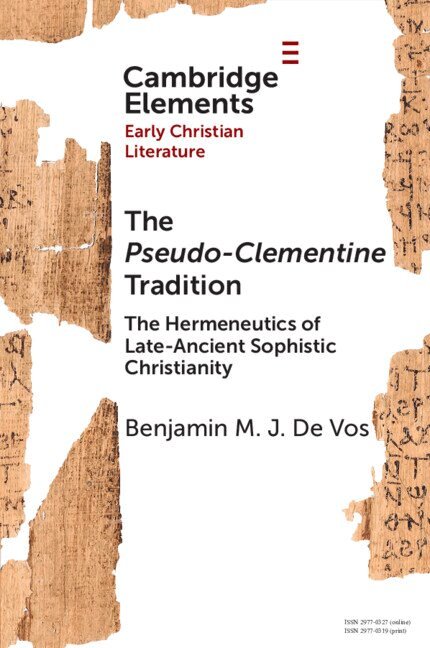
This Element, through detailed example, scrutinizes the exact nature of Christian storytelling in the case of the Greek Pseudo-Clementines, or Klementia, and examines what exactly is involved in the correct interpretation of this Christian prose fiction as a redefined pepaideumenos. In the act of such reconsideration of paideia, Greek cultural capital, and the accompanying reflections on prose literature and fiction, it becomes clear that the Klementinist exploits certain cases of intertextual and meta-literary reflections on the Greek novelistic fiction, such as Chariton's Chaereas and Callirhoe and Achilles Tatius' Leucippe and Cleitophon, in order to evoke these reconsiderations of storytelling, interpretive hermeneutics, and one's role as a culturally Greek reader pepaideumenos. This Element argues that the Klementia bears witness to a rich, dynamic, and Sophistic context in which reflections on paideia, dynamics regarding Greek identity, and literary production were neatly intertwined with reflections on reading and interpreting truth and fiction.
Inbunden, Engelska, 2025
853 kr
Skickas inom 7-10 vardagar
This Element, through detailed example, scrutinizes the exact nature of Christian storytelling in the case of the Greek Pseudo-Clementines, or Klementia, and examines what exactly is involved in the correct interpretation of this Christian prose fiction as a redefined pepaideumenos. In the act of such reconsideration of paideia, Greek cultural capital, and the accompanying reflections on prose literature and fiction, it becomes clear that the Klementinist exploits certain cases of intertextual and meta-literary reflections on the Greek novelistic fiction, such as Chariton's Chaereas and Callirhoe and Achilles Tatius' Leucippe and Cleitophon, in order to evoke these reconsiderations of storytelling, interpretive hermeneutics, and one's role as a culturally Greek reader pepaideumenos. This Element argues that the Klementia bears witness to a rich, dynamic, and Sophistic context in which reflections on paideia, dynamics regarding Greek identity, and literary production were neatly intertwined with reflections on reading and interpreting truth and fiction.
Inbunden, Engelska, 2026
853 kr
Skickas inom 7-10 vardagar
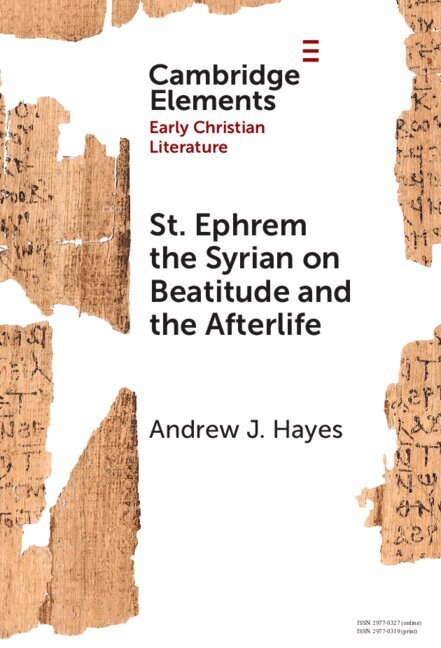
The poetry of Ephrem the Syrian abounds with vivid symbols for the conclusion of salvation history, which forms a path leading from Paradise back to God. His transfiguring glory-light nourishes and enriches the blessed. Those in Gehenna behold the same goal, yet due to self-inflicted inner blindness, they experience it in opposite fashion. Ephrem's eschatology takes shape along the relation between creator and creature rather than along the contrast between particular and universal outcomes. This Element argues that freedom's capacity for transformative growth in relation to God, even post mortem, establishes Ephrem's coherent epektatic account of blessedness, rooted in the quasi-infinite character of human desire despite the finitude of human effort. Freedom's inherent uncertainty makes the salvation of all unknowable. Ephrem refuses to collapse definitively the polarity between creator and creature. Yet a person's freedom remains capable, with divine assistance, of repentance and growth even in Gehenna.
Häftad, Engelska, 2026
265 kr
Skickas inom 7-10 vardagar
The poetry of Ephrem the Syrian abounds with vivid symbols for the conclusion of salvation history, which forms a path leading from Paradise back to God. His transfiguring glory-light nourishes and enriches the blessed. Those in Gehenna behold the same goal, yet due to self-inflicted inner blindness, they experience it in opposite fashion. Ephrem's eschatology takes shape along the relation between creator and creature rather than along the contrast between particular and universal outcomes. This Element argues that freedom's capacity for transformative growth in relation to God, even post mortem, establishes Ephrem's coherent epektatic account of blessedness, rooted in the quasi-infinite character of human desire despite the finitude of human effort. Freedom's inherent uncertainty makes the salvation of all unknowable. Ephrem refuses to collapse definitively the polarity between creator and creature. Yet a person's freedom remains capable, with divine assistance, of repentance and growth even in Gehenna.
Inbunden, Engelska, 2025
742 kr
Skickas inom 7-10 vardagar
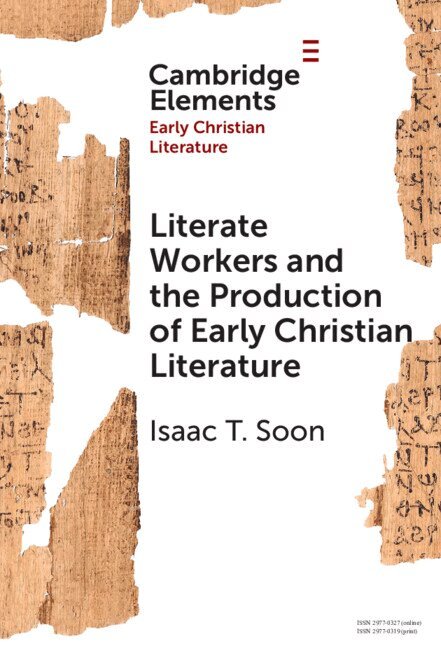
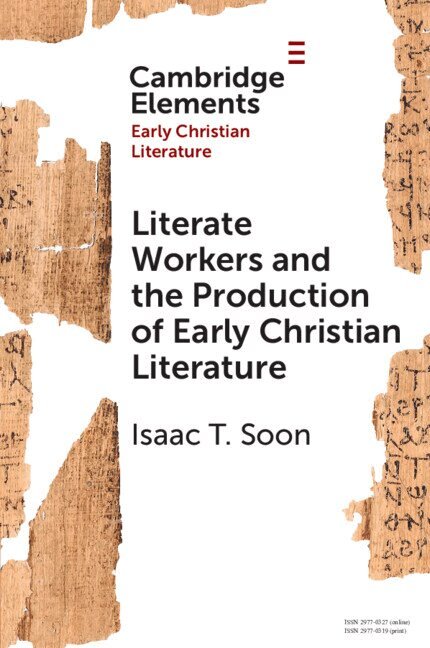
This Element provides a historical overview of the sources and key scholarship related to literate workers in early Christianity. It argues that literate workers were indispensable for the creation, production, maintenance, interpretation, and preservation of ancient Christian thought, theology, and literature. This Element centres the embodiment and lived experience of literate workers-as much as is able to be retrieved from our extant Christian sources. Who were they? What did they look like? What was their relationship with named authors? What kinds of aspirations and career trajectories did they have? The aim of this project is to help researchers reconfigure their perspectives on ancient works, that such documents not only represent the genius of named authors but also of (enslaved) literate workers as well.
Häftad, Engelska, 2025
230 kr
Skickas inom 7-10 vardagar
This Element provides a historical overview of the sources and key scholarship related to literate workers in early Christianity. It argues that literate workers were indispensable for the creation, production, maintenance, interpretation, and preservation of ancient Christian thought, theology, and literature. This Element centres the embodiment and lived experience of literate workers-as much as is able to be retrieved from our extant Christian sources. Who were they? What did they look like? What was their relationship with named authors? What kinds of aspirations and career trajectories did they have? The aim of this project is to help researchers reconfigure their perspectives on ancient works, that such documents not only represent the genius of named authors but also of (enslaved) literate workers as well.
Häftad, Engelska, 2026
230 kr
Skickas inom 7-10 vardagar
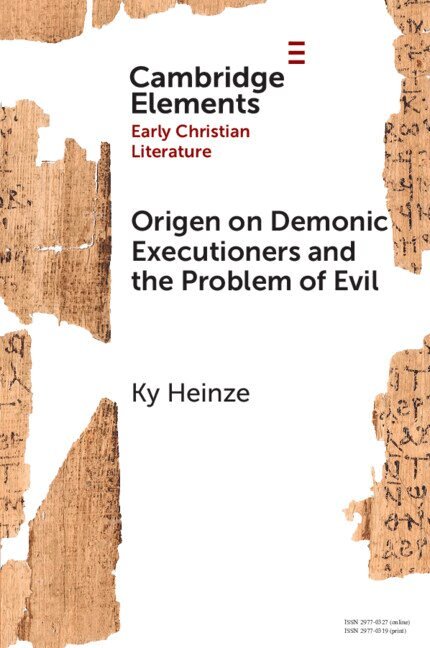
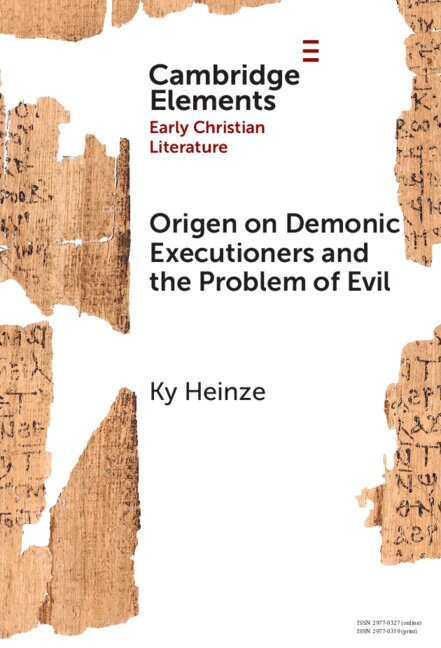
Origen believed that God's providence makes good use of everything, including the actions of wicked demons, which serve to discipline sinners and test the righteous. This Element, which focuses on the disciplinary function of demons, will show that Origen's position was the synthesis and development of a long Jewish and early Christian tradition - a fact not recognized in most scholarship. Disciplinary demons were an important part of Origen's theodicy. According to him, the suffering sinners experience is not the direct action of supposed divine anger, but the wicked attack of demons that is directed (but not caused) by God. Origen's belief that even rebel demons do not escape from fulfilling the divine purpose avoids dualism. This contradicts the frequently expressed view that early Christian intellectuals (particularly Origen) overemphasized Satan's autonomy and endangered the supremacy of God.
Inbunden, Engelska, 2026
742 kr
Skickas inom 7-10 vardagar
Origen believed that God's providence makes good use of everything, including the actions of wicked demons, which serve to discipline sinners and test the righteous. This Element, which focuses on the disciplinary function of demons, will show that Origen's position was the synthesis and development of a long Jewish and early Christian tradition - a fact not recognized in most scholarship. Disciplinary demons were an important part of Origen's theodicy. According to him, the suffering sinners experience is not the direct action of supposed divine anger, but the wicked attack of demons that is directed (but not caused) by God. Origen's belief that even rebel demons do not escape from fulfilling the divine purpose avoids dualism. This contradicts the frequently expressed view that early Christian intellectuals (particularly Origen) overemphasized Satan's autonomy and endangered the supremacy of God.
Häftad, Engelska, 2026
230 kr
Kommande
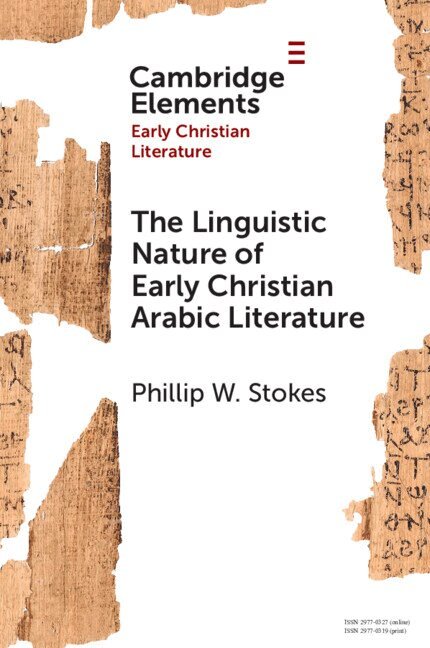
This Element examines the forms of Arabic used by Christians in the early Islamic period in theological treatises and Arabic Bible translations. It argues that linguistic analysis of these texts not only clarifies the nature of early Islamic Arabic but also sheds new light on Christian institutional and intellectual culture. Focusing on nominal case, verbal mood, and gender and number agreement, the study challenges the common view that Christian authors wrote either flawed Classical Arabic or in a substandard register. Instead, it shows that their Arabic was typical of the early Islamic period. The Element also identifies differences in linguistic choices between theological treatises and biblical translations. After the Muslim conquests, Arabic was the language appropriate to both genres. The Element argues that Christians deftly and creatively adapted Arabic writing to their literary activities, in language appropriate to their different audiences.
Inbunden, Engelska, 2026
742 kr
Kommande
This Element examines the forms of Arabic used by Christians in the early Islamic period in theological treatises and Arabic Bible translations. It argues that linguistic analysis of these texts not only clarifies the nature of early Islamic Arabic but also sheds new light on Christian institutional and intellectual culture. Focusing on nominal case, verbal mood, and gender and number agreement, the study challenges the common view that Christian authors wrote either flawed Classical Arabic or in a substandard register. Instead, it shows that their Arabic was typical of the early Islamic period. The Element also identifies differences in linguistic choices between theological treatises and biblical translations. After the Muslim conquests, Arabic was the language appropriate to both genres. The Element argues that Christians deftly and creatively adapted Arabic writing to their literary activities, in language appropriate to their different audiences.
Inbunden, Engelska, 2025
675 kr
Skickas inom 7-10 vardagar
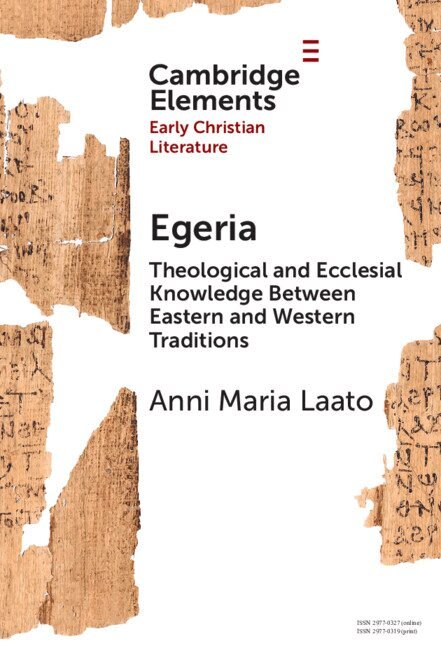
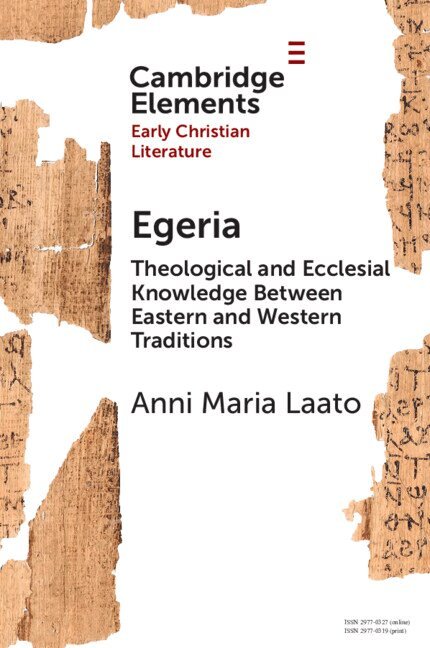
Egeria's Itinerarium is a unique document. It is one of the few surviving works from antiquity written by a woman and is one of the first Christian travelogues depicting a pilgrimage to and in the Holy Land. In her Itinerarium, Egeria describes not only her travels but also the practices of pilgrimage and the liturgical life in Jerusalem at a time when both of these were developing rapidly. As Egeria's explicit goal is to communicate her observations and thoughts to her friends, a community of women in the west, this study focusses on Egeria's role as a communicator. Both the contents of her text - what she wanted to communicate and the techniques she used to mediate her experiences and learning to her friends, that is, how she chose to communicate, are scrutinized. Special attention is given to how Egeria describes lived religion in antiquity.
Häftad, Engelska, 2025
218 kr
Skickas inom 7-10 vardagar
Egeria's Itinerarium is a unique document. It is one of the few surviving works from antiquity written by a woman and is one of the first Christian travelogues depicting a pilgrimage to and in the Holy Land. In her Itinerarium, Egeria describes not only her travels but also the practices of pilgrimage and the liturgical life in Jerusalem at a time when both of these were developing rapidly. As Egeria's explicit goal is to communicate her observations and thoughts to her friends, a community of women in the west, this study focusses on Egeria's role as a communicator. Both the contents of her text - what she wanted to communicate and the techniques she used to mediate her experiences and learning to her friends, that is, how she chose to communicate, are scrutinized. Special attention is given to how Egeria describes lived religion in antiquity.