SUNY series, Hot Topics: Contemporary Philosophy and Culture – serie
Visar alla böcker i serien SUNY series, Hot Topics: Contemporary Philosophy and Culture. Handla med fri frakt och snabb leverans.
4 produkter
4 produkter
1 215 kr
Tillfälligt slut
Addresses the place of addiction in modern art, literature, philosophy, and psychology, including its effects on the works of such thinkers and writers as Heidegger, Nietzsche, DeQuincey, Breton, and Burroughs.This is the first comprehensive text to address addiction and its multiple effects on and extensions into art, literature, philosophy, and psychology. Most research into addiction has taken place within the disciplines of medicine, criminology, politics, and social psychology. When seen from a broad cultural perspective, however, addiction emerges directly alongside modernity, haunting its various discourses of digression, dissent, and the transcendence of the commonplace. Who could even imagine modern writing without the addictive, visionary excesses of writers like Baudelaire, DeQuincey, Poe, Burroughs, or Artaud? Or, for that matter, modern culture without its "outsiders," its incorrigible addicts, its defaced subjects: smokers, users, overeaters, alcoholics, the insane? Taking a cultural studies approach to addiction, High Culture offers a readable and accessible collection of essays on these socially marginalized practices and discourses so central to modernity.
416 kr
Tillfälligt slut
Addresses the place of addiction in modern art, literature, philosophy, and psychology, including its effects on the works of such thinkers and writers as Heidegger, Nietzsche, DeQuincey, Breton, and Burroughs.This is the first comprehensive text to address addiction and its multiple effects on and extensions into art, literature, philosophy, and psychology. Most research into addiction has taken place within the disciplines of medicine, criminology, politics, and social psychology. When seen from a broad cultural perspective, however, addiction emerges directly alongside modernity, haunting its various discourses of digression, dissent, and the transcendence of the commonplace. Who could even imagine modern writing without the addictive, visionary excesses of writers like Baudelaire, DeQuincey, Poe, Burroughs, or Artaud? Or, for that matter, modern culture without its "outsiders," its incorrigible addicts, its defaced subjects: smokers, users, overeaters, alcoholics, the insane? Taking a cultural studies approach to addiction, High Culture offers a readable and accessible collection of essays on these socially marginalized practices and discourses so central to modernity.
1 057 kr
Tillfälligt slut
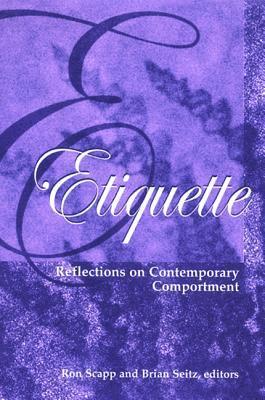
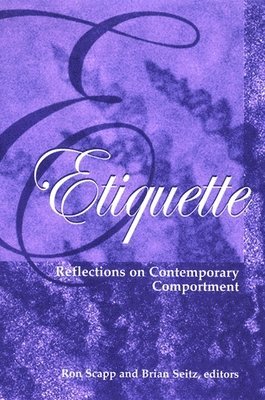
Brings etiquette into dialogue with ethics.Etiquette, the field of multifarious prescriptions governing comportment in life's interactions, has generally been neglected by philosophers, who may be inclined to dismiss it as trivial, most specifically in contrast to ethics. Philosophy tends to grant absolute privilege to ethics over etiquette, placing the former alongside all of the traditional values favored by metaphysics (order, truth, rationality, mind, masculinity, depth, reality), while consigning the latter to metaphysics' familiar, divisive list of hazards and rejects (arbitrariness, mere opinion, irrationality, the body, femininity, surface, appearance). Addressing a broad range of subjects, from sexuality, clothes, and cell phones to hip-hop culture, bodybuilding, and imperialism, the contributors to Etiquette challenge these traditional values-not in order to favor etiquette over ethics, but to explore the various ways in which practice subtends theory, in which manners are morals, and in which ethics, the practice of living a good life, has always depended upon the graceful relations for which etiquette provides the armature.
489 kr
Tillfälligt slut
Brings etiquette into dialogue with ethics.Etiquette, the field of multifarious prescriptions governing comportment in life's interactions, has generally been neglected by philosophers, who may be inclined to dismiss it as trivial, most specifically in contrast to ethics. Philosophy tends to grant absolute privilege to ethics over etiquette, placing the former alongside all of the traditional values favored by metaphysics (order, truth, rationality, mind, masculinity, depth, reality), while consigning the latter to metaphysics' familiar, divisive list of hazards and rejects (arbitrariness, mere opinion, irrationality, the body, femininity, surface, appearance). Addressing a broad range of subjects, from sexuality, clothes, and cell phones to hip-hop culture, bodybuilding, and imperialism, the contributors to Etiquette challenge these traditional values-not in order to favor etiquette over ethics, but to explore the various ways in which practice subtends theory, in which manners are morals, and in which ethics, the practice of living a good life, has always depended upon the graceful relations for which etiquette provides the armature.