LCA Compendium – The Complete World of Life Cycle Assessment – Serie
Visar alla böcker i serien LCA Compendium – The Complete World of Life Cycle Assessment. Handla med fri frakt och snabb leverans.
14 produkter
14 produkter
1 365 kr
Skickas inom 10-15 vardagar
Life Cycle Inventory (LCI) Analysis is the second phase in the Life Cycle Assessment (LCA) framework. Chapter 9 “The Link Between Life Cycle Inventory Analysis and Life Cycle Impact Assessment” uses four examples to discuss the link between LCI analysis and LCIA.
977 kr
Skickas inom 10-15 vardagar
Life Cycle Inventory (LCI) Analysis is the second phase in the Life Cycle Assessment (LCA) framework. Chapter 9 “The Link Between Life Cycle Inventory Analysis and Life Cycle Impact Assessment” uses four examples to discuss the link between LCI analysis and LCIA.
1 365 kr
Skickas inom 10-15 vardagar
in practice, the performance of a critical review can be made much easier if the preparers of a life cycle assessment study very carefully follow the requirements that are specifically placed on the interpretation.Because the critical review is the independent quality control of an LCA, the results improve the credibility of reporting.
977 kr
Skickas inom 10-15 vardagar
in practice, the performance of a critical review can be made much easier if the preparers of a life cycle assessment study very carefully follow the requirements that are specifically placed on the interpretation.Because the critical review is the independent quality control of an LCA, the results improve the credibility of reporting.
534 kr
Skickas inom 10-15 vardagar
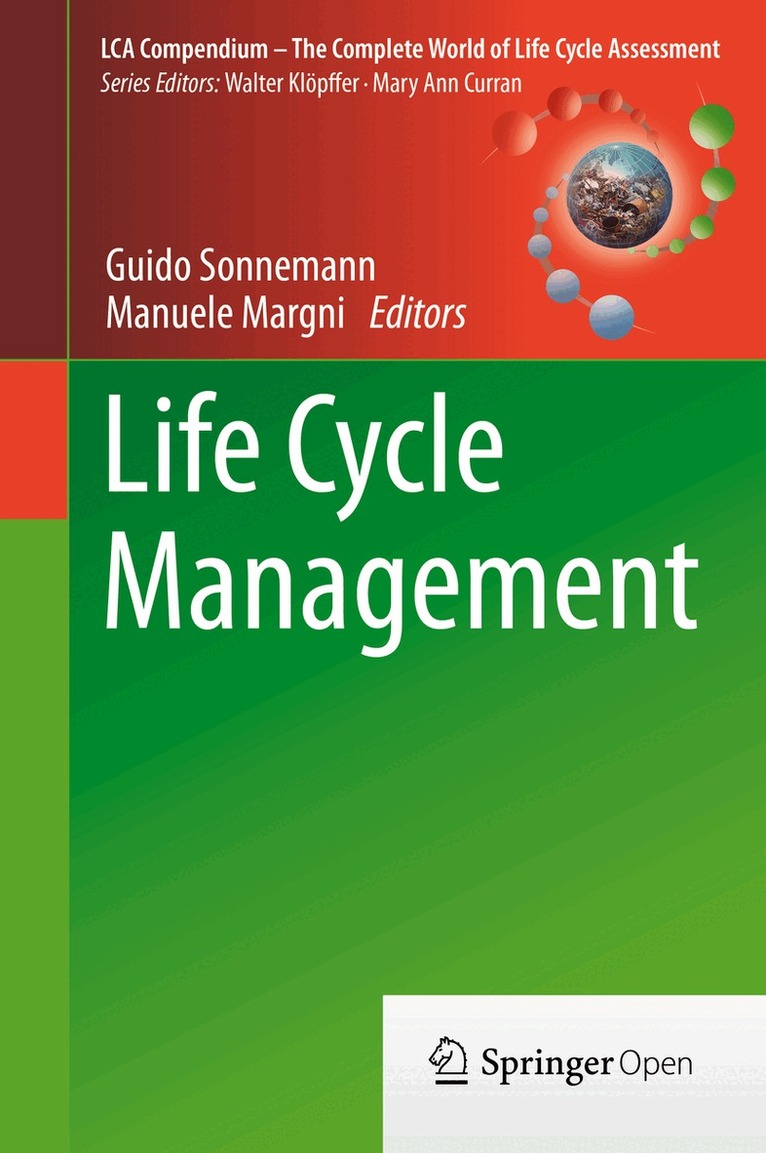
This book provides insight into the Life Cycle Management (LCM) concept and the progress in its implementation. LCM is a management concept applied in industrial and service sectors to improve products and services, while enhancing the overall sustainability performance of business and its value chains. In this regard, LCM is an opportunity to differentiate through sustainability performance on the market place, working with all departments of a company such as research and development, procurement and marketing, and to enhance the collaboration with stakeholders along a company’s value chain. LCM is used beyond short-term business success and aims at long-term achievements by minimizing environmental and socio-economic burden, while maximizing economic and social value.
2 117 kr
Skickas inom 10-15 vardagar
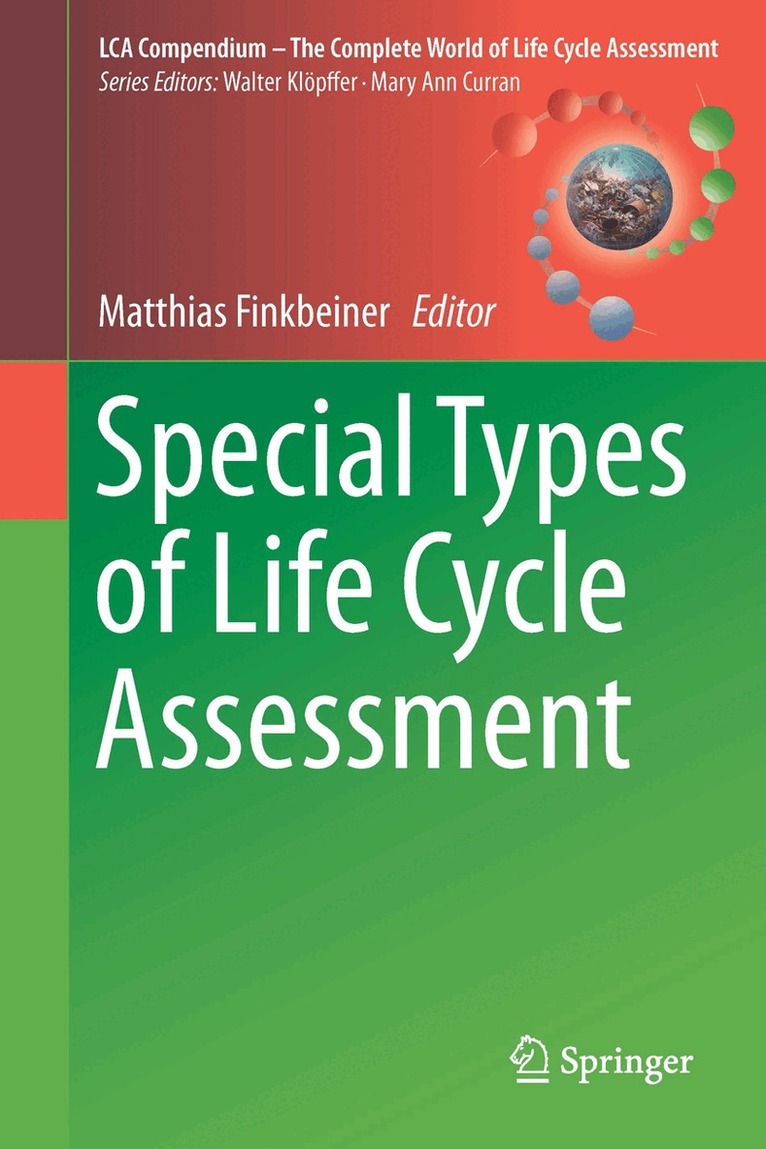
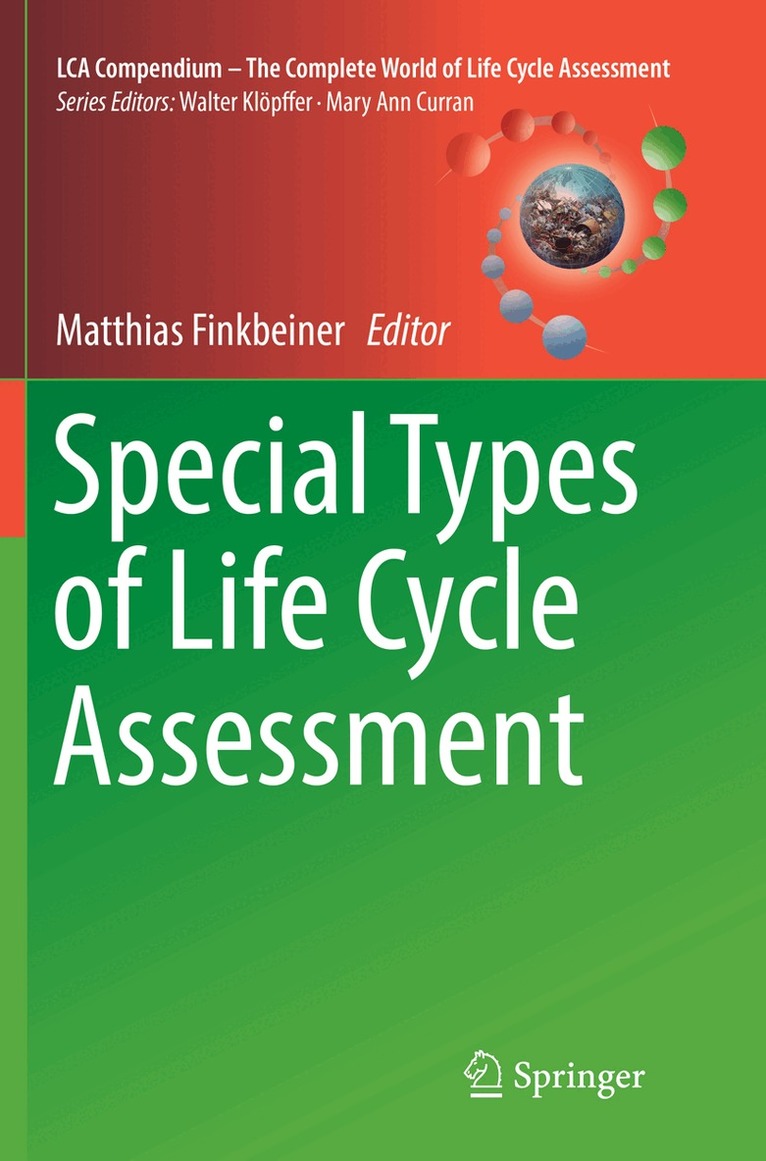
This book presents specialised methods and tools built on classical LCA. In the first book-length overview, their importance for the further growth and application of LCA is demonstrated for some of the most prominent species of this emerging trend: Carbon footprinting; Water footprinting; Eco-efficiency assessment; Resource efficiency assessment; Input-output and hybrid LCA; Material flow analysis; Organizational LCA.Carbon footprinting was a huge driver for the market expansion of simplified LCA. The discussions led to an ample proliferation of different guidelines and standards including ISO/TS 14067 on Carbon Footprint of Product. Atsushi Inaba (Kogakuin University, Tokyo, Japan) and his eight co-authors provide an up-to-date status of Carbon Footprint of Products. The increasing relevance of Water Footprinting and the diverse methods were the drivers to develop the ISO 14046 as international water footprint standard. Markus Berger (Technische Universität Berlin, Germany), Stephan Pfister (ETH Zurich, Switzerland) and Masaharu Motoshita (Agency of Industrial Science and Technology, Tsukuba, Japan) present a status of water resources and demands from a global and regional perspective. A core part is the discussion and comparison of the different water footprint methods, databases and tools. Peter Saling from BASF SE in Ludwigshafen, Germany, broadens the perspective towards Eco-efficiency Assessment. He describes the BASF-specific type of eco-efficiency analysis plus adaptions like the so-called SEEBALANCE and AgBalance applications. Laura Schneider, Vanessa Bach and Matthias Finkbeiner (Technische Universität Berlin, Germany) address multi-dimensional LCA perspectives in the form of Resource Efficiency Assessment. Research needs and proposed methodological developments for abiotic resource efficiency assessment, and especially for the less developed area of biotic resources, are discussed.The fundamentals ofInput-output and Hybrid LCA are covered by Shinichiro Nakamura (Waseda University, Tokyo, Japan) and Keisuke Nansai (National Institute for Environmental Studies, Tsukuba, Japan). The concepts of environmentally extended IO, different types of hybrid IO-LCA and the waste model are introduced. David Laner and Helmut Rechberger (Vienna University of Technology, Austria) present the basic terms and procedures of Material Flow Analysismethodology. The combination of MFA and LCA is discussed as a promising approach for environmental decision support. Julia Martínez-Blanco (Technische Universität Berlin, Germany; now at Inèdit, Barcelona, Spain), Atsushi Inaba (Kogakuin University, Tokyo, Japan) and Matthias Finkbeiner (Technische Universität Berlin, Germany) introduce a recent development which could develop a new trend, namely the LCA of Organizations.
1 062 kr
Skickas inom 10-15 vardagar
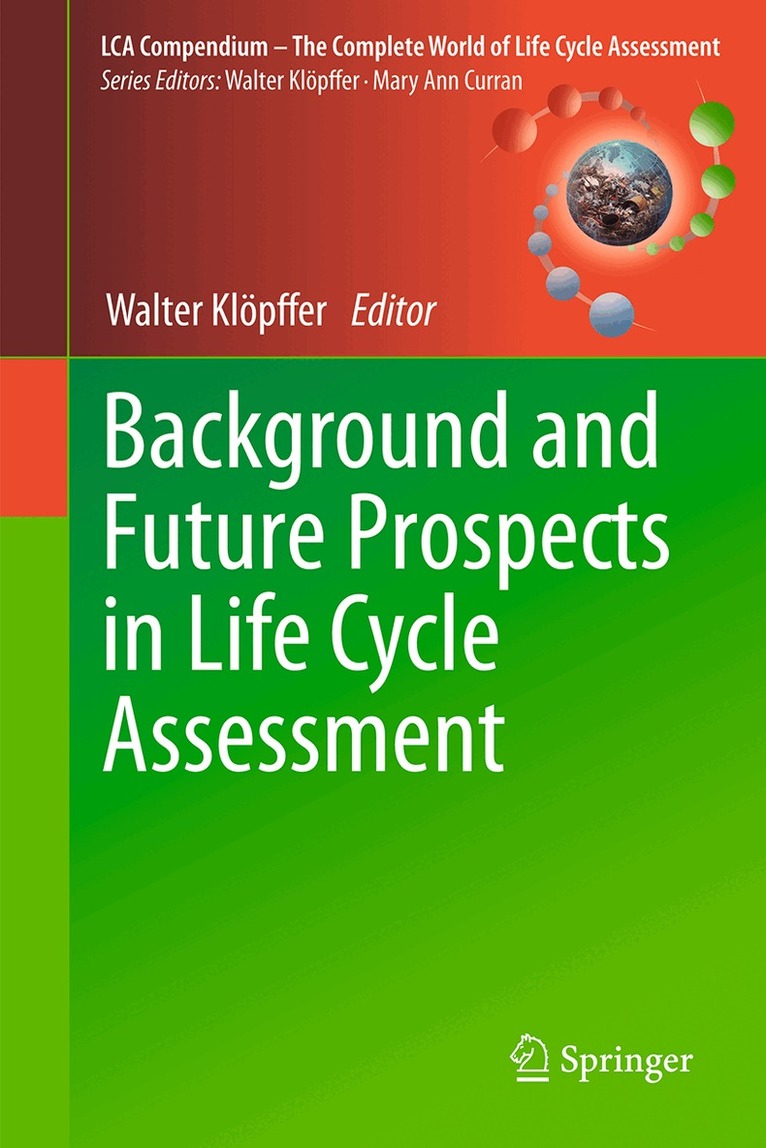
Life Cycle Assessment (LCA) has become the recognized instrument to assess the ecological burdens and human health impacts connected with the complete life cycle (creation, use, end-of-life) of products, processes and activities, enabling the assessor to model the entire system from which products are derived or in which processes and activities operate. This volume introduces the major new book series LCA Compendium - The Complete World of Life Cycle Assessment. In this volume, the main drivers in the development of LCA are explored. The volume also discusses strengths and limitations in LCA as well as challenges and gaps, thus offering an unbiased picture of the state-of-the-art and future of LCA.
1 906 kr
Skickas inom 10-15 vardagar
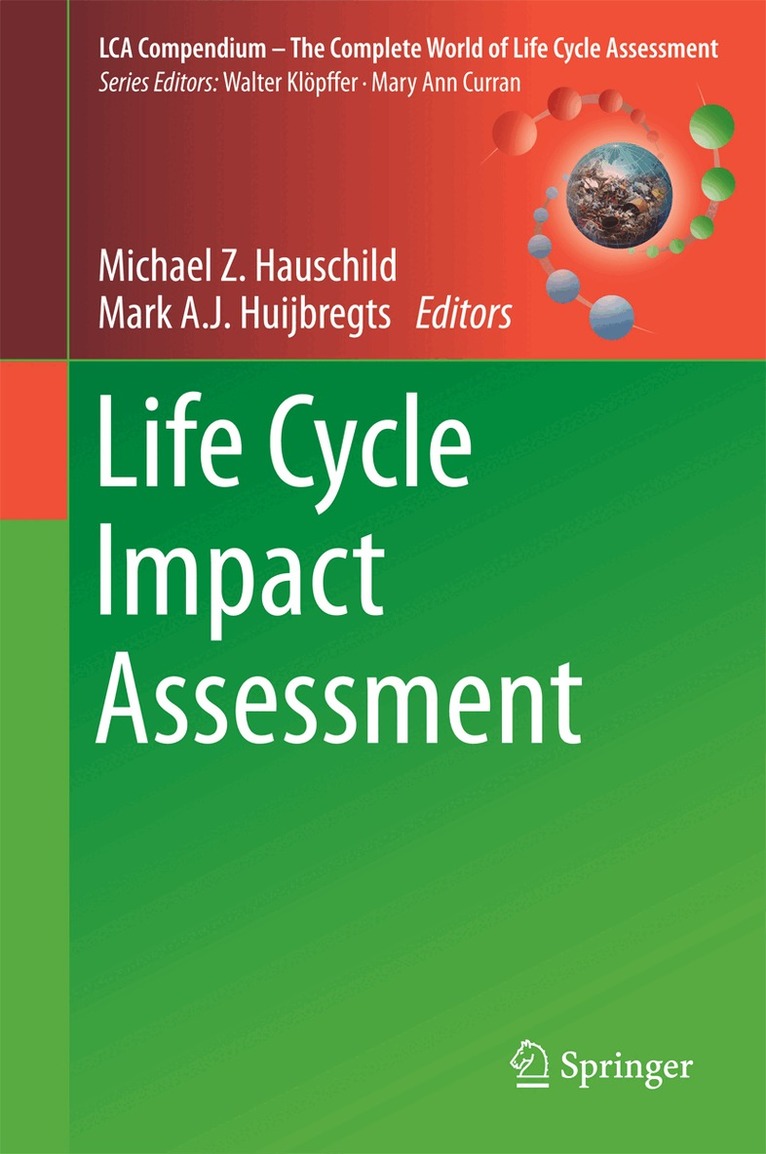
This book offers a detailed presentation of the principles and practice of life cycle impact assessment. As a volume of the LCA compendium, the book is structured according to the LCIA framework developed by the International Organisation for Standardisation (ISO)passing through the phases of definition or selection of impact categories, category indicators and characterisation models (Classification): calculation of category indicator results (Characterisation); calculating the magnitude of category indicator results relative to reference information (Normalisation); and converting indicator results of different impact categories by using numerical factors based on value-choices (Weighting).Chapter one offers a historical overview of the development of life cycle impact assessment and presents the boundary conditions and the general principles and constraints of characterisation modelling in LCA. The second chapter outlines the considerations underlying the selection of impact categories and the classification or assignment of inventory flows into these categories. Chapters three through thirteen exploreall the impact categories that are commonly included in LCIA, discussing the characteristics of each followed by a review of midpoint and endpoint characterisation methods, metrics, uncertainties and new developments, and a discussion of research needs. Chapter-length treatment is accorded to Climate Change; Stratospheric Ozone Depletion; Human Toxicity; Particulate Matter Formation; Photochemical Ozone Formation; Ecotoxicity; Acidification; Eutrophication; Land Use; Water Use; and Abiotic Resource Use. The final two chapters map out the optional LCIA steps of Normalisation and Weighting.
1 906 kr
Skickas inom 10-15 vardagar
This book offers a detailed presentation of the principles and practice of life cycle impact assessment. As a volume of the LCA compendium, the book is structured according to the LCIA framework developed by the International Organisation for Standardisation (ISO)passing through the phases of definition or selection of impact categories, category indicators and characterisation models (Classification): calculation of category indicator results (Characterisation); calculating the magnitude of category indicator results relative to reference information (Normalisation); and converting indicator results of different impact categories by using numerical factors based on value-choices (Weighting).Chapter one offers a historical overview of the development of life cycle impact assessment and presents the boundary conditions and the general principles and constraints of characterisation modelling in LCA. The second chapter outlines the considerations underlying the selection of impact categories and the classification or assignment of inventory flows into these categories. Chapters three through thirteen exploreall the impact categories that are commonly included in LCIA, discussing the characteristics of each followed by a review of midpoint and endpoint characterisation methods, metrics, uncertainties and new developments, and a discussion of research needs. Chapter-length treatment is accorded to Climate Change; Stratospheric Ozone Depletion; Human Toxicity; Particulate Matter Formation; Photochemical Ozone Formation; Ecotoxicity; Acidification; Eutrophication; Land Use; Water Use; and Abiotic Resource Use. The final two chapters map out the optional LCIA steps of Normalisation and Weighting.
534 kr
Skickas inom 10-15 vardagar
This book provides insight into the Life Cycle Management (LCM) concept and the progress in its implementation. LCM is a management concept applied in industrial and service sectors to improve products and services, while enhancing the overall sustainability performance of business and its value chains. In this regard, LCM is an opportunity to differentiate through sustainability performance on the market place, working with all departments of a company such as research and development, procurement and marketing, and to enhance the collaboration with stakeholders along a company’s value chain. LCM is used beyond short-term business success and aims at long-term achievements by minimizing environmental and socio-economic burden, while maximizing economic and social value.
1 062 kr
Skickas inom 10-15 vardagar
Life Cycle Assessment (LCA) has become the recognized instrument to assess the ecological burdens and human health impacts connected with the complete life cycle (creation, use, end-of-life) of products, processes and activities, enabling the assessor to model the entire system from which products are derived or in which processes and activities operate. This volume introduces the major new book series LCA Compendium - The Complete World of Life Cycle Assessment. In this volume, the main drivers in the development of LCA are explored. The volume also discusses strengths and limitations in LCA as well as challenges and gaps, thus offering an unbiased picture of the state-of-the-art and future of LCA.
1 637 kr
Skickas inom 10-15 vardagar
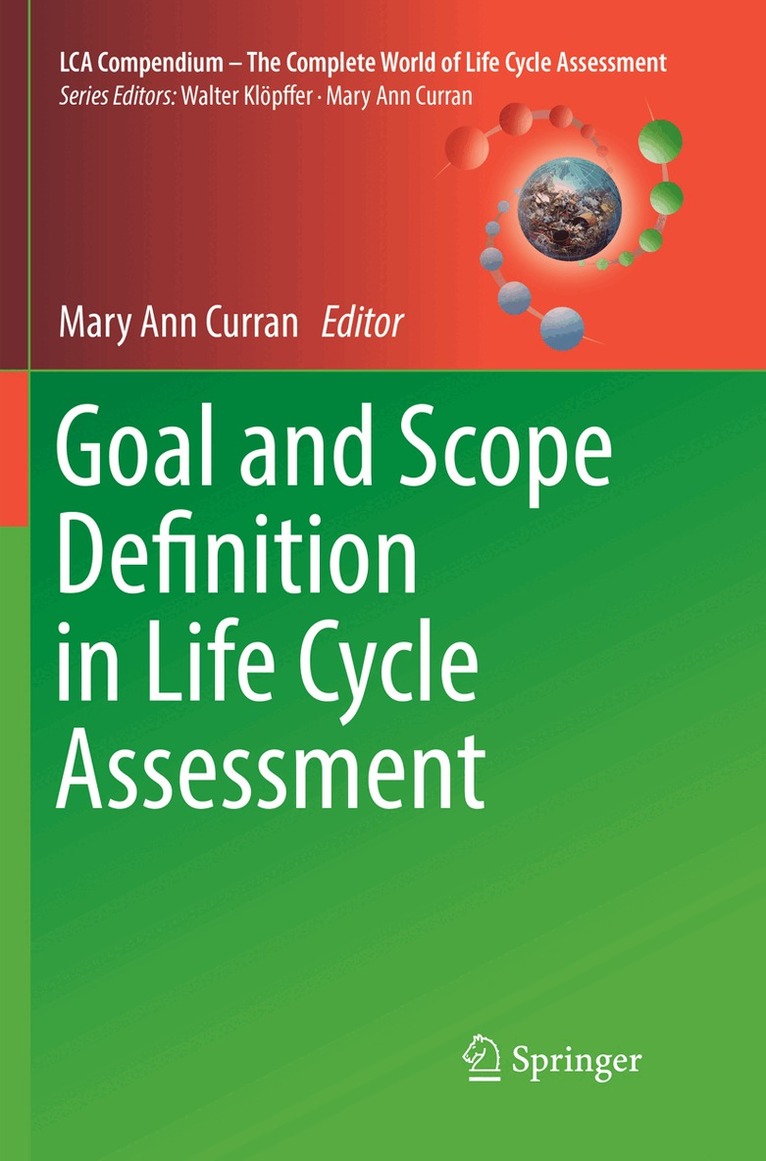
This book describes the importance of the goal and scope phase for the entire LCA study. In this first phase of the LCA framework (ISO standardized), the purpose of the assessment is defined and decisions are made about the details of the industrial system being studied and how the study will be conducted. Selecting impact categories, category indicators, characterization models, and peer review is decided during goal and scope definition. The book provides practical guidance and an overview of LCIA methods available in LCA software. Although not specified in the ISO standards, Attributional LCA and Consequential LCA are presented in order to appropriately determine the goal and scope of an assessment. The book closes with the interconnection between goal and scope definition and the interpretation phase. Example goal and scope documents for attributional and consequential LCAs are provided in the annexes.
2 117 kr
Skickas inom 10-15 vardagar
This book presents specialised methods and tools built on classical LCA. In the first book-length overview, their importance for the further growth and application of LCA is demonstrated for some of the most prominent species of this emerging trend: Carbon footprinting; Water footprinting; Eco-efficiency assessment; Resource efficiency assessment; Input-output and hybrid LCA; Material flow analysis; Organizational LCA.Carbon footprinting was a huge driver for the market expansion of simplified LCA. The discussions led to an ample proliferation of different guidelines and standards including ISO/TS 14067 on Carbon Footprint of Product. Atsushi Inaba (Kogakuin University, Tokyo, Japan) and his eight co-authors provide an up-to-date status of Carbon Footprint of Products. The increasing relevance of Water Footprinting and the diverse methods were the drivers to develop the ISO 14046 as international water footprint standard. Markus Berger (Technische Universität Berlin, Germany), Stephan Pfister (ETH Zurich, Switzerland) and Masaharu Motoshita (Agency of Industrial Science and Technology, Tsukuba, Japan) present a status of water resources and demands from a global and regional perspective. A core part is the discussion and comparison of the different water footprint methods, databases and tools. Peter Saling from BASF SE in Ludwigshafen, Germany, broadens the perspective towards Eco-efficiency Assessment. He describes the BASF-specific type of eco-efficiency analysis plus adaptions like the so-called SEEBALANCE and AgBalance applications. Laura Schneider, Vanessa Bach and Matthias Finkbeiner (Technische Universität Berlin, Germany) address multi-dimensional LCA perspectives in the form of Resource Efficiency Assessment. Research needs and proposed methodological developments for abiotic resource efficiency assessment, and especially for the less developed area of biotic resources, are discussed.The fundamentals ofInput-output and Hybrid LCA are covered by Shinichiro Nakamura (Waseda University, Tokyo, Japan) and Keisuke Nansai (National Institute for Environmental Studies, Tsukuba, Japan). The concepts of environmentally extended IO, different types of hybrid IO-LCA and the waste model are introduced. David Laner and Helmut Rechberger (Vienna University of Technology, Austria) present the basic terms and procedures of Material Flow Analysismethodology. The combination of MFA and LCA is discussed as a promising approach for environmental decision support. Julia Martínez-Blanco (Technische Universität Berlin, Germany; now at Inèdit, Barcelona, Spain), Atsushi Inaba (Kogakuin University, Tokyo, Japan) and Matthias Finkbeiner (Technische Universität Berlin, Germany) introduce a recent development which could develop a new trend, namely the LCA of Organizations.
1 637 kr
Skickas inom 10-15 vardagar
This book describes the importance of the goal and scope phase for the entire LCA study. In this first phase of the LCA framework (ISO standardized), the purpose of the assessment is defined and decisions are made about the details of the industrial system being studied and how the study will be conducted. Selecting impact categories, category indicators, characterization models, and peer review is decided during goal and scope definition. The book provides practical guidance and an overview of LCIA methods available in LCA software. Although not specified in the ISO standards, Attributional LCA and Consequential LCA are presented in order to appropriately determine the goal and scope of an assessment. The book closes with the interconnection between goal and scope definition and the interpretation phase. Example goal and scope documents for attributional and consequential LCAs are provided in the annexes.