Messenger Lectures - Böcker
Visar alla böcker i serien Messenger Lectures. Handla med fri frakt och snabb leverans.
5 produkter
5 produkter
262 kr
Skickas inom 11-20 vardagar
Francis Fukuyama famously predicted "the end of history" with the ascendancy of liberal democracy and global capitalism. The topic of his latest book is, therefore, surprising: the building of new nation-states. The end of history was never an automatic procedure, Fukuyama argues, and the well-governed polity was always its necessary precondition. "Weak or failed states are the source of many of the world's most serious problems," he believes. He traces what we know—and more often don't know—about how to transfer functioning public institutions to developing countries in ways that will leave something of permanent benefit to the citizens of the countries concerned. These are important lessons, especially as the United States wrestles with its responsibilities in Afghanistan, Iraq, and beyond. Fukuyama begins State-Building with an account of the broad importance of "stateness." He rejects the notion that there can be a science of public administration, and discusses the causes of contemporary state weakness. He ends the book with a discussion of the consequences of weak states for international order, and the grounds on which the international community may legitimately intervene to prop them up.
337 kr
Skickas inom 10-15 vardagar
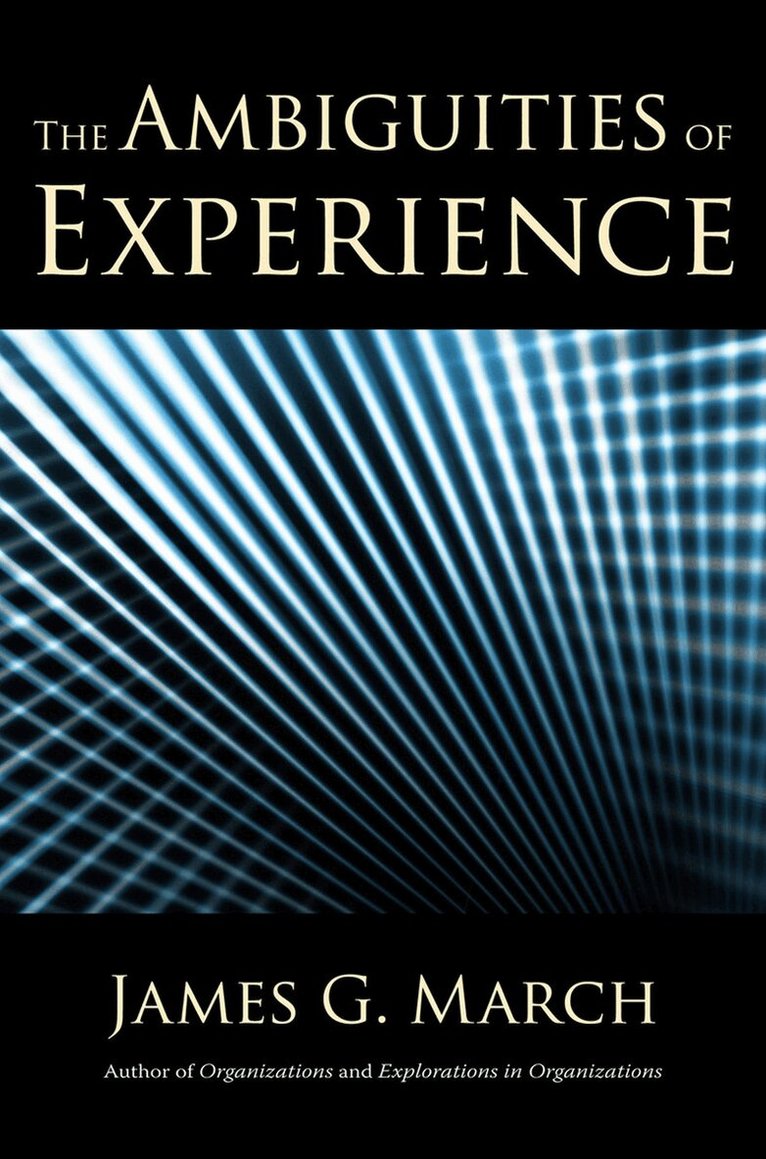
The first component of intelligence involves effective adaptation to an environment. In order to adapt effectively, organizations require resources, capabilities at using them, knowledge about the worlds in which they exist, good fortune, and good decisions. They typically face competition for resources and uncertainties about the future. Many, but possibly not all, of the factors determining their fates are outside their control. Populations of organizations and individual organizations survive, in part, presumably because they possess adaptive intelligence; but survival is by no means assured. The second component of intelligence involves the elegance of interpretations of the experiences of life. Such interpretations encompass both theories of history and philosophies of meaning, but they go beyond such things to comprehend the grubby details of daily existence. Interpretations decorate human existence. They make a claim to significance that is independent of their contribution to effective action. Such intelligence glories in the contemplation, comprehension, and appreciation of life, not just the control of it.—from The Ambiguities of ExperienceIn The Ambiguities of Experience, James G. March asks a deceptively simple question: What is, or should be, the role of experience in creating intelligence, particularly in organizations? Folk wisdom both trumpets the significance of experience and warns of its inadequacies. On one hand, experience is described as the best teacher. On the other hand, experience is described as the teacher of fools, of those unable or unwilling to learn from accumulated knowledge or the teaching of experts. The disagreement between those folk aphorisms reflects profound questions about the human pursuit of intelligence through learning from experience that have long confronted philosophers and social scientists. This book considers the unexpected problems organizations (and the individuals in them) face when they rely on experience to adapt, improve, and survive.While acknowledging the power of learning from experience and the extensive use of experience as a basis for adaptation and for constructing stories and models of history, this book examines the problems with such learning. March argues that although individuals and organizations are eager to derive intelligence from experience, the inferences stemming from that eagerness are often misguided. The problems lie partly in errors in how people think, but even more so in properties of experience that confound learning from it. "Experience," March concludes, "may possibly be the best teacher, but it is not a particularly good teacher."
248 kr
Skickas inom 10-15 vardagar
This succinct and engaging history of the founding of Cornell University traces the institution's origins within the educational climate of mid-nineteenth-century America. Originally delivered as six lectures celebrating the seventy-fifth anniversary of the opening the university, this book was first published by Cornell University Press in 1943. Beginning with a survey of collegiate education prior to the Civil War, Carl L. Becker details the history of the Morrill Land Grant College Act that made possible the establishment of Cornell (among other universities); deftly portrays the lives of the Ezra Cornell, who supplied the essential idea and funding for the university, and Andrew D. White, who, as legislator, lobbyist, and first university president, made Cornell's dream a reality; and desrcibes the events surrounding the incorporation and opening of the university in 1868. Also included in this book are fifteen documents pertaining to its founding, as well as Becker's 1940 lecture, "The Cornell Tradition: Freedom and Responsibility."
189 kr
Skickas inom 10-15 vardagar
The first component of intelligence involves effective adaptation to an environment. In order to adapt effectively, organizations require resources, capabilities at using them, knowledge about the worlds in which they exist, good fortune, and good decisions. They typically face competition for resources and uncertainties about the future. Many, but possibly not all, of the factors determining their fates are outside their control. Populations of organizations and individual organizations survive, in part, presumably because they possess adaptive intelligence; but survival is by no means assured. The second component of intelligence involves the elegance of interpretations of the experiences of life. Such interpretations encompass both theories of history and philosophies of meaning, but they go beyond such things to comprehend the grubby details of daily existence. Interpretations decorate human existence. They make a claim to significance that is independent of their contribution to effective action. Such intelligence glories in the contemplation, comprehension, and appreciation of life, not just the control of it.—from The Ambiguities of ExperienceIn The Ambiguities of Experience, James G. March asks a deceptively simple question: What is, or should be, the role of experience in creating intelligence, particularly in organizations? Folk wisdom both trumpets the significance of experience and warns of its inadequacies. On one hand, experience is described as the best teacher. On the other hand, experience is described as the teacher of fools, of those unable or unwilling to learn from accumulated knowledge or the teaching of experts. The disagreement between those folk aphorisms reflects profound questions about the human pursuit of intelligence through learning from experience that have long confronted philosophers and social scientists. This book considers the unexpected problems organizations (and the individuals in them) face when they rely on experience to adapt, improve, and survive.While acknowledging the power of learning from experience and the extensive use of experience as a basis for adaptation and for constructing stories and models of history, this book examines the problems with such learning. March argues that although individuals and organizations are eager to derive intelligence from experience, the inferences stemming from that eagerness are often misguided. The problems lie partly in errors in how people think, but even more so in properties of experience that confound learning from it. "Experience," March concludes, "may possibly be the best teacher, but it is not a particularly good teacher."
338 kr
Skickas inom 10-15 vardagar
Originally published in 1943, Civilization and Disease was based on a series of lectures that the medical historian Henry E. Sigerist delivered at Cornell University in 1940. Now back in print, the book is a wide-ranging account of the importance of social factors on health and illness and the impact that disease has had on societies throughout human history. Despite considerable advances in both medicine and historiography, Civilization and Disease remains a landmark work in the history of medicine and a fascinating look at, first, civilization as a factor in the genesis and spread of disease, and second, the effects of disease on such aspects of civilization as economics, social life, law, philosophy, religion, science, and the arts. In a new foreword written for this edition, Elizabeth Fee outlines Sigerist's life, works, and legacy as a historian, a teacher, and an advocate for universal health care, hailing Civilization and Disease as "an excellent introduction to Sigerist's work."