267 kr
James G. March – författare
- Häftad, Engelska, 2005In this series of lectures, previously unpublished in English, and here translated from a French reconstruction and interpretation by noted scholar Thierry Weil, leading organizational scholar James March uses great works of literature to explore the problems of leadership. Uses great works of literature to explore the problems of leadership, for example War and Peace, Othello, and Don Quixote. Presents moral dilemmas related to leadership, for example the balance between private life and public duties, and between the expression and the control of sexuality. Encourages readers to explore ideas that are sometimes subversive and unpalatable but may allow organizations to adapt in a rapidly changing world.
- Häftad, Engelska, 1992
504 kr
Skickas inom 5-8 vardagar
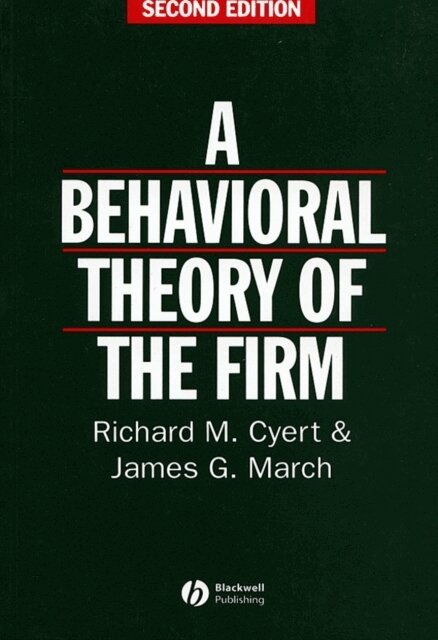
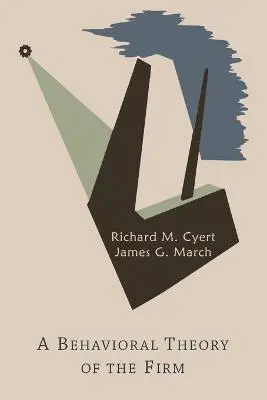
Behavioural Theory of the Firm has become a classic work in organizational theory, and is one of the most significant contributions to improving the theory of the firm. This second edition includes new material which puts the original text in a contemporary context. - Häftad, Engelska, 1998
446 kr
Skickas inom 5-8 vardagar
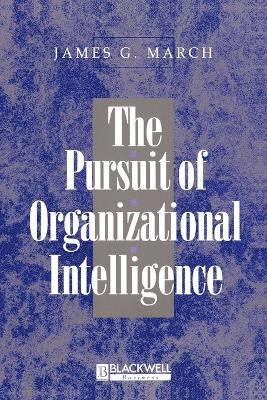
The Pursuit of Organizational Intelligence brings together the writing of one of the best-known academics in the field of decision making and organizational theory. - Häftad, Engelska, 2022
752 kr
Skickas inom 5-8 vardagar
- Häftad, Engelska, 1989
360 kr
Skickas inom 5-8 vardagar
This book collects together for the first time over 20 of James March's key essays, including those co-authorised with R.M. Cyert and J.P. Olsen and others. The coverage ranges from his early work on the behavioural theory of the firm, through conflict and adaptive rules in organizations, to decision-making under ambiguity (including the famed 'garbage can' model). - Häftad, Engelska, 1993
421 kr
Skickas inom 5-8 vardagar
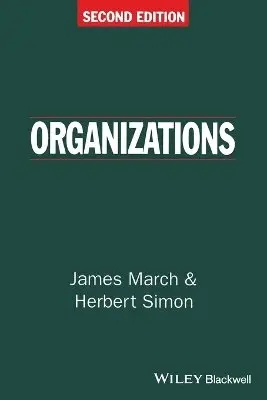
Everything you ever wanted to know about growing grapesMarch and Simon's Organizations has become a classic in the field of organizational management for its broad scope and depth of information. Written by two of the most prominent experts in the field, this book offers invaluable insight on all aspects of organizational culture through deep discussion of organization theory. The definitive reference for topics including bounded rationality, satisficing, inducement/contribution balances, attention focus, uncertainty absorption and more, this seminal text offers authoritative insight with a practical grounding in the field. - Inbunden, Engelska, 2010
346 kr
Skickas inom 3-6 vardagar
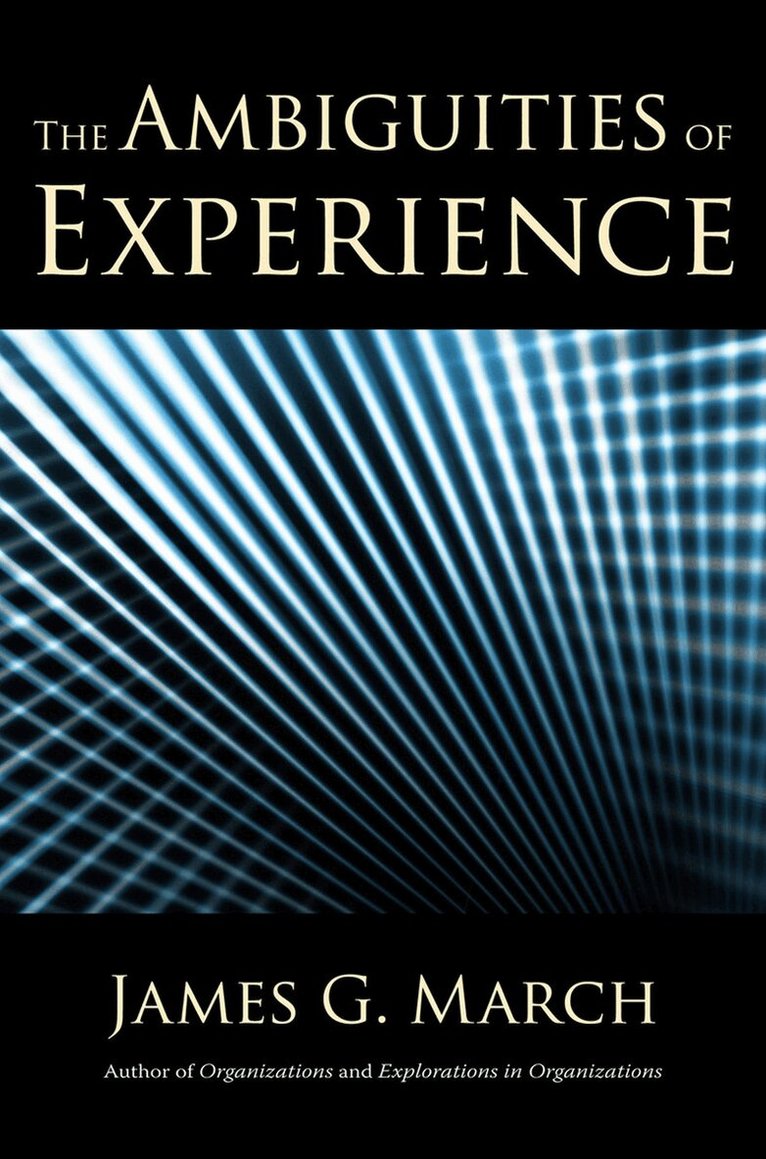
The first component of intelligence involves effective adaptation to an environment. In order to adapt effectively, organizations require resources, capabilities at using them, knowledge about the worlds in which they exist, good fortune, and good decisions. They typically face competition for resources and uncertainties about the future. Many, but possibly not all, of the factors determining their fates are outside their control. Populations of organizations and individual organizations survive, in part, presumably because they possess adaptive intelligence; but survival is by no means assured. The second component of intelligence involves the elegance of interpretations of the experiences of life. Such interpretations encompass both theories of history and philosophies of meaning, but they go beyond such things to comprehend the grubby details of daily existence. Interpretations decorate human existence. They make a claim to significance that is independent of their contribution to effective action. Such intelligence glories in the contemplation, comprehension, and appreciation of life, not just the control of it.—from The Ambiguities of ExperienceIn The Ambiguities of Experience, James G. March asks a deceptively simple question: What is, or should be, the role of experience in creating intelligence, particularly in organizations? Folk wisdom both trumpets the significance of experience and warns of its inadequacies. On one hand, experience is described as the best teacher. On the other hand, experience is described as the teacher of fools, of those unable or unwilling to learn from accumulated knowledge or the teaching of experts. The disagreement between those folk aphorisms reflects profound questions about the human pursuit of intelligence through learning from experience that have long confronted philosophers and social scientists. This book considers the unexpected problems organizations (and the individuals in them) face when they rely on experience to adapt, improve, and survive.While acknowledging the power of learning from experience and the extensive use of experience as a basis for adaptation and for constructing stories and models of history, this book examines the problems with such learning. March argues that although individuals and organizations are eager to derive intelligence from experience, the inferences stemming from that eagerness are often misguided. The problems lie partly in errors in how people think, but even more so in properties of experience that confound learning from it. "Experience," March concludes, "may possibly be the best teacher, but it is not a particularly good teacher." - Inbunden, Engelska, 2000
1 790 kr
Skickas inom 5-8 vardagar
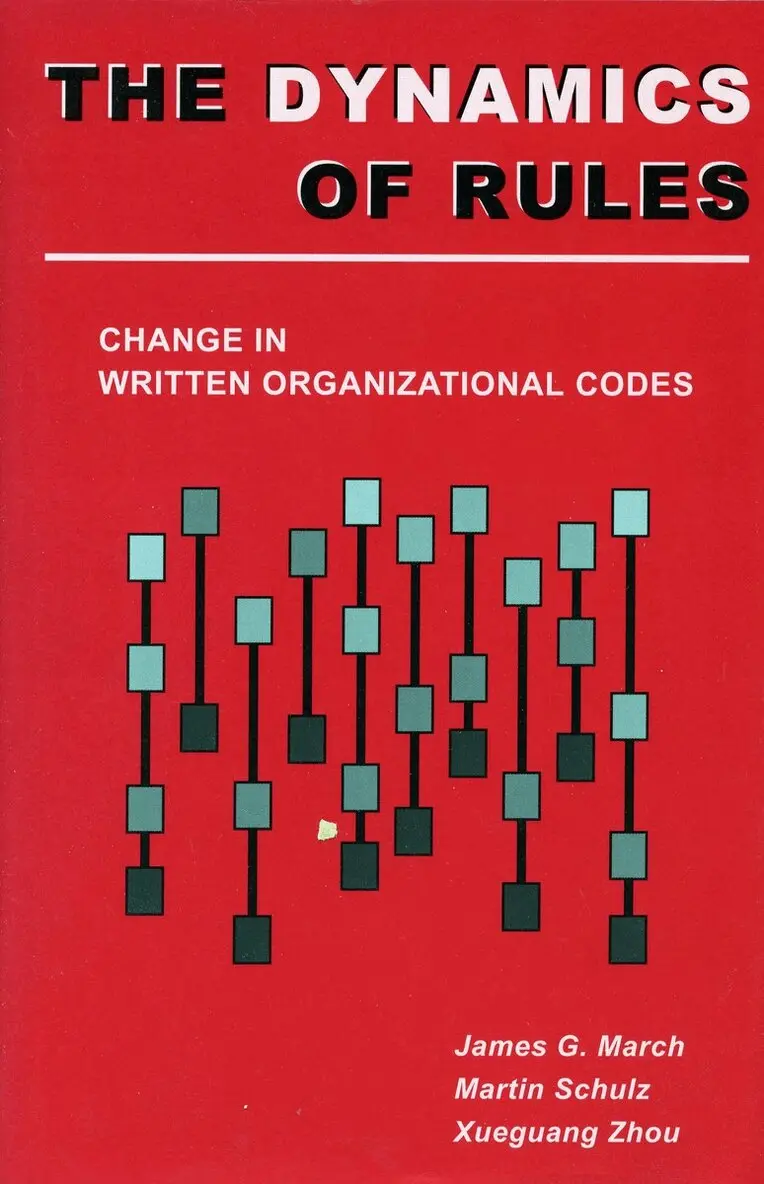
Written rules in formal organizations are distinctive elements of organizational history; they shape organizational change and are in turn shaped by it. These rules are created, revised, and eliminated in ways that leave historical traces, and they have a visibility and durability that elude non-written rules. They thus provide rich data for an empirical probe into the dynamics of organizational history.This study uses qualitative and quantitative data from the history of a specific organization, Stanford University, to develop speculations about the ways in which written rules change. It contributes both to a theory of rules and to theories of organizational decision-making, change, and learning. Organizations respond to problems and react to internal or external pressures by focusing attention on existing and potential rules. The creation, modification, or elimination of a rule, then, is a response to events in the outside environment (such as new government regulations) or to events within the organization (such as alterations in internal government structures).The authors elaborate a simple set of ideas about written rules and their dynamics, emphasizing the interplay among periodic major shocks to the system from outside, experiences with individual rules as they age and are revised, and the spread of effects through an interconnected set of rules. It is a story in which changes introduced in one part of a rule system create adjustments in other parts, including the same rule later in time, as the consequences of the changes are experienced and as rule-making attention is mobilized, satiated, and redirected. These processes involve the full panoply of political negotiation, symbolic competition, discussion, and problem solving that are typical of organizational decision making. - Häftad, Engelska, 2000
439 kr
Skickas inom 5-8 vardagar
Written rules in formal organizations are distinctive elements of organizational history; they shape organizational change and are in turn shaped by it. These rules are created, revised, and eliminated in ways that leave historical traces, and they have a visibility and durability that elude non-written rules. They thus provide rich data for an empirical probe into the dynamics of organizational history.This study uses qualitative and quantitative data from the history of a specific organization, Stanford University, to develop speculations about the ways in which written rules change. It contributes both to a theory of rules and to theories of organizational decision-making, change, and learning. Organizations respond to problems and react to internal or external pressures by focusing attention on existing and potential rules. The creation, modification, or elimination of a rule, then, is a response to events in the outside environment (such as new government regulations) or to events within the organization (such as alterations in internal government structures).The authors elaborate a simple set of ideas about written rules and their dynamics, emphasizing the interplay among periodic major shocks to the system from outside, experiences with individual rules as they age and are revised, and the spread of effects through an interconnected set of rules. It is a story in which changes introduced in one part of a rule system create adjustments in other parts, including the same rule later in time, as the consequences of the changes are experienced and as rule-making attention is mobilized, satiated, and redirected. These processes involve the full panoply of political negotiation, symbolic competition, discussion, and problem solving that are typical of organizational decision making. - Inbunden, Engelska, 2008
1 614 kr
Skickas inom 10-15 vardagar
Explorations in Organizations presents readers with contemporary issues in the study of organizations, and introduces the paths down which tomorrow's organizational scholarship might travel. A collection of recent papers by or co-authored by the eminent James G. March, the book consists of five sections: exploring theories of organizational action; novelty in organizational adaptation; institutions and the logic of appropriateness; the history of organization studies; and uses of literature in the study of organizations. Each section begins with a new essay by a scholar whose work has focused on the theme explored in that part of the book. These introductory essays not only introduce and tie together the papers that follow, but also serve to add additional voices to the volume in order to deepen the discussion within it. - Häftad, Engelska, 2008
394 kr
Skickas inom 5-8 vardagar
Explorations in Organizations presents readers with contemporary issues in the study of organizations, and introduces the paths down which tomorrow's organizational scholarship might travel. A collection of recent papers by or co-authored by the eminent James G. March, the book consists of five sections: exploring theories of organizational action; novelty in organizational adaptation; institutions and the logic of appropriateness; the history of organization studies; and uses of literature in the study of organizations. Each section begins with a new essay by a scholar whose work has focused on the theme explored in that part of the book. These introductory essays not only introduce and tie together the papers that follow, but also serve to add additional voices to the volume in order to deepen the discussion within it. - Inbunden, Engelska, 2011
1 523 kr
Skickas inom 5-8 vardagar
Some rather remarkable changes took place in North American business schools between 1945 and 1970, altering the character of these institutions, the possibilities for their future, and the terms of discourse about them. This period represents a minor revolution, during which business school are reported to have become more academic, more analytic, and more quantitative.The Roots, Rituals, and Rhetorics of Change considers these changes and explores their roots. It traces the origins of this quiet revolution and shows how it shaped discussions about management education, leading to a shift in that weakened the place of business cases and experiential knowledge and strengthened support for a concept of professionalism that applied to management.The text considers how the rhetoric of change was organized around three core questions: Should business schools concern themselves primarily with experiential knowledge or with academic knowledge? What vision of managers and management should be reflected by business schools? How should managerial education connect its teaching to some version of reality? - E-bokEngelska, 2011
428 kr
Läs direkt efter köp
Some rather remarkable changes took place in North American business schools between 1945 and 1970, altering the character of these institutions, the possibilities for their future, and the terms of discourse about them. This period represents a minor revolution, during which business school are reported to have become more academic, more analytic, and more quantitative.The Roots, Rituals, and Rhetorics of Change considers these changes and explores their roots. It traces the origins of this quiet revolution and shows how it shaped discussions about management education, leading to a shift in that weakened the place of business cases and experiential knowledge and strengthened support for a concept of professionalism that applied to management.The text considers how the rhetoric of change was organized around three core questions: Should business schools concern themselves primarily with experiential knowledge or with academic knowledge? What vision of managers and management should be reflected by business schools? How should managerial education connect its teaching to some version of reality? - Häftad, Engelska, 2013
372 kr
Skickas inom 5-8 vardagar
Some rather remarkable changes took place in North American business schools between 1945 and 1970, altering the character of these institutions, the possibilities for their future, and the terms of discourse about them. This period represents a minor revolution, during which business school are reported to have become more academic, more analytic, and more quantitative.The Roots, Rituals, and Rhetorics of Change considers these changes and explores their roots. It traces the origins of this quiet revolution and shows how it shaped discussions about management education, leading to a shift in that weakened the place of business cases and experiential knowledge and strengthened support for a concept of professionalism that applied to management.The text considers how the rhetoric of change was organized around three core questions: Should business schools concern themselves primarily with experiential knowledge or with academic knowledge? What vision of managers and management should be reflected by business schools? How should managerial education connect its teaching to some version of reality? - Häftad, Engelska, 1993
1 052 kr
Skickas inom 10-15 vardagar
What is a model? How do you construct one? What are some common models in the social sciences? How can models be applied in new situations? What makes a model good? Focusing on answers to these and related questions, this multidisciplinary introduction to model building in the social sciences formulates interesting problems that involve students in creative model building and the process of invention. The book describes models of individual choice, exchange, adaptation, and diffusion. Throughout, student participation in analytical thinking is encouraged. Originally published in 1975 by HarperCollins Publishers. - Inbunden, Engelska, 2005
857 kr
Skickas inom 5-8 vardagar
In this series of lectures, previously unpublished in English, and here translated from a French reconstruction and interpretation by noted scholar Thierry Weil, leading organizational scholar James March uses great works of literature to explore the problems of leadership. Uses great works of literature to explore the problems of leadership, for example War and Peace, Othello, and Don Quixote. Presents moral dilemmas related to leadership, for example the balance between private life and public duties, and between the expression and the control of sexuality. Encourages readers to explore ideas that are sometimes subversive and unpalatable but may allow organizations to adapt in a rapidly changing world. - E-bokPDF, Engelska, 2009
1 021 kr
Läs direkt efter köp
In this series of lectures, previously unpublished in English, and here translated from a French reconstruction and interpretation by noted scholar Thierry Weil, leading organizational scholar James March uses great works of literature to explore the problems of leadership. Uses great works of literature to explore the problems of leadership, for example War and Peace, Othello, and Don Quixote. Presents moral dilemmas related to leadership, for example the balance between private life and public duties, and between the expression and the control of sexuality. Encourages readers to explore ideas that are sometimes subversive and unpalatable but may allow organizations to adapt in a rapidly changing world. - E-bokEngelska, 1994
209 kr
Läs direkt efter köp
Building on lecture notes from his acclaimed course at Stanford University, James March provides a brilliant introduction to decision making, a central human activity fundamental to individual, group, organizational, and societal life. March draws on research from all the disciplines of social and behavioral science to show decision making in its broadest context. By emphasizing how decisions are actually made -- as opposed to how they should be made -- he enables those involved in the process to understand it both as observers and as participants.March sheds new light on the decision-making process by delineating four deep issues that persistently divide students of decision making: Are decisions based on rational choices involving preferences and expected consequences, or on rules that are appropriate to the identity of the decision maker and the situation? Is decision making a consistent, clear process or one characterized by ambiguity and inconsistency? Is decision making significant primarily for its outcomes, or for the individual and social meanings it creates and sustains? And finally, are the outcomes of decision processes attributable solely to the actions of individuals, or to the combined influence of interacting individuals, organizations, and societies? March''s observations on how intelligence is -- or is not -- achieved through decision making, and possibilities for enhancing decision intelligence, are also provided.March explains key concepts of vital importance to students of decision making and decision makers, such as limited rationality, history-dependent rules, and ambiguity, and weaves these ideas into a full depiction of decision making.He includes a discussion of the modern aspects of several classic issues underlying these concepts, such as the relation between reason and ignorance, intentionality and fate, and meaning and interpretation.This valuable textbook by one of the seminal figures in the history of organizational decision making will be required reading for a new generation of scholars, managers, and other decision makers. - Häftad, Engelska, 2009
214 kr
Skickas inom 5-8 vardagar
Building on lecture notes from his acclaimed course at Stanford University, James March provides a brilliant introduction to decision making, a central human activity fundamental to individual, group, organizational, and societal life. March draws on research from all the disciplines of social and behavioral science to show decision making in its broadest context. By emphasizing how decisions are actually made -- as opposed to how they should be made -- he enables those involved in the process to understand it both as observers and as participants.March sheds new light on the decision-making process by delineating four deep issues that persistently divide students of decision making: Are decisions based on rational choices involving preferences and expected consequences, or on rules that are appropriate to the identity of the decision maker and the situation? Is decision making a consistent, clear process or one characterized by ambiguity and inconsistency? Is decision making significant primarily for its outcomes, or for the individual and social meanings it creates and sustains? And finally, are the outcomes of decision processes attributable solely to the actions of individuals, or to the combined influence of interacting individuals, organizations, and societies? March's observations on how intelligence is -- or is not -- achieved through decision making, and possibilities for enhancing decision intelligence, are also provided.March explains key concepts of vital importance to students of decision making and decision makers, such as limited rationality, history-dependent rules, and ambiguity, and weaves these ideas into a full depiction of decision making.He includes a discussion of the modern aspects of several classic issues underlying these concepts, such as the relation between reason and ignorance, intentionality and fate, and meaning and interpretation.This valuable textbook by one of the seminal figures in the history of organizational decision making will be required reading for a new generation of scholars, managers, and other decision makers. - E-bokEngelska, 2010
261 kr
Läs direkt efter köp
The authors propose a new theory of political behavior that re-invigorates the role of institutions—from laws and bureaucracy to rituals and symbols—as essential to understanding the modern political and economic systems that guide contemporary life. - E-bokEngelska, 1993
1 144 kr
Läs direkt efter köp
What is a model? How do you construct one? What are some common models in the social sciences? How can models be applied in new situations? What makes a model good? Focusing on answers to these and related questions, this multidisciplinary introduction to model building in the social sciences formulates interesting problems that involve students in creative model building and the process of invention. The book describes models of individual choice, exchange, adaptation, and diffusion. Throughout, student participation in analytical thinking is encouraged. Originally published in 1975 by HarperCollins Publishers. - Häftad, Engelska, 2017
196 kr
Skickas inom 10-15 vardagar
The first component of intelligence involves effective adaptation to an environment. In order to adapt effectively, organizations require resources, capabilities at using them, knowledge about the worlds in which they exist, good fortune, and good decisions. They typically face competition for resources and uncertainties about the future. Many, but possibly not all, of the factors determining their fates are outside their control. Populations of organizations and individual organizations survive, in part, presumably because they possess adaptive intelligence; but survival is by no means assured. The second component of intelligence involves the elegance of interpretations of the experiences of life. Such interpretations encompass both theories of history and philosophies of meaning, but they go beyond such things to comprehend the grubby details of daily existence. Interpretations decorate human existence. They make a claim to significance that is independent of their contribution to effective action. Such intelligence glories in the contemplation, comprehension, and appreciation of life, not just the control of it.—from The Ambiguities of ExperienceIn The Ambiguities of Experience, James G. March asks a deceptively simple question: What is, or should be, the role of experience in creating intelligence, particularly in organizations? Folk wisdom both trumpets the significance of experience and warns of its inadequacies. On one hand, experience is described as the best teacher. On the other hand, experience is described as the teacher of fools, of those unable or unwilling to learn from accumulated knowledge or the teaching of experts. The disagreement between those folk aphorisms reflects profound questions about the human pursuit of intelligence through learning from experience that have long confronted philosophers and social scientists. This book considers the unexpected problems organizations (and the individuals in them) face when they rely on experience to adapt, improve, and survive.While acknowledging the power of learning from experience and the extensive use of experience as a basis for adaptation and for constructing stories and models of history, this book examines the problems with such learning. March argues that although individuals and organizations are eager to derive intelligence from experience, the inferences stemming from that eagerness are often misguided. The problems lie partly in errors in how people think, but even more so in properties of experience that confound learning from it. "Experience," March concludes, "may possibly be the best teacher, but it is not a particularly good teacher." - Häftad, Engelska, 2013
372 kr
Skickas inom 3-6 vardagar
- Inbunden, Engelska, 2002
2 852 kr
Skickas inom 5-8 vardagar
This collection of original essays has been commissioned especially for this volume in honour of the ideas and work of the late Richard M. Cyert who made a seminal contribution to the fields of industrial organization and change. In keeping with the range and significance of his work, the essays in this book examine the economics of decision making, uncertainty, information processing, learning, evolution and organizational structure.The distinguished set of contributors discusses the following topics:behavioural and evolutionary theories of the firmcognitive factors in organization and economic actionthe place of rules in organizationslearning from experience and from the knowledge of othersselection in economic changethe impact of information technology and the evolution of organizational forms.This coherent and worthy collection emphasizes the adaptive nature of economic action and the links between economies and studies of human information processing and action. It will be essential reading for scholars with an interest in behavioural and adaptive economics, along with industrial organization. - Häftad, Engelska, 2004
980 kr
Skickas inom 5-8 vardagar
This collection of original essays has been commissioned especially for this volume in honour of the ideas and work of the late Richard M. Cyert who made a seminal contribution to the fields of industrial organization and change. In keeping with the range and significance of his work, the essays in this book examine the economics of decision making, uncertainty, information processing, learning, evolution and organizational structure.The distinguished set of contributors discusses the following topics:behavioural and evolutionary theories of the firmcognitive factors in organization and economic actionthe place of rules in organizationslearning from experience and from the knowledge of othersselection in economic changethe impact of information technology and the evolution of organizational forms.This coherent and worthy collection emphasizes the adaptive nature of economic action and the links between economies and studies of human information processing and action. It will be essential reading for scholars with an interest in behavioural and adaptive economics, along with industrial organization. - E-bokPDF, Tyska, 2013
447 kr
Läs direkt efter köp
Mit dem vorliegenden Band wollen wir ein bereits klassisch gewordenes Werk dem deutschen Sprachgebiet zugänglich machen. Das Buch bietet eine Zusammenfassung der bedeutendsten Literatur über Organisationen und versucht einen Überblick über die verschiedenen Organisationstheorien zu geben. Die Autoren übernehmen es, diese Theorien, ihre Bedeurung und ihren Zweck darzulegen und liefern dabei eine eigene Interpretation der grundlegenden Theorien des menschlichen Verhaltens in Organi sationen. Das Buch läßt sich in drei Hauptteile gliedern. Ausgangspunkt bildet die Betrachtung des Indi viduums als Insttument und physiologischer Automat - eine für die "Wissenschaftliche Be triebsführung" typische Ansicht. Anschließend beschäftigen sich die Autoren mit motivationa len und affektiven Aspekten des menschlichen Verhaltens in Organisationen. Dabei stützen sie ihre Aussagen auf umfangreiches empirisches Untersuchungsmaterial. Den Abschluß des Buches bilden Theorien über kognitive Prozesse des organisatorischen Verhaltens. Hier bewegen sie sich zum Teil noch auf reichlich unerforschtem Neuland. Das Buch fUgt sich daher hervorragend in unsere Schriftenreihe ein und - obwohl bereits ein klassisches Werk - ist es eine zeitlose Informationsquelle für den Wissenschaftler, da es eine gedrängte, aber geordnete Zusammenfassung der wichtigsten Organisationstheorien mit Anregungen zu weiterer Forschungstätigkeit bietet, für den Praktiker, da es ihm hilft, die Komplexität moderner Großorganisationen besser zu erkennen, was zu einem besseren Verständnis seiner eigenen Organi sationsprobleme führen kann, für den Studenten, der sich für die soziale Welt der Organisationen, die ja später auch sein Leben beeinflussen werden, interessiert. - Del 3 - Führung - Strategie - Organisation
Organisation und Individuum
Menschliches Verhalten in Organisationen
Häftad, Tyska, 1976571 kr
Skickas inom 10-15 vardagar
Mit dem vorliegenden Band wollen wir ein bereits klassisch gewordenes Werk dem deutschen Sprachgebiet zugänglich machen. Das Buch bietet eine Zusammenfassung der bedeutendsten Literatur über Organisationen und versucht einen Überblick über die verschiedenen Organisationstheorien zu geben. Die Autoren übernehmen es, diese Theorien, ihre Bedeurung und ihren Zweck darzulegen und liefern dabei eine eigene Interpretation der grundlegenden Theorien des menschlichen Verhaltens in Organi sationen. Das Buch läßt sich in drei Hauptteile gliedern. Ausgangspunkt bildet die Betrachtung des Indi viduums als Insttument und physiologischer Automat - eine für die "Wissenschaftliche Be triebsführung" typische Ansicht. Anschließend beschäftigen sich die Autoren mit motivationa len und affektiven Aspekten des menschlichen Verhaltens in Organisationen. Dabei stützen sie ihre Aussagen auf umfangreiches empirisches Untersuchungsmaterial. Den Abschluß des Buches bilden Theorien über kognitive Prozesse des organisatorischen Verhaltens. Hier bewegen sie sich zum Teil noch auf reichlich unerforschtem Neuland. Das Buch fUgt sich daher hervorragend in unsere Schriftenreihe ein und - obwohl bereits ein klassisches Werk - ist es eine zeitlose Informationsquelle für den Wissenschaftler, da es eine gedrängte, aber geordnete Zusammenfassung der wichtigsten Organisationstheorien mit Anregungen zu weiterer Forschungstätigkeit bietet, für den Praktiker, da es ihm hilft, die Komplexität moderner Großorganisationen besser zu erkennen, was zu einem besseren Verständnis seiner eigenen Organi sationsprobleme führen kann, für den Studenten, der sich für die soziale Welt der Organisationen, die ja später auch sein Leben beeinflussen werden, interessiert.