Non-State Actors in Global Governance - Böcker
Visar alla böcker i serien Non-State Actors in Global Governance. Handla med fri frakt och snabb leverans.
13 produkter
13 produkter
2 096 kr
Skickas inom 10-15 vardagar
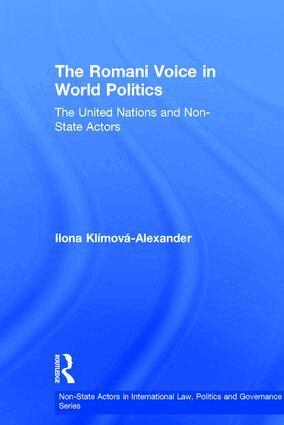
Ilona KlÃmová-Alexander brings Europe's largest transnational and most marginalized ethnic minority, the Roma (Gypsies), into the discourse of international relations. The book describes and analyzes the attempts of the Romani activists to gain voice in world politics by interacting with the United Nations (UN) system and explores their capabilities and impact. This study has three objectives: it provides an introduction to global Romani activism in terms of its anatomy, history, political manifestos, goals and activities; it establishes the extent and essence of the Romani voice in world politics and its influence on the UN discourse on Roma; furthermore, it looks at how interacting with the UN system has affected the organizational structure of the global Romani activism and its discourse. Based largely on primary resources and fieldwork, this book will engage international relations scholars, political scientists and those concerned with social movements and ethnic and racial studies.
Choosing the Lesser Evil
Understanding Decision Making in Humanitarian Aid NGOs
Inbunden, Engelska, 2007
2 096 kr
Skickas inom 10-15 vardagar
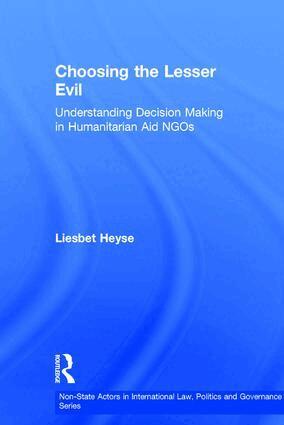
How do non-governmental humanitarian aid organizations initiate, terminate and extend their project activities? Humanitarian aid organizations regularly face difficult decisions about life and death in a context of serious time constraints which force them daily to select whom to help and whom not to help. Liesbet Heyse focuses on how humanitarian aid organizations make these decisions and provides an inside view of the decision making processes. Two NGO case studies are used as illustration - Médecins sans Frontières (MSF) and Acting with Churches Together (ACT) - both of which operate in an international network and represent specific types of NGOs often found in the community. This book opens up the black box of NGO operations, provides an empirical account of organizational decision making and combines insights of organization theory and organizational decision making theory.
Closing or Widening the Gap?
Legitimacy and Democracy in Regional Integration Organizations
Inbunden, Engelska, 2007
1 928 kr
Skickas inom 10-15 vardagar
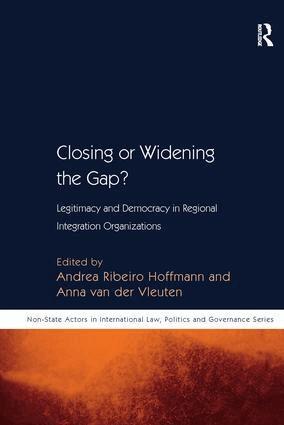
Combining normative analysis and theory-driven empirical research in a comparative framework, this volume clarifies and explains the connections between regional international governance, legitimacy and democracy. It focuses on the quality of democracy and the legitimacy of policy making in multilevel regional systems. The volume offers a much-needed clarification of confusing concepts such as legitimacy, democracy and 'civil society' in non-national political systems. It critically assesses the quality of democracy and legitimacy within different Regional International Organizations (RIOs); it examines how networks of non-state actors become a kind of transnational civil society and assesses their potential for solving legitimacy deficits; and it investigates the impact of democratic conditionality in different RIOs. The contributors deepen our understanding of a relatively new non-state actor on the international scene - the regional international organization - and investigate the potential contribution of transnational non-state actors to the quality of governance at the regional level.
2 096 kr
Skickas inom 10-15 vardagar
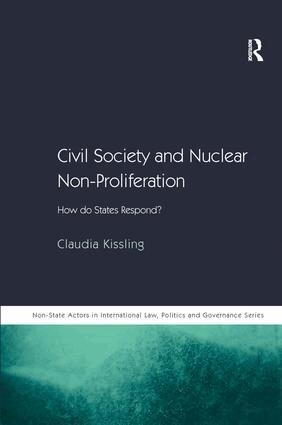
Since the end of the Cold War, globalization has brought new actors to the political arena. One of those which has attracted considerable attention in academic research is civil society or NGOs. Claudia Kissling addresses the topic of civil society participation in the nuclear non-proliferation regime. The regime qualifies well for this objective since it features, given its characteristics as a treaty regime in the international security field, notable legal avenues for civil society participation. The study takes on a twofold perspective. It addresses the empirical question of whether civil society can contribute to the evolution of regimes in the security field, especially when it comes to security cooperation. It also questions whether civil society can, under certain conditions, contribute to the democratic quality of international decision-making. Here, empirical findings are used in order to test normative political theories on the legitimacy and democracy of global institutions.
Transforming Law and Institution
Indigenous Peoples, the United Nations and Human Rights
Inbunden, Engelska, 2011
1 928 kr
Skickas inom 10-15 vardagar
In the past thirty or so years, discussions of the status and rights of indigenous peoples have come to the forefront of the United Nations human rights agenda. During this period, indigenous peoples have emerged as legitimate subjects of international law with rights to exist as distinct peoples. At the same time, we have witnessed the establishment of a number of UN fora and mechanisms on indigenous issues, including the UN Permanent Forum on Indigenous Issues, all pointing to the importance that the UN has come to place on the promotion and protection of indigenous peoples' rights. Morgan describes, analyses, and evaluates the efforts of the global indigenous movement to engender changes in UN discourse and international law on indigenous peoples' rights and to bring about certain institutional developments reflective of a heightened international concern. By the same token, focusing on the interaction of the global indigenous movement with the UN system, this book examines the reverse influence, that is, the ways in which interacting with the UN system has influenced the claims, tactical repertoires, and organizational structures of the movement.
Making Corporate Social Responsibility a Global Concern
Norm Construction in a Globalizing World
Inbunden, Engelska, 2010
2 096 kr
Skickas inom 10-15 vardagar
In recent decades, claims have increasingly been made on transnational corporations to take responsibility for the promotion and protection of human and labour rights in countries where they operate. This behavioural obligation results from the persistent advocacy of non-governmental organizations and is commonly known as corporate social responsibility (CSR). Driven by the theory of the 'norm life cycle model', the book uses an interesting range of case studies, including Nike and the anti-apartheid movement, to trace the development of CSR as an international norm. The development is examined through five selected non-governmental organizations: Clean Clothes Campaign, Fairtrade Labelling Organizations International, Global Exchange, International Business Leaders Forum and the International Labor Rights Fund. The book makes a lucid contribution to an emerging scholarship, and will interest researchers and practitioners involved in issues of global governance and global civil society.
2 096 kr
Skickas inom 10-15 vardagar
How do international organizations support local peacebuilding? Do they really understand conflict? Partners in Peace challenges the global perceptions and assumptions of the roles played by civil society in peacebuilding and offers a radically new perspective on how international organizations can support such efforts. Framing the debate using case studies from Africa and Central America, the author examines different meanings of peacebuilding, the practices and politics of interpreting conflict and how planned interventions work out. Comparing original views with contemporary perceptions of non-state actors, Partners in Peace includes many recommendations for NGOs involved in peacebuilding and constructs a new understanding on how these possible solutions relate to politics and practices on the ground. Concise in both theoretical and empirical analysis, this book is an important contribution to our understanding of civil society's role in building sustainable peace.
2 096 kr
Skickas inom 10-15 vardagar
This book explores the role and relevance of non-state actors (NSAs) in the international system by analyzing the ways these actors gain influence in the United Nations (UN). Offering a systematic, theoretical, and empirical account of how NSAs contest and potentially change state sovereignty through the UN the author considers the successes and failures of national liberation movements and indigenous peoples and examines how and under what conditions such a challenge is possible. This book will be of great interest to scholars and graduate students in the fields of international law, politics, history, human rights, and governance. It will be especially useful to those with an interest in the proliferation of non-state actors in the international system and the role and relevance of Intergovernmental Organizations.
573 kr
Skickas inom 10-15 vardagar
This book explores the role and relevance of non-state actors (NSAs) in the international system by analyzing the ways these actors gain influence in the United Nations (UN). Offering a systematic, theoretical, and empirical account of how NSAs contest and potentially change state sovereignty through the UN the author considers the successes and failures of national liberation movements and indigenous peoples and examines how and under what conditions such a challenge is possible. This book will be of great interest to scholars and graduate students in the fields of international law, politics, history, human rights, and governance. It will be especially useful to those with an interest in the proliferation of non-state actors in the international system and the role and relevance of Intergovernmental Organizations.
573 kr
Skickas inom 10-15 vardagar
The often violent emergence of new independent states following the end of the Cold War generated discussion about the normative grounds of territorial separatism. A number of opposing approaches surfaced debating whether and under which circumstances there is a right for a community to secede from its host country. Overwhelmingly, these studies placed emphasis on the right to secession and neglected the moral stance of secessionist movements as agents in international relations. In this book Costas Laoutides explores the collective moral agency involved in secessionist struggles offering a theoretical model for the collective responsibility of secessionist groups. Case-studies on the Kurds and the people of Moldova-Transdniestria illustrate the author’s theoretical arguments as he seeks to establish how, although the principle of self-determination was envisaged as a means of gradually bestowing political power upon the people, it never managed to realize its full potential because it was interpreted strictly within a framework of exclusionary politics of identity.
688 kr
Skickas inom 10-15 vardagar
Ilona KlÃmová-Alexander brings Europe's largest transnational and most marginalized ethnic minority, the Roma (Gypsies), into the discourse of international relations. The book describes and analyzes the attempts of the Romani activists to gain voice in world politics by interacting with the United Nations (UN) system and explores their capabilities and impact. This study has three objectives: it provides an introduction to global Romani activism in terms of its anatomy, history, political manifestos, goals and activities; it establishes the extent and essence of the Romani voice in world politics and its influence on the UN discourse on Roma; furthermore, it looks at how interacting with the UN system has affected the organizational structure of the global Romani activism and its discourse. Based largely on primary resources and fieldwork, this book will engage international relations scholars, political scientists and those concerned with social movements and ethnic and racial studies.
1 928 kr
Skickas inom 10-15 vardagar
Non-state actors have always been treated with ambivalence in the works of international law. While their empirical existence is widely acknowledged and their impact and influence uncontested, non-state actors are still not in the centre of international legal research. The idea that non-state actors are not law-makers, however, stands in sharp contrast with the growing notion of non-state actors as law-takers. This book examines the position of non-state actors in international law as law-makers and law-takers and questions whether these different positions can or should be separated from each other. Each contribution reveals both the political and normative aspects of the question as well as the positivistic possibilities and constraints to accommodate non-state actors as law-takers and law-makers in the contemporary international legal system. Altogether, each expert reveals that the position of non-state actors in international law is not a fixed one but changes with the functional and theoretical perspectives of the observer. Non-State Actor Dynamics in International Law is a welcomed addition to an under researched field of legal study. An indispensable read to scholars and policy makers wishing to gain new insights into general discourse on non-state actors in international law and the process of norm formation in the international realm.
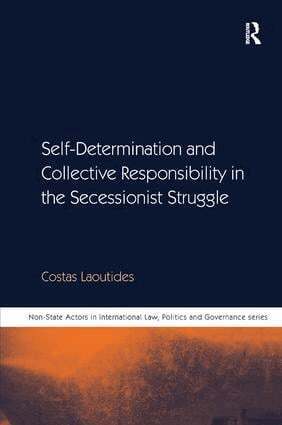
Self-Determination and Collective Responsibility in the Secessionist Struggle
Inbunden, Engelska, 2015
1 928 kr
Skickas inom 10-15 vardagar
The often violent emergence of new independent states following the end of the Cold War generated discussion about the normative grounds of territorial separatism. A number of opposing approaches surfaced debating whether and under which circumstances there is a right for a community to secede from its host country. Overwhelmingly, these studies placed emphasis on the right to secession and neglected the moral stance of secessionist movements as agents in international relations. In this book Costas Laoutides explores the collective moral agency involved in secessionist struggles offering a theoretical model for the collective responsibility of secessionist groups. Case-studies on the Kurds and the people of Moldova-Transdniestria illustrate the author’s theoretical arguments as he seeks to establish how, although the principle of self-determination was envisaged as a means of gradually bestowing political power upon the people, it never managed to realize its full potential because it was interpreted strictly within a framework of exclusionary politics of identity.