Routledge Advances in Behavioural Economics and Finance – serie
Visar alla böcker i serien Routledge Advances in Behavioural Economics and Finance. Handla med fri frakt och snabb leverans.
20 produkter
20 produkter
Inbunden, Engelska, 2020
2 073 kr
Skickas inom 10-15 vardagar
Neuroeconomics has emerged as a paradigmatic field where neuroscience and the social sciences are integrated in one analytical and empirical approach. However, the different disciplines involved often only relate to each other via the shared object of research, and less through the constructing of precise models of integrative mechanisms.Social Neuroeconomics explores the potential of philosophical and methodological reflections in the neurosciences and the social sciences to inform those efforts at cross-disciplinary integration, with a special focus on recent contributions to mechanistic explanations. The collected essays are drawn from the fields of neuroscience, psychology, economics, sociology and philosophy, and examine the ways and methods of constructing unified conceptual frameworks that can guide empirical work and hypothesis building. This is demonstrated in a range of applications, particularly regarding finance and consumer behavior. The concept of the ‘social brain’ is also explored; a multilevel framework in which complex analytical categories such as emotions or socially mediated cognitive processes connect neuronal and social phenomena in specific mechanisms that generate behavior.This book addresses a wide audience across the various disciplines, reaching from the neurosciences to the social sciences and philosophy.
Häftad, Engelska, 2019
353 kr
Skickas inom 10-15 vardagar
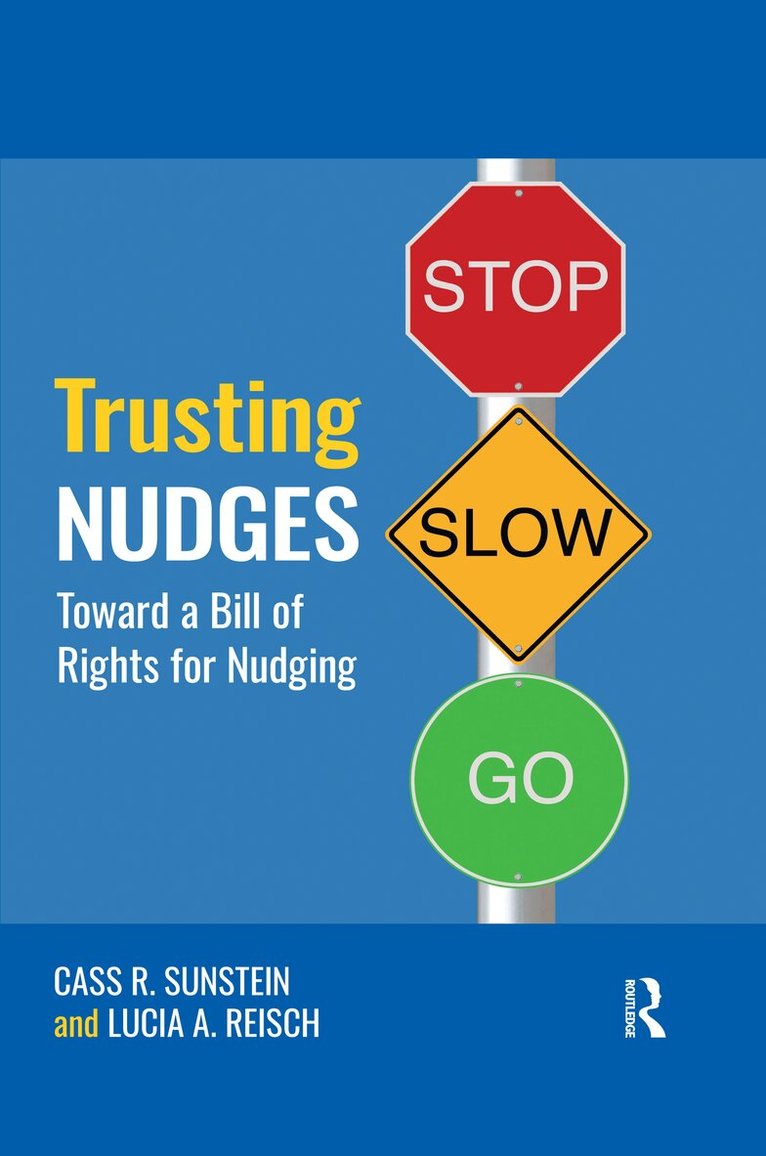
Many "nudges" aim to make life simpler, safer, or easier for people to navigate, but what do members of the public really think about these policies? Drawing on surveys from numerous nations around the world, Sunstein and Reisch explore whether citizens approve of nudge policies. Their most important finding is simple and striking. In diverse countries, both democratic and nondemocratic, strong majorities approve of nudges designed to promote health, safety, and environmental protection—and their approval cuts across political divisions.In recent years, many governments have implemented behaviorally informed policies, focusing on nudges—understood as interventions that preserve freedom of choice, but that also steer people in certain directions. In some circles, nudges have become controversial, with questions raised about whether they amount to forms of manipulation. This fascinating book carefully considers these criticisms and answers important questions. What do citizens actually think about behaviorally informed policies? Do citizens have identifiable principles in mind when they approve or disapprove of the policies? Do citizens of different nations agree with each other?From the answers to these questions, the authors identify six principles of legitimacy—a "bill of rights" for nudging that build on strong public support for nudging policies around the world, while also recognizing what citizens disapprove of. Their bill of rights is designed to capture citizens’ central concerns, reflecting widespread commitments to freedom and welfare that transcend national boundaries.
Häftad, Engelska, 2022
713 kr
Skickas inom 10-15 vardagar
Neuroeconomics has emerged as a paradigmatic field where neuroscience and the social sciences are integrated in one analytical and empirical approach. However, the different disciplines involved often only relate to each other via the shared object of research, and less through the constructing of precise models of integrative mechanisms.Social Neuroeconomics explores the potential of philosophical and methodological reflections in the neurosciences and the social sciences to inform those efforts at cross-disciplinary integration, with a special focus on recent contributions to mechanistic explanations. The collected essays are drawn from the fields of neuroscience, psychology, economics, sociology and philosophy, and examine the ways and methods of constructing unified conceptual frameworks that can guide empirical work and hypothesis building. This is demonstrated in a range of applications, particularly regarding finance and consumer behavior. The concept of the ‘social brain’ is also explored; a multilevel framework in which complex analytical categories such as emotions or socially mediated cognitive processes connect neuronal and social phenomena in specific mechanisms that generate behavior.This book addresses a wide audience across the various disciplines, reaching from the neurosciences to the social sciences and philosophy.
Inbunden, Engelska, 2021
2 540 kr
Skickas inom 10-15 vardagar
Economists have entered into the realm of sports to provide what they believe to be more cogent explanations for sport-related behaviour and to suggest ways in which incentives can improve sports outcomes. But prices and income, the traditional workhorses of conventional economics, can only provide partial explanations and understandings. Drawing on a bounded rationality approach to behavioural economics, this book demonstrates the analytical insights to be gained by supplementing the conventional economics toolbox with psychological, cognitive, sociological, and institutional factors.The international cast list of contributors cover a wide range of sports topics on which a behavioural approach can reveal new insights. These include preferences, managerial, efficiency, choking, doping, favouritism, athlete well- being, and spectator behaviour. Throughout the book, there is an emphasis on the cognitive limits to smart decision-making as well as the critical role played by the decision-making environment. This volume demonstrates that adopting a bounded rationality approach, complimented with other behaviouralist approaches, helps to better explain sport-related behavioural, sub-optimal behavioural, and market failures. It also provides insights that could be used to improve sports outcomes and the well-being of those involved in sports and to better configure policy to enhance sports performance.This groundbreaking book will be an indispensable reference to students and scholars of sports economics, sports management, and sports science.
Häftad, Engelska, 2023
713 kr
Skickas inom 10-15 vardagar
Economists have entered into the realm of sports to provide what they believe to be more cogent explanations for sport-related behaviour and to suggest ways in which incentives can improve sports outcomes. But prices and income, the traditional workhorses of conventional economics, can only provide partial explanations and understandings. Drawing on a bounded rationality approach to behavioural economics, this book demonstrates the analytical insights to be gained by supplementing the conventional economics toolbox with psychological, cognitive, sociological, and institutional factors.The international cast list of contributors cover a wide range of sports topics on which a behavioural approach can reveal new insights. These include preferences, managerial, efficiency, choking, doping, favouritism, athlete well- being, and spectator behaviour. Throughout the book, there is an emphasis on the cognitive limits to smart decision-making as well as the critical role played by the decision-making environment. This volume demonstrates that adopting a bounded rationality approach, complimented with other behaviouralist approaches, helps to better explain sport-related behavioural, sub-optimal behavioural, and market failures. It also provides insights that could be used to improve sports outcomes and the well-being of those involved in sports and to better configure policy to enhance sports performance.This groundbreaking book will be an indispensable reference to students and scholars of sports economics, sports management, and sports science.
Häftad, Engelska, 2021
553 kr
Skickas inom 10-15 vardagar
Applying experimental methods has become one of the most powerful and versatile ways to obtain economic insights, and experimental economics has especially supported the development of behavioral economics. The Art of Experimental Economics identifies and reviews 20 of the most important papers to have been published in experimental economics in order to highlight the power and methods of this area, and provides many examples of findings in behavioral economics that have extended knowledge in the economics discipline as a whole.Chosen through a combination of citations, recommendations by scholars in the field, and voting by members of leading societies, the 20 papers under review – some by Nobel prize-winning economists – run the full gamut of experimental economics from theoretical expositions to applications demonstrating experimental economics in action. Also written by a leading experimental economist, each chapter provides a brief summary of the paper, makes the case for why that paper is one of the top 20 in the field, discusses the use made of the experimental method, and considers related work to provide context for each paper. These reviews quickly expose readers to the breadth of application possibilities and the methodological issues, leaving them with a firm understanding of the legacy of the papers’ contributions.This text provides a survey of some of the very best research in experimental and behavioral economics and is a valuable resource for scholars and economics instructors, students seeking to develop capability in applying experimental methods, and economics researchers who wish to further explore the experimental approach.
Inbunden, Engelska, 2021
1 747 kr
Skickas
Applying experimental methods has become one of the most powerful and versatile ways to obtain economic insights, and experimental economics has especially supported the development of behavioral economics. The Art of Experimental Economics identifies and reviews 20 of the most important papers to have been published in experimental economics in order to highlight the power and methods of this area, and provides many examples of findings in behavioral economics that have extended knowledge in the economics discipline as a whole.Chosen through a combination of citations, recommendations by scholars in the field, and voting by members of leading societies, the 20 papers under review – some by Nobel prize-winning economists – run the full gamut of experimental economics from theoretical expositions to applications demonstrating experimental economics in action. Also written by a leading experimental economist, each chapter provides a brief summary of the paper, makes the case for why that paper is one of the top 20 in the field, discusses the use made of the experimental method, and considers related work to provide context for each paper. These reviews quickly expose readers to the breadth of application possibilities and the methodological issues, leaving them with a firm understanding of the legacy of the papers’ contributions.This text provides a survey of some of the very best research in experimental and behavioral economics and is a valuable resource for scholars and economics instructors, students seeking to develop capability in applying experimental methods, and economics researchers who wish to further explore the experimental approach.
Inbunden, Engelska, 2011
2 409 kr
Skickas inom 10-15 vardagar
Economics and moral philosophy have in recent years been considered to be distinct and separate fields. However, behavioural economics has started to reconcile various aspects of morality and economics, which has offered new conceptual opportunities to advance economics ethics and business ethics. This book aims to advance economic ethics and business ethics by combining normative principles and empirical evidence grounded on the key motivational forces in economic decision making. It has three core objectives: to assess order ethics as a theory of both economic ethics and business ethics, using behavioural economics methods and evidence; to identify cardinal virtues for modern business ethics; to to set up valuable guidelines for the implementation of economic ethics and business ethics.
Häftad, Engelska, 2013
699 kr
Skickas inom 10-15 vardagar
Economics and moral philosophy have in recent years been considered to be distinct and separate fields. However, behavioural economics has started to reconcile various aspects of morality and economics, which has offered new conceptual opportunities to advance economics ethics and business ethics. This book aims to advance economic ethics and business ethics by combining normative principles and empirical evidence grounded on the key motivational forces in economic decision making. It has three core objectives: to assess order ethics as a theory of both economic ethics and business ethics, using behavioural economics methods and evidence; to identify cardinal virtues for modern business ethics; to to set up valuable guidelines for the implementation of economic ethics and business ethics.
Inbunden, Engelska, 2022
2 073 kr
Skickas inom 10-15 vardagar
In recent years, the idea of "nudges" – small changes in individual choice architecture that do not involve incentives or coercion – has entered policy discourse and practice to address various problems ranging from energy usage to retirement savings. However, how nudges can be incorporated into regulatory practice, and whether the experimental methodologies used to design nudges are still appropriate when they are being used as a regulatory instrument is still an unexplored issue. As this book shows, the translation of ideas into the world of regulation is not so simple and straightforward.By analysing the different experimental alternatives that regulators can use when designing nudges and through a close analysis of a real-world example – the case of the European Union tobacco warnings – this book proposes an alternative design process more in tune with the reality of regulation. The book explores the implications of iterative experimental methodologies and processes for regulators, concluding with a call for an alternative nudging’s design process tailored to the regulatory space.This book is crucial for researchers and policy-makers interested in the incorporation of nudging into regulation and anyone interested in the implications of behavioural economics – and evidence more generally – for regulatory design.
Häftad, Engelska, 2024
602 kr
Skickas inom 10-15 vardagar
In recent years, the idea of "nudges" – small changes in individual choice architecture that do not involve incentives or coercion – has entered policy discourse and practice to address various problems ranging from energy usage to retirement savings. However, how nudges can be incorporated into regulatory practice, and whether the experimental methodologies used to design nudges are still appropriate when they are being used as a regulatory instrument is still an unexplored issue. As this book shows, the translation of ideas into the world of regulation is not so simple and straightforward.By analysing the different experimental alternatives that regulators can use when designing nudges and through a close analysis of a real-world example – the case of the European Union tobacco warnings – this book proposes an alternative design process more in tune with the reality of regulation. The book explores the implications of iterative experimental methodologies and processes for regulators, concluding with a call for an alternative nudging’s design process tailored to the regulatory space.This book is crucial for researchers and policy-makers interested in the incorporation of nudging into regulation and anyone interested in the implications of behavioural economics – and evidence more generally – for regulatory design.
Inbunden, Engelska, 2023
2 133 kr
Skickas inom 10-15 vardagar
With the rise of modern behavioural economics and increasing interest in subjective well-being research, the question of the relationship between economics and psychology has again been brought to the fore. Drawing on the history of economic thought, this book explores the historical relationship between the two disciplines. The book opens with a description of the primary philosophical foundations for early arguments supporting the interplay between economics and psychology. Both classical economists and other prominent pre-marginalists writers are examined in this context. The ensuing discussion explores the marginalist revolution and how well-known economists like Jevons and Edgeworth, influenced by pre-marginalist writers, incorporated ideas and findings from psychology. The book then describes how, following the so-called “Paretian turn”, early neoclassical economists attempted to expel psychological concepts from economic analysis. Combined with the increasing formalization, the influence of the classical physics scientific ideal, and the impact of positivism, this methodological stance became dominant in modern mainstream economics. In contrast, non-mainstream traditions continued to acknowledge the significance of psychology in their economic analysis. This tradition includes inter alia the so-called old behavioural economics, mainly of Herbert Simon and George Katona. The revival of psychology in economics came mainly with the emergence and development of new behavioural economics as a distinct branch during the last few decades. The trend was further assisted by the emergence of the economics of subjective well-being. Finally, the book briefly explores the state of the current debate concerning the relationship between economics and psychology. This book will be invaluable reading to anyone interested in the history of the study of economics and psychology, as well as of great interest to students and scholars of history of economic thought, psychological economics, behavioural economics and the history and philosophy of social sciences.
Häftad, Engelska, 2025
639 kr
Skickas inom 10-15 vardagar
With the rise of modern behavioural economics and increasing interest in subjective well-being research, the question of the relationship between economics and psychology has again been brought to the fore. Drawing on the history of economic thought, this book explores the historical relationship between the two disciplines. The book opens with a description of the primary philosophical foundations for early arguments supporting the interplay between economics and psychology. Both classical economists and other prominent pre-marginalists writers are examined in this context. The ensuing discussion explores the marginalist revolution and how well-known economists like Jevons and Edgeworth, influenced by pre-marginalist writers, incorporated ideas and findings from psychology. The book then describes how, following the so-called “Paretian turn”, early neoclassical economists attempted to expel psychological concepts from economic analysis. Combined with the increasing formalization, the influence of the classical physics scientific ideal, and the impact of positivism, this methodological stance became dominant in modern mainstream economics. In contrast, non-mainstream traditions continued to acknowledge the significance of psychology in their economic analysis. This tradition includes inter alia the so-called old behavioural economics, mainly of Herbert Simon and George Katona. The revival of psychology in economics came mainly with the emergence and development of new behavioural economics as a distinct branch during the last few decades. The trend was further assisted by the emergence of the economics of subjective well-being. Finally, the book briefly explores the state of the current debate concerning the relationship between economics and psychology. This book will be invaluable reading to anyone interested in the history of the study of economics and psychology, as well as of great interest to students and scholars of history of economic thought, psychological economics, behavioural economics and the history and philosophy of social sciences.
Inbunden, Engelska, 2022
1 985 kr
Skickas inom 10-15 vardagar
Economic Biology and Behavioral Economics: The Prophesy of Alfred Marshall explores the prophesy of Alfred Marshall, the grand synthesizer of neoclassical economics, that the "Mecca of the economist lies in economic biology".The book presents the proof of that prophesy through examination and establishment of the fundamental biological science necessary and then applying that science to the examination of current economic theory. In doing so, the book focuses primarily on the fundamentals of neoclassical economic theory— which is the reigning theory and the general framework of which is taught as "science" in first courses in college economics. These courses are at best an idealization, if not an ideology, of the discipline—presented to fresh minds misleadingly as confirmed science. The book examines the bases and the history of these idealizations, points to the sources of their error from the biological perspective and suggests a path forward for the discipline. Through this process, the book demonstrates the power of the biological perspective anticipated by Marshall.This book provides invaluable reading for anyone interested in the future of economics and economic theory, and particularly those interested in behavioral economics and neuroeconomics.
Häftad, Engelska, 2024
586 kr
Skickas inom 10-15 vardagar
Economic Biology and Behavioral Economics: The Prophesy of Alfred Marshall explores the prophesy of Alfred Marshall, the grand synthesizer of neoclassical economics, that the "Mecca of the economist lies in economic biology".The book presents the proof of that prophesy through examination and establishment of the fundamental biological science necessary and then applying that science to the examination of current economic theory. In doing so, the book focuses primarily on the fundamentals of neoclassical economic theory— which is the reigning theory and the general framework of which is taught as "science" in first courses in college economics. These courses are at best an idealization, if not an ideology, of the discipline—presented to fresh minds misleadingly as confirmed science. The book examines the bases and the history of these idealizations, points to the sources of their error from the biological perspective and suggests a path forward for the discipline. Through this process, the book demonstrates the power of the biological perspective anticipated by Marshall.This book provides invaluable reading for anyone interested in the future of economics and economic theory, and particularly those interested in behavioral economics and neuroeconomics.
Inbunden, Engelska, 2019
2 073 kr
Skickas inom 10-15 vardagar
Many "nudges" aim to make life simpler, safer, or easier for people to navigate, but what do members of the public really think about these policies? Drawing on surveys from numerous nations around the world, Sunstein and Reisch explore whether citizens approve of nudge policies. Their most important finding is simple and striking. In diverse countries, both democratic and nondemocratic, strong majorities approve of nudges designed to promote health, safety, and environmental protection—and their approval cuts across political divisions.In recent years, many governments have implemented behaviorally informed policies, focusing on nudges—understood as interventions that preserve freedom of choice, but that also steer people in certain directions. In some circles, nudges have become controversial, with questions raised about whether they amount to forms of manipulation. This fascinating book carefully considers these criticisms and answers important questions. What do citizens actually think about behaviorally informed policies? Do citizens have identifiable principles in mind when they approve or disapprove of the policies? Do citizens of different nations agree with each other?From the answers to these questions, the authors identify six principles of legitimacy—a "bill of rights" for nudging that build on strong public support for nudging policies around the world, while also recognizing what citizens disapprove of. Their bill of rights is designed to capture citizens’ central concerns, reflecting widespread commitments to freedom and welfare that transcend national boundaries.
Häftad, Engelska, 2018
687 kr
Skickas inom 10-15 vardagar
Economics Nobel Laureate Herbert Simon developed the concept of bounded rationality in the 1950s. This asserts that the cognitive abilities of human decision-makers are not always sufficient to find optimal solutions to complex real-life problems, leading decision-makers to find satisfactory, sub-optimal outcomes. This was a foundational component of the development of Behavioural Economics but in recent years the two fields have diverged, each with its own literature, its own approach and its own proponents. Behavioural Economics explores the areas of commonality between Economics and Psychology, in terms of its focus and its approach, whereas the bounded rationality literature largely analyses the implications of sub-optimal decision‐making through the mathematically sophisticated methodology of mainstream Economics. This book examines the nature and consequences of this divergence and questions whether this is a case of beneficial specialisation or whether it is unhelpful, potentially stunting the development of some aspects of Economics. It has been suggested that the major deficiency of Behavioural Economics is that it has failed to produce a single, widely applicable alternative to constrained optimisation. This book evaluates the extent to which this is the true and, if it is, the extent to which it is a product of the divergence between the two literatures. It also seeks to identify commonalities between the two subjects and suggests avenues of research in Economics that would benefit from a re-fusion of these two fields.
Häftad, Engelska, 2018
699 kr
Skickas inom 10-15 vardagar
Corporate governance failures are all too frequent and their patterns and outcomes seem avoidably familiar. This book examines the findings of behavioural finance and economics that are most relevant to governance problems, and suggests potential solutions that are best suited to real-world practice and circumstance.There is a great deal of existing theory that claims to predict the causes and effects of poor governance, and provide solutions. However, the implementation of such measures seems to do little more than merely delay inevitable crises. This book develops a synthesis framework to examine the relative strengths and weaknesses of a behavioural versus deductive approach to understanding the failures of governance. It concludes with a discussion of how corporate governance theory may need to shift going forward, perhaps to include a ‘heterodox’ ecosystem of theoretical paradigms.This book will be of interest to students, researchers and practitioners concerned with corporate governance, economic theory and behavioural economics.
Inbunden, Engelska, 2015
2 140 kr
Skickas inom 10-15 vardagar
Economics Nobel Laureate Herbert Simon developed the concept of bounded rationality in the 1950s. This asserts that the cognitive abilities of human decision-makers are not always sufficient to find optimal solutions to complex real-life problems, leading decision-makers to find satisfactory, sub-optimal outcomes. This was a foundational component of the development of Behavioural Economics but in recent years the two fields have diverged, each with its own literature, its own approach and its own proponents. Behavioural Economics explores the areas of commonality between Economics and Psychology, in terms of its focus and its approach, whereas the bounded rationality literature largely analyses the implications of sub-optimal decision‐making through the mathematically sophisticated methodology of mainstream Economics. This book examines the nature and consequences of this divergence and questions whether this is a case of beneficial specialisation or whether it is unhelpful, potentially stunting the development of some aspects of Economics. It has been suggested that the major deficiency of Behavioural Economics is that it has failed to produce a single, widely applicable alternative to constrained optimisation. This book evaluates the extent to which this is the true and, if it is, the extent to which it is a product of the divergence between the two literatures. It also seeks to identify commonalities between the two subjects and suggests avenues of research in Economics that would benefit from a re-fusion of these two fields.
Inbunden, Engelska, 2015
2 338 kr
Skickas inom 10-15 vardagar
Corporate governance failures are all too frequent and their patterns and outcomes seem avoidably familiar. This book examines the findings of behavioural finance and economics that are most relevant to governance problems, and suggests potential solutions that are best suited to real-world practice and circumstance.There is a great deal of existing theory that claims to predict the causes and effects of poor governance, and provide solutions. However, the implementation of such measures seems to do little more than merely delay inevitable crises. This book develops a synthesis framework to examine the relative strengths and weaknesses of a behavioural versus deductive approach to understanding the failures of governance. It concludes with a discussion of how corporate governance theory may need to shift going forward, perhaps to include a ‘heterodox’ ecosystem of theoretical paradigms.This book will be of interest to students, researchers and practitioners concerned with corporate governance, economic theory and behavioural economics.