Routledge Library Editions: Philosophy of Mind - Böcker
Visar alla böcker i serien Routledge Library Editions: Philosophy of Mind. Handla med fri frakt och snabb leverans.
17 produkter
17 produkter
19 554 kr
Skickas inom 10-15 vardagar
Reissuing works originally published between 1949 and ‘79, this set presents a rich selection of renowned scholarship across the subject, touching also on ethics, religion, and psychology and other behavioural science. Classic previously out-of-print works are brought back into print here in this set of important discourse and theory.
2 113 kr
Skickas inom 10-15 vardagar
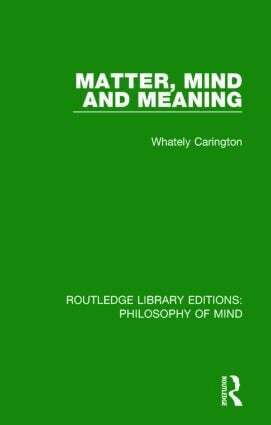
This volume is concerned with the philosophical foundations of Psychical Research. Traditional metaphysical theories have led to apparently insoluble problems concerning the nature of mind, of matter and the relation between the two. The author holds that these theories arise from misconception about the way in which words acquire meaning. His aim is to show that once the relation between words and the experienceable entities which they mean is clearly understood, these seemingly insoluble problems disappear, and the metaphysical theories which give rise to them are seen to be literally nonsensical. The philosophy which results is a radically empirical one, a form of Neutral Monism.The book intended to ‘clear the decks’ for Psychical Research by removing certain traditional pseudo-problems, but it will be of interest to all who followed the revival of Empiricist Philosophy, whether they are students of Psychical Research or not. It is written in a pithy and sparkling style, with a minimum of technical terms, and serves as an introduction to Empiricist Philosophy. Originally published 1949.
2 113 kr
Skickas inom 10-15 vardagar
Presenting some modern views on the problem of the nature of mind and its relationship to the brain, this book, published in 1965, brings together contributors from various disciplines which are affected by this issue. Coming from different philosophical outlooks as well as subjects, these contributors also comment on each other’s’ chapters with a view of developing thought on the approaches to the problem. The theory of mind-brain relationship is vital to human interest and has been in debate throughout western thought over centuries, split mainly into dualist and monistic theories. These discussions had and still have wide impact philosophy, psychology, religion and cosmology, among other areas.
1 705 kr
Skickas inom 10-15 vardagar
The concepts of mind and soul have occupied the thoughts of philosophers throughout the ages and have given rise to numerous conflicting theories. This book provides an incisive and stimulating introduction to central tropics in the philosophy of mind. The author writes about the differences and connections between the ideas of ‘mind’ and ‘soul’ and about the metaphysical issues of Dualism, Solipsism, Behaviourism and Materialism. In the course of her account she discusses the arguments of several philosophers including Plato, Descartes, Wittgenstein, Ryle and Hume. Review of the original edition, 1974:"It is clear, incisive and unidiosyncratic. Issues and theories are discussed simply yet without serious distortion or vapidity, and the book is full of argument.’ – Stewart Candish, Mind
578 kr
Skickas inom 10-15 vardagar
This volume is concerned with the philosophical foundations of Psychical Research. Traditional metaphysical theories have led to apparently insoluble problems concerning the nature of mind, of matter and the relation between the two. The author holds that these theories arise from misconception about the way in which words acquire meaning. His aim is to show that once the relation between words and the experienceable entities which they mean is clearly understood, these seemingly insoluble problems disappear, and the metaphysical theories which give rise to them are seen to be literally nonsensical. The philosophy which results is a radically empirical one, a form of Neutral Monism.The book intended to ‘clear the decks’ for Psychical Research by removing certain traditional pseudo-problems, but it will be of interest to all who followed the revival of Empiricist Philosophy, whether they are students of Psychical Research or not. It is written in a pithy and sparkling style, with a minimum of technical terms, and serves as an introduction to Empiricist Philosophy. Originally published 1949.
578 kr
Skickas inom 10-15 vardagar
Presenting some modern views on the problem of the nature of mind and its relationship to the brain, this book, published in 1965, brings together contributors from various disciplines which are affected by this issue. Coming from different philosophical outlooks as well as subjects, these contributors also comment on each other’s’ chapters with a view of developing thought on the approaches to the problem. The theory of mind-brain relationship is vital to human interest and has been in debate throughout western thought over centuries, split mainly into dualist and monistic theories. These discussions had and still have wide impact philosophy, psychology, religion and cosmology, among other areas.
578 kr
Skickas inom 10-15 vardagar
The concepts of mind and soul have occupied the thoughts of philosophers throughout the ages and have given rise to numerous conflicting theories. This book provides an incisive and stimulating introduction to central tropics in the philosophy of mind. The author writes about the differences and connections between the ideas of ‘mind’ and ‘soul’ and about the metaphysical issues of Dualism, Solipsism, Behaviourism and Materialism. In the course of her account she discusses the arguments of several philosophers including Plato, Descartes, Wittgenstein, Ryle and Hume. Review of the original edition, 1974:"It is clear, incisive and unidiosyncratic. Issues and theories are discussed simply yet without serious distortion or vapidity, and the book is full of argument.’ – Stewart Candish, Mind
2 113 kr
Skickas inom 10-15 vardagar
This book, published in 1976, presents an entirely original approach to the subject of the mind-body problem, examining it in terms of the conceptual links between the physical sciences and the sciences of human behaviour. It is based on the cybernetic concepts of information and feedback and on the related concepts of thermodynamic and communication-theoretic entropy.The foundation of the approach is the theme of continuity between evolution, learning and human consciousness. The author defines life as a process of energy exchange between organism and environment, and evolution as a feedback process maintaining equilibrium between environment and reproductive group. He demonstrates that closely related feedback processes on the levels of the behaving organism and of the organism’s nervous system constitute the phenomena of learning and consciousness respectively. He analyses language as an expedient for extending human information-processing and control capacities beyond those provided by one’s own nervous system, and shows reason to be a mode of processing information in the form of concepts removed from immediate stimulus control. The last chapter touches on colour vision, pleasure and pain, intentionality, self-awareness and other subjective phenomena. Of special interest to the communication theorist and philosopher, this study is also of interest to psychologists and anyone interested in the connection between the physical and life sciences.
578 kr
Skickas inom 10-15 vardagar
This book, published in 1976, presents an entirely original approach to the subject of the mind-body problem, examining it in terms of the conceptual links between the physical sciences and the sciences of human behaviour. It is based on the cybernetic concepts of information and feedback and on the related concepts of thermodynamic and communication-theoretic entropy.The foundation of the approach is the theme of continuity between evolution, learning and human consciousness. The author defines life as a process of energy exchange between organism and environment, and evolution as a feedback process maintaining equilibrium between environment and reproductive group. He demonstrates that closely related feedback processes on the levels of the behaving organism and of the organism’s nervous system constitute the phenomena of learning and consciousness respectively. He analyses language as an expedient for extending human information-processing and control capacities beyond those provided by one’s own nervous system, and shows reason to be a mode of processing information in the form of concepts removed from immediate stimulus control. The last chapter touches on colour vision, pleasure and pain, intentionality, self-awareness and other subjective phenomena. Of special interest to the communication theorist and philosopher, this study is also of interest to psychologists and anyone interested in the connection between the physical and life sciences.
2 588 kr
Skickas inom 10-15 vardagar
The central theme of this impressively argued study is that the mental and physical are identical. Drawing heavily on recent scientific research into the mind-brain relationship, Dr Wilson argues that human mentality, rationality and purposefulness are phenomena which come within the compass of scientifically based explanation. The consequences of this thesis are enormous both in relation to the controversies about reasons and causes as explanations of human behaviour, and, more important, to the problems of free will, moral responsibility, penal philosophy, ethics and the law. The book argues that free will is a misconceived idea and that our notions of moral responsibility need radical revision. The book is of considerable relevance not only to academic philosophy but also to scientists and jurisprudents interested in the implications of this study. Originally published in 1979.
578 kr
Skickas inom 10-15 vardagar
The central theme of this impressively argued study is that the mental and physical are identical. Drawing heavily on recent scientific research into the mind-brain relationship, Dr Wilson argues that human mentality, rationality and purposefulness are phenomena which come within the compass of scientifically based explanation. The consequences of this thesis are enormous both in relation to the controversies about reasons and causes as explanations of human behaviour, and, more important, to the problems of free will, moral responsibility, penal philosophy, ethics and the law. The book argues that free will is a misconceived idea and that our notions of moral responsibility need radical revision. The book is of considerable relevance not only to academic philosophy but also to scientists and jurisprudents interested in the implications of this study. Originally published in 1979.
2 588 kr
Skickas inom 10-15 vardagar
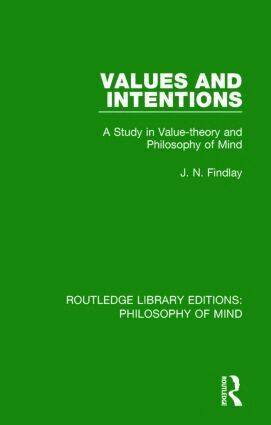
Professor Findlay in this book, originally published in 1961, set out to justify, and to some extent carry out, a ‘material value-ethic’, ie. A systematic setting forth of the ends of rational action.The book is in the tradition of Moore, Rashfall, Ross, Scheler and Hartmann though it avoids altogether dogmatic intuitive methods. It argues that an organised framework of ends of action follows from the attitude underlying our moral pronouncements, and that this framework, while allowing personal elaboration, is not a matter for individual decision. The relations connecting our fundamental value-judgements with one another, and the frames of mind behind them, are not rigorously deductive but are sufficiently compelling to be called logical. Something of a ‘transcendental deduction’ of a well-ordered family for our basic heads of valuation is both possible and necessary. The work is further critical of the notion of obligation which has been extended far beyond legal contracts and understandings. The book also contains a chapter on religion.
618 kr
Skickas inom 10-15 vardagar
Professor Findlay in this book, originally published in 1961, set out to justify, and to some extent carry out, a ‘material value-ethic’, ie. A systematic setting forth of the ends of rational action. The book is in the tradition of Moore, Rashfall, Ross, Scheler and Hartmann though it avoids altogether dogmatic intuitive methods. It argues that an organised framework of ends of action follows from the attitude underlying our moral pronouncements, and that this framework, while allowing personal elaboration, is not a matter for individual decision. The relations connecting our fundamental value-judgements with one another, and the frames of mind behind them, are not rigorously deductive but are sufficiently compelling to be called logical. Something of a ‘transcendental deduction’ of a well-ordered family for our basic heads of valuation is both possible and necessary. The work is further critical of the notion of obligation which has been extended far beyond legal contracts and understandings. The book also contains a chapter on religion.
1 705 kr
Skickas inom 10-15 vardagar
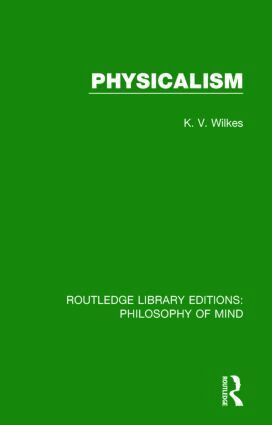
The primary aim of this study is to dissolve the mind-body problem. It shows how the ‘problem’ separates into two distinct sets of issues, concerning ontology on the one hand, and explanation on the other, and argues that explanation – whether or not human behaviour can be explained in physical terms – is the more crucial.The author contends that a functionalist methodology in psychology and neurophysiology will prove adequate to explain human behaviour. Defence of this thesis requires: an examination of the mental/physical dichotomy, and its rejection in favour of a distinction between psychological and physical terms; a description and discussion of functionalism in psychology and neurophysiology, showing how the notorious problem of the necessary intensionality of psychological terms may be circumvented; an examination of the role of computer simulation in psycho-physical research; and an explanation of how the phenomena of sentience fit the functional framework.The book concludes that the thesis presented is in all essentials that of Aristotle; Aristotle had no ‘mind-body problem’, and were it not for a subsequent over-obsession with Cartesian scepticism, we need not have had one either.
673 kr
Skickas inom 10-15 vardagar
The primary aim of this study is to dissolve the mind-body problem. It shows how the ‘problem’ separates into two distinct sets of issues, concerning ontology on the one hand, and explanation on the other, and argues that explanation – whether or not human behaviour can be explained in physical terms – is the more crucial.The author contends that a functionalist methodology in psychology and neurophysiology will prove adequate to explain human behaviour. Defence of this thesis requires: an examination of the mental/physical dichotomy, and its rejection in favour of a distinction between psychological and physical terms; a description and discussion of functionalism in psychology and neurophysiology, showing how the notorious problem of the necessary intensionality of psychological terms may be circumvented; an examination of the role of computer simulation in psycho-physical research; and an explanation of how the phenomena of sentience fit the functional framework.The book concludes that the thesis presented is in all essentials that of Aristotle; Aristotle had no ‘mind-body problem’, and were it not for a subsequent over-obsession with Cartesian scepticism, we need not have had one either.
1 705 kr
Skickas inom 10-15 vardagar
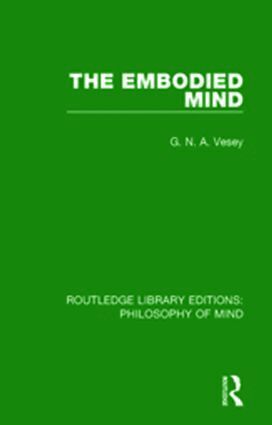
Originally published in 1965. For hundreds of years the thinking of philosophers, psychologists, and theologians on the problem of the mind’s relation to the body was dominated by the Cartesian notion that mind and matter are distinct substances. That Descartes also held that there is a union of mind and matter, in a person, has largely been ignored. This may be because, as he admitted in his private correspondence, it is impossible to think of mind and matter both as being distinct substances and also as being, in some sense, united. The fact of mind being united with matter in a person – our experience of ourselves as embodied minds – cannot be accounted for on Cartesian principles. This book rejects the panaceas of the Double Aspect Theory and the Identity Theory and investigates the possibility of accommodating this experience within a conceptual framework derived from Kant, the basis of which is the concept of mind, not as immaterial substance, but as a subject related, in experience, to its objects.
578 kr
Skickas inom 10-15 vardagar
Originally published in 1965. For hundreds of years the thinking of philosophers, psychologists, and theologians on the problem of the mind’s relation to the body was dominated by the Cartesian notion that mind and matter are distinct substances. That Descartes also held that there is a union of mind and matter, in a person, has largely been ignored. This may be because, as he admitted in his private correspondence, it is impossible to think of mind and matter both as being distinct substances and also as being, in some sense, united. The fact of mind being united with matter in a person – our experience of ourselves as embodied minds – cannot be accounted for on Cartesian principles. This book rejects the panaceas of the Double Aspect Theory and the Identity Theory and investigates the possibility of accommodating this experience within a conceptual framework derived from Kant, the basis of which is the concept of mind, not as immaterial substance, but as a subject related, in experience, to its objects.