Routledge Library Editions: Social and Cultural Anthropology – serie
Visar alla böcker i serien Routledge Library Editions: Social and Cultural Anthropology. Handla med fri frakt och snabb leverans.
17 produkter
17 produkter
19 938 kr
Skickas inom 10-15 vardagar
RLE Social and Cultural Anthropology brings together a collection of key titles from a range of historic imprints. From Anthropology and Nursing to Everyday Life, from The Gift Economy to Two-Dimensional Man, they form an essential reference source from a selection of acclaimed international authors.
Inbunden, Engelska, 2015
2 137 kr
Skickas inom 10-15 vardagar
This book, first published in 1984, examines the politics and philosophy of ordinary men and women, and their ordinary transactions. It analyses the interaction between the individual and the social, both for the roots of everyday behaviour and for the means to change the social fabric. Using an approach that combines Marx, Husserl, Heidegger and Aristotle, Agnes Heller defines categories such as ‘group’, ‘crowd’, ‘community’, and deals with characteristics of everyday life such as repetition, rules, norms, economics, habits, probability, imitation. She also analyses everyday knowledge, and concludes by looking at the place of personality in everyday life.
Häftad, Engelska, 2017
557 kr
Skickas inom 10-15 vardagar
This book, first published in 1984, examines the politics and philosophy of ordinary men and women, and their ordinary transactions. It analyses the interaction between the individual and the social, both for the roots of everyday behaviour and for the means to change the social fabric. Using an approach that combines Marx, Husserl, Heidegger and Aristotle, Agnes Heller defines categories such as ‘group’, ‘crowd’, ‘community’, and deals with characteristics of everyday life such as repetition, rules, norms, economics, habits, probability, imitation. She also analyses everyday knowledge, and concludes by looking at the place of personality in everyday life.
Inbunden, Engelska, 2015
3 010 kr
Skickas inom 10-15 vardagar
Considering such witnesses of the time as Shakespeare, Dante, Petrarch, Michelangelo, Machiavelli, Montaigne, More and Bacon, Agnes Heller looks at both the concept and the image of a Renaissance man. The concept was generalised and accepted by all; its characteristic features were man as a dynamic being, creating and re-creating himself throughout his life. The images of man, however, were very different, having been formed through the ideas and imagination of artists, politicians, philosophers, scientists and theologians and viewed from the different aspects of work, love, fate, death, friendship, devotion and the concepts of space and time. Renaissance Man thus stood as both as a leading protagonist of his time, one who led and formulated the substantial attitudes of his time, and as one who stood as a witness on the sidelines of the discussion. This book, first published in English in 1978, is based on the diverse but equally important sources of autobiographies, works of art and literature, and the writings of philosophers. Although she uses Florence as a starting point, Agnes Heller points out that the Renaissance was a social and cultural phenomenon common to all of Western Europe; her Renaissance Man is thus a figure to be found throughout Europe.
Häftad, Engelska, 2017
557 kr
Skickas inom 10-15 vardagar
Considering such witnesses of the time as Shakespeare, Dante, Petrarch, Michelangelo, Machiavelli, Montaigne, More and Bacon, Agnes Heller looks at both the concept and the image of a Renaissance man. The concept was generalised and accepted by all; its characteristic features were man as a dynamic being, creating and re-creating himself throughout his life. The images of man, however, were very different, having been formed through the ideas and imagination of artists, politicians, philosophers, scientists and theologians and viewed from the different aspects of work, love, fate, death, friendship, devotion and the concepts of space and time. Renaissance Man thus stood as both as a leading protagonist of his time, one who led and formulated the substantial attitudes of his time, and as one who stood as a witness on the sidelines of the discussion. This book, first published in English in 1978, is based on the diverse but equally important sources of autobiographies, works of art and literature, and the writings of philosophers. Although she uses Florence as a starting point, Agnes Heller points out that the Renaissance was a social and cultural phenomenon common to all of Western Europe; her Renaissance Man is thus a figure to be found throughout Europe.
Inbunden, Engelska, 2015
2 201 kr
Skickas inom 10-15 vardagar
Nursing has been described as the most ‘natural’ female occupation of all, embodying the so-called feminine ideals of tenderness and caring. Yet these ideals are juxtaposed with images of nurses as sex objects, or as ruthlessly efficient harridans. How have these very different images been constructed? And how do they relate to the reality of nursing - the close contact with blood, urine and faeces, and the involvement with the rites of birth, illness and death? This book, first published in 1991, explores the alternative ways different societies have developed to reconcile these contradictions. Using contemporary, historical and cross-cultural case material, the contributors trace the historical development of the role, and investigate the expected qualities of nurses within different cultural settings, such as India, Uganda and Japan. They look closely at ‘the nurse’ as a social construct, and demonstrate how the stereotypes relate to a particular society's notions of gender. Designed primarily for anthropologists and sociologists interested in health, illness and systems of health care, this book challenges some of the myths of traditional nursing studies and provides an original perspective on doctor/nurse/patient relationships.
Häftad, Engelska, 2017
584 kr
Skickas inom 10-15 vardagar
Nursing has been described as the most ‘natural’ female occupation of all, embodying the so-called feminine ideals of tenderness and caring. Yet these ideals are juxtaposed with images of nurses as sex objects, or as ruthlessly efficient harridans. How have these very different images been constructed? And how do they relate to the reality of nursing - the close contact with blood, urine and faeces, and the involvement with the rites of birth, illness and death? This book, first published in 1991, explores the alternative ways different societies have developed to reconcile these contradictions. Using contemporary, historical and cross-cultural case material, the contributors trace the historical development of the role, and investigate the expected qualities of nurses within different cultural settings, such as India, Uganda and Japan. They look closely at ‘the nurse’ as a social construct, and demonstrate how the stereotypes relate to a particular society's notions of gender. Designed primarily for anthropologists and sociologists interested in health, illness and systems of health care, this book challenges some of the myths of traditional nursing studies and provides an original perspective on doctor/nurse/patient relationships.
Inbunden, Engelska, 2015
2 137 kr
Skickas inom 10-15 vardagar
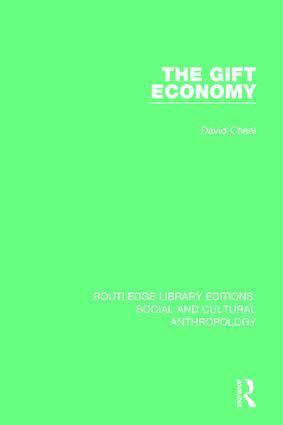
Until recently we have known more about gift giving practices in pre-industrial societies than about those of industrial western society. In this book, first published in 1988, David Cheal shows that the process of present giving and receiving is a vital element in contemporary social life, relevant to some of the most important theoretical traditions in sociology, particularly those of Durkheim and Weber, and to the social constructionism of Peter Berger and Thomas Luckmann. This volume is the result of a major study of gift rituals carried out by David Cheal and his associates in which general themes are richly illustrated with details from individual case histories gathered during the research. It is highly significant that in western society women are more active gift givers than men and, while their voices explain how emotions and interests are interrelated within the gift economy, the author shows how that in turn is related to current theories about family, gender and religion.
Häftad, Engelska, 2017
584 kr
Skickas inom 10-15 vardagar
Until recently we have known more about gift giving practices in pre-industrial societies than about those of industrial western society. In this book, first published in 1988, David Cheal shows that the process of present giving and receiving is a vital element in contemporary social life, relevant to some of the most important theoretical traditions in sociology, particularly those of Durkheim and Weber, and to the social constructionism of Peter Berger and Thomas Luckmann. This volume is the result of a major study of gift rituals carried out by David Cheal and his associates in which general themes are richly illustrated with details from individual case histories gathered during the research. It is highly significant that in western society women are more active gift givers than men and, while their voices explain how emotions and interests are interrelated within the gift economy, the author shows how that in turn is related to current theories about family, gender and religion.
Inbunden, Engelska, 2015
1 725 kr
Skickas inom 10-15 vardagar
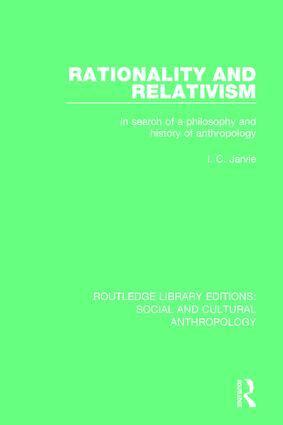
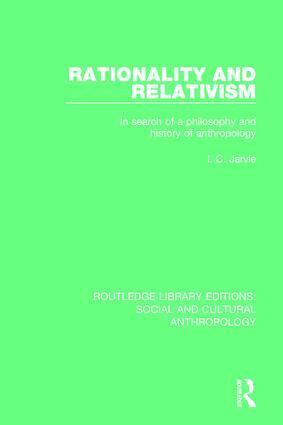
Anthropology revolves round answers to problems about the nature, development and unity of mankind; problems that are both philosophical and scientific. In this book, first published in 1984, Professor Jarvie applies Popper’s philosophy of science to understanding the history and theory of anthropology. Jarvie describes how the ancient view that the aim of science and philosophy was to get at the truth is challenged in anthropology by the doctrine of cultural relativism; that is, that truth varies with the cultural framework. He shows how philosophers as various as Peter Winch, W.V.O. Quine, W.T. Jones, Nelson Goodman and Richard Rorty were influenced by this doctrine. Yet these philosophers also accept the value of rational argument. Jarvie believes that there is a contradiction between relativism and any notion of human rationality that centres around argument. Forced by the contradiction to choose between rationality and relativism, he argues strongly that logical, scientific and moral considerations favour rationality and urge repudiation of relativism. The central argument of the book is that relativism is intellectually disastrous and has fostered intellectual attitudes from which anthropology still suffers.
Häftad, Engelska, 2017
584 kr
Skickas inom 10-15 vardagar
Anthropology revolves round answers to problems about the nature, development and unity of mankind; problems that are both philosophical and scientific. In this book, first published in 1984, Professor Jarvie applies Popper’s philosophy of science to understanding the history and theory of anthropology. Jarvie describes how the ancient view that the aim of science and philosophy was to get at the truth is challenged in anthropology by the doctrine of cultural relativism; that is, that truth varies with the cultural framework. He shows how philosophers as various as Peter Winch, W.V.O. Quine, W.T. Jones, Nelson Goodman and Richard Rorty were influenced by this doctrine. Yet these philosophers also accept the value of rational argument. Jarvie believes that there is a contradiction between relativism and any notion of human rationality that centres around argument. Forced by the contradiction to choose between rationality and relativism, he argues strongly that logical, scientific and moral considerations favour rationality and urge repudiation of relativism. The central argument of the book is that relativism is intellectually disastrous and has fostered intellectual attitudes from which anthropology still suffers.
Inbunden, Engelska, 2015
2 137 kr
Skickas inom 10-15 vardagar
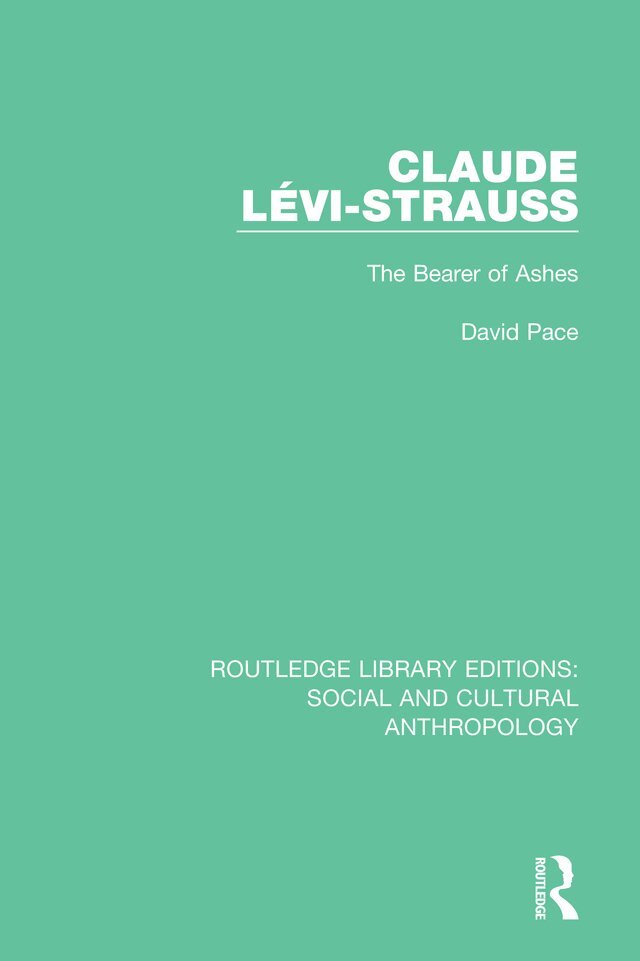
Lévi-Strauss is one of the intellectual giants of the twentieth century yet he is a very private and isolated figure, who has been reticent about himself. This book, first published in 1983,provides a fascinating insight into his character through a careful reading of the more speculative passages of his books and interviews. His personal existential and psychological orientation is explored through a structural analysis of Tristes Tropiques, his most personal book, and his writings on art, nature and civilization and through a consideration of his debt to Rousseau. Dr Pace examines in depth Lévi-Strauss’s critique of cultural evolutionism and his attack on the notion of world history. He assesses the political implications of Lévi-Strauss’s own interpretation of human progress through an examination of his debates with Sartre and other Marxists in the 1950s and 1960s and his subsequent movement to the right. The author’s concern throughout is to place the world-view of this great French anthropologist in the context of twentieth-century intellectuals’ struggle to come to grips with cultural relativism and the ‘problem’ of the primitive.
Häftad, Engelska, 2017
584 kr
Skickas inom 10-15 vardagar
Lévi-Strauss is one of the intellectual giants of the twentieth century yet he is a very private and isolated figure, who has been reticent about himself. This book, first published in 1983,provides a fascinating insight into his character through a careful reading of the more speculative passages of his books and interviews. His personal existential and psychological orientation is explored through a structural analysis of Tristes Tropiques, his most personal book, and his writings on art, nature and civilization and through a consideration of his debt to Rousseau. Dr Pace examines in depth Lévi-Strauss’s critique of cultural evolutionism and his attack on the notion of world history. He assesses the political implications of Lévi-Strauss’s own interpretation of human progress through an examination of his debates with Sartre and other Marxists in the 1950s and 1960s and his subsequent movement to the right. The author’s concern throughout is to place the world-view of this great French anthropologist in the context of twentieth-century intellectuals’ struggle to come to grips with cultural relativism and the ‘problem’ of the primitive.
Inbunden, Engelska, 2015
2 137 kr
Skickas inom 10-15 vardagar
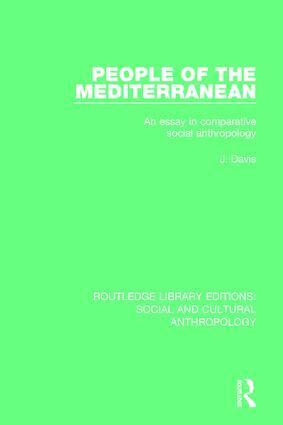
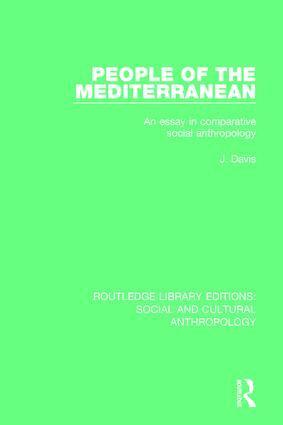
The Mediterranean countries have long attracted the attention of social anthropologists, from Frazer and Durkheim to the present day. In this volume, first published in 1977, Dr Davis reviews the extensive anthropological material collected and published by people who have worked in the area and claims that social anthropologists have a distinctive opportunity to compare similar kinds of institution and process in a variety of contexts – political, economic, bureaucratic, religious. He examines countries, tribes and communities stretching from Spain all the way round the Mediterranean and back along the coast of North Africa. In chapters on economics, stratification, politics, family and kinship, he has found it possible and sensible to set Albanian and Berber tribesmen beside each other, and to discuss Italian and Lebanese peasants in the same paragraph. The result is both a survey of the anthropological material and an essay in comparison, founded on a critique of the work of his predecessors and colleagues. The last chapter is an account of the uses anthropologists have made of the historical sources available to them.
Inbunden, Engelska, 2015
1 931 kr
Skickas inom 10-15 vardagar
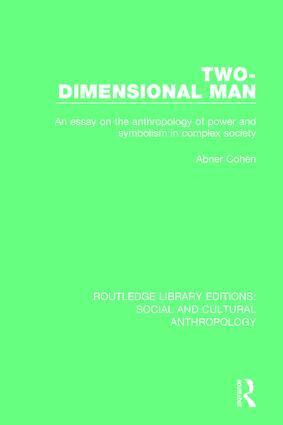
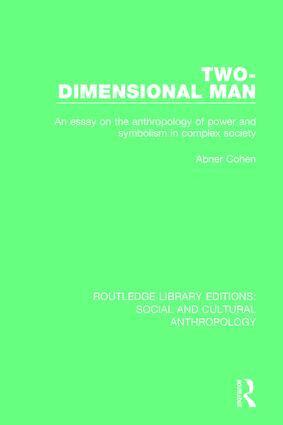
Central to this original study, first published in 1974, is that Political Man is also Symbolist Man, that man is two-dimensional. The book explores the possibilities of the systematic study of the dialectical interdependence between power relationships and symbolic action in modern, complex society. The discussion focuses on the processes by which interest groups, that cannot organise themselves formally, manipulate different types of symbolic formations to articulate a number of basic organisational functions: distinctiveness, communication, decision-making, authority, ideology and socialisation. The analysis is worked out in terms of specific case studies of different types of groupings, or ‘invisible organisations’ – ethnic, elitist, religious, ritually secret, cousinhood – which go through processes of cultural metamorphosis, shifting from one symbolic strategy to another, in response to changes in their circumstances. In conclusion, the discussion is brought to bear on the study of stratification in large-scale industrial society generally.
Häftad, Engelska, 2017
584 kr
Skickas inom 10-15 vardagar
The Mediterranean countries have long attracted the attention of social anthropologists, from Frazer and Durkheim to the present day. In this volume, first published in 1977, Dr Davis reviews the extensive anthropological material collected and published by people who have worked in the area and claims that social anthropologists have a distinctive opportunity to compare similar kinds of institution and process in a variety of contexts – political, economic, bureaucratic, religious. He examines countries, tribes and communities stretching from Spain all the way round the Mediterranean and back along the coast of North Africa. In chapters on economics, stratification, politics, family and kinship, he has found it possible and sensible to set Albanian and Berber tribesmen beside each other, and to discuss Italian and Lebanese peasants in the same paragraph. The result is both a survey of the anthropological material and an essay in comparison, founded on a critique of the work of his predecessors and colleagues. The last chapter is an account of the uses anthropologists have made of the historical sources available to them.
Häftad, Engelska, 2017
584 kr
Skickas inom 10-15 vardagar
Central to this original study, first published in 1974, is that Political Man is also Symbolist Man, that man is two-dimensional. The book explores the possibilities of the systematic study of the dialectical interdependence between power relationships and symbolic action in modern, complex society. The discussion focuses on the processes by which interest groups, that cannot organise themselves formally, manipulate different types of symbolic formations to articulate a number of basic organisational functions: distinctiveness, communication, decision-making, authority, ideology and socialisation. The analysis is worked out in terms of specific case studies of different types of groupings, or ‘invisible organisations’ – ethnic, elitist, religious, ritually secret, cousinhood – which go through processes of cultural metamorphosis, shifting from one symbolic strategy to another, in response to changes in their circumstances. In conclusion, the discussion is brought to bear on the study of stratification in large-scale industrial society generally.