Routledge Studies in Policing and Society - Böcker
Visar alla böcker i serien Routledge Studies in Policing and Society. Handla med fri frakt och snabb leverans.
13 produkter
13 produkter
2 113 kr
Skickas inom 10-15 vardagar
This book explores how predictive policing transforms police work. Police departments around the world have started to use data-driven applications to produce crime forecasts and intervene into the future through targeted prevention measures. Based on three years of field research in Germany and Switzerland, this book provides a theoretically sophisticated and empirically detailed account of how the police produce and act upon criminal futures as part of their everyday work practices.The authors argue that predictive policing must not be analyzed as an isolated technological artifact, but as part of a larger sociotechnical system that is embedded in organizational structures and occupational cultures. The book highlights how, for crime prediction software to come to matter and play a role in more efficient and targeted police work, several translation processes are needed to align human and nonhuman actors across different divisions of police work. Police work is a key function for the production and maintenance of public order, but it can also discriminate, exclude, and violate civil liberties and human rights. When criminal futures come into being in the form of algorithmically produced risk estimates, this can have wide-ranging consequences. Building on empirical findings, the book presents a number of practical recommendations for the prudent use of algorithmic analysis tools in police work that will speak to the protection of civil liberties and human rights as much as they will speak to the professional needs of police organizations.An accessible and compelling read, this book will appeal to students and scholars of criminology, sociology, and cultural studies as well as to police practitioners and civil liberties advocates, in addition to all those who are interested in how to implement reasonable forms of data-driven policing.
1 944 kr
Skickas inom 10-15 vardagar
This is the first book to look at women in policing in the mainland of the People’s Republic of China. Informed by empirical data as well as rich secondary information drawn from a wide range of published materials, and written by a former police officer in China, this book offers a detailed discussion of key issues concerning women in the Chinese police. Mainly drawing on face-to-face interviews with police officers and student probationers in multiple force areas, Women Police in Contemporary China offers rich insights into women’s lives in Chinese policing. The book first discusses how Chinese women were introduced to the male-only organisation and their representation in the Chinese police today. It elaborates women’s experiences as female officers in the police and, more specifically, their everyday work, contributions to policing, women police’s own perceptions of their roles and positions in the police profession and the gendered challenges and concerns facing them. It also looks at police occupational culture from a gendered lens.This book is illuminating reading for all those engaged in policing studies, gender and justice, policymaking, comparative criminal justice and all those interested in a woman’s role in the Chinese police.
1 944 kr
Skickas inom 10-15 vardagar
Building on five years of research, and drawing on criminology, science and technology studies (STS), socio-legal studies and social psychology, this book is the first non-medical book written on electric-shock weapons, of which the best well known is the TASER brand. The police’s ability to use force is one of their most crucial powers, yet one that has been relatively neglected by criminology. This book challenges some of the myths surrounding the use of these weapons and considers their human rights implications and impact on members of the public and officers alike. Drawing on STS, it also considers the role and impact of electric-shock technologies, examines the extent to which technologies and non-human agency may also play a role in shaping officer decision making and discretion, and contributes to long standing debates about police accountability.This is essential reading for policing scholars around the world, particularly those engaged with use of force, culture and accountability, as well as those engaged with Science and Technology studies.
506 kr
Skickas inom 10-15 vardagar
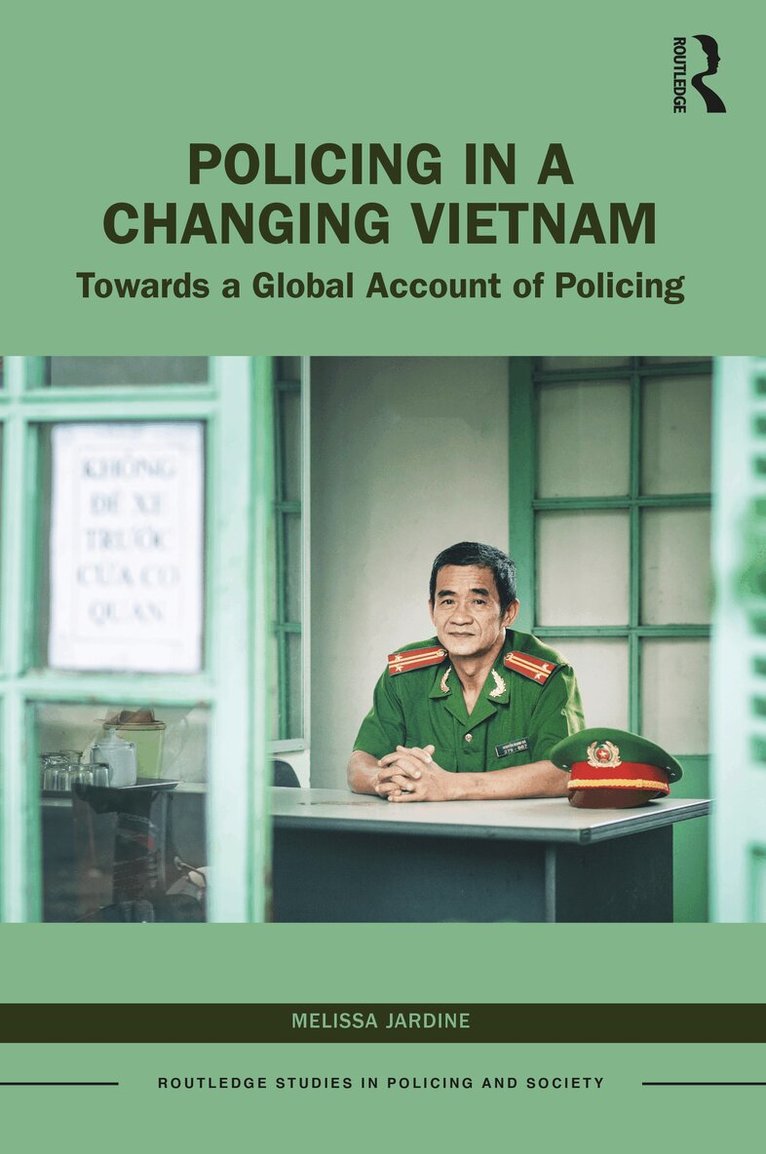
Knowledge about policing has been produced and disseminated unevenly so that our understanding comes from a skewed emphasis on the Anglo-American experience. Drawing on an original and comprehensive study of policing in Vietnam and engaging a Southern Criminological framework, this book explores police cultures and practices in a postcolonial, post-Confucian, transitioning economy. Identifying both similarities and differences in policing and police culture in Vietnam with those found in the dominant literature from the Global North, Policing in a Changing Vietnam challenges assumptions that police are (purportedly) apolitical, averse to tertiary education and defer to legalistic approaches to policing and law enforcement. It highlights that the variations identified in policing in Vietnam must be understood, not as deviations from Anglo-American normality, but as significant separate practices and traditions of policing from which the Global North may have something to learn. Contributing to ongoing debates on police culture and socialisation, this book explores the assumptions about relationships between the police, political systems, broad societal cultures, legal frameworks, organisations, communities and gender.An accessible and compelling read, this book will appeal to students and scholars of criminology, policing, gender studies, sociology, politics, law and all those who are interested in understanding the experiences and views of the Vietnamese police.
1 756 kr
Skickas inom 10-15 vardagar
Knowledge about policing has been produced and disseminated unevenly so that our understanding comes from a skewed emphasis on the Anglo-American experience. Drawing on an original and comprehensive study of policing in Vietnam and engaging a Southern Criminological framework, this book explores police cultures and practices in a postcolonial, post-Confucian, transitioning economy. Identifying both similarities and differences in policing and police culture in Vietnam with those found in the dominant literature from the Global North, Policing in a Changing Vietnam challenges assumptions that police are (purportedly) apolitical, averse to tertiary education and defer to legalistic approaches to policing and law enforcement. It highlights that the variations identified in policing in Vietnam must be understood, not as deviations from Anglo-American normality, but as significant separate practices and traditions of policing from which the Global North may have something to learn. Contributing to ongoing debates on police culture and socialisation, this book explores the assumptions about relationships between the police, political systems, broad societal cultures, legal frameworks, organisations, communities and gender.An accessible and compelling read, this book will appeal to students and scholars of criminology, policing, gender studies, sociology, politics, law and all those who are interested in understanding the experiences and views of the Vietnamese police.
618 kr
Skickas inom 10-15 vardagar
This book explores how predictive policing transforms police work. Police departments around the world have started to use data-driven applications to produce crime forecasts and intervene into the future through targeted prevention measures. Based on three years of field research in Germany and Switzerland, this book provides a theoretically sophisticated and empirically detailed account of how the police produce and act upon criminal futures as part of their everyday work practices.The authors argue that predictive policing must not be analyzed as an isolated technological artifact, but as part of a larger sociotechnical system that is embedded in organizational structures and occupational cultures. The book highlights how, for crime prediction software to come to matter and play a role in more efficient and targeted police work, several translation processes are needed to align human and nonhuman actors across different divisions of police work. Police work is a key function for the production and maintenance of public order, but it can also discriminate, exclude, and violate civil liberties and human rights. When criminal futures come into being in the form of algorithmically produced risk estimates, this can have wide-ranging consequences. Building on empirical findings, the book presents a number of practical recommendations for the prudent use of algorithmic analysis tools in police work that will speak to the protection of civil liberties and human rights as much as they will speak to the professional needs of police organizations.An accessible and compelling read, this book will appeal to students and scholars of criminology, sociology, and cultural studies as well as to police practitioners and civil liberties advocates, in addition to all those who are interested in how to implement reasonable forms of data-driven policing.
561 kr
Skickas inom 10-15 vardagar
Based on the study of a police organization in England, this book explores the role of social relations in the ways that people construct, mobilize, consume, and reconstruct meaning about wellbeing. Wellbeing is a powerful, institutionalized concept in police organizations across England and Wales. With the emergence of numerous policies, strategies, and practices that both explicitly and implicitly address wellbeing in the workplace, the concept has come to feature prominently. Wellbeing is addressed as an issue that needs to be understood intersubjectively by attending to the underlying social issues that shape how it is promoted or denied.After a theoretical exploration of police culture and wellbeing, the book traverses ethnographic data and captures insights from individuals across the organization’s hierarchy. It explores what individuals perceive wellbeing to mean and how they make sense of the concept. The book reveals discernible ideological-laden tensions across the hierarchy in terms of wellbeing constructions. By exploring these tensions, there is a potential to understand the constructions of wellbeing and the resultant implications for practice.This book will be of interest to academics, researchers, and students in policing, criminology, criminal justice, leadership/management, organizational behaviour, and wellbeing. Given its empirical focus and applicability to practitioners, it will also be of interest to a range of non-academics, including police officers and leaders, public servants, private organizations, policymakers, and human resources professionals.
1 855 kr
Skickas inom 10-15 vardagar
Based on the study of a police organization in England, this book explores the role of social relations in the ways that people construct, mobilize, consume, and reconstruct meaning about wellbeing. Wellbeing is a powerful, institutionalized concept in police organizations across England and Wales. With the emergence of numerous policies, strategies, and practices that both explicitly and implicitly address wellbeing in the workplace, the concept has come to feature prominently. Wellbeing is addressed as an issue that needs to be understood intersubjectively by attending to the underlying social issues that shape how it is promoted or denied.After a theoretical exploration of police culture and wellbeing, the book traverses ethnographic data and captures insights from individuals across the organization’s hierarchy. It explores what individuals perceive wellbeing to mean and how they make sense of the concept. The book reveals discernible ideological-laden tensions across the hierarchy in terms of wellbeing constructions. By exploring these tensions, there is a potential to understand the constructions of wellbeing and the resultant implications for practice.This book will be of interest to academics, researchers, and students in policing, criminology, criminal justice, leadership/management, organizational behaviour, and wellbeing. Given its empirical focus and applicability to practitioners, it will also be of interest to a range of non-academics, including police officers and leaders, public servants, private organizations, policymakers, and human resources professionals.
1 966 kr
Skickas inom 10-15 vardagar
The policing of drugs is an intriguing, complex, and contentious domain that brings into sharp focus the multifaceted nature of the police role and has farreaching consequences for health, crime, and justice. While research on drugs policing has historically been surprisingly sparse, fragmented, and underdeveloped, the field has recently become a burgeoning area of academic study, influenced by contemporary trends in policing practices, changes in drug policy, and wider social movements. This book makes a much-needed interdisciplinary and international contribution that engages with established and emerging areas of scholarship, advances cutting-edge debates, and sets an agenda for future directions in drugs policing.Drug Law Enforcement, Policing and Harm Reduction is the first edited collection to devote its attention exclusively to drugs policing. It brings together a range of leading scholars to provide a deep and thorough account of the current state of knowledge. In addition to academic analysis, authors also include serving police officers and policymakers, who have influenced how drugs policing is framed and carried out. Together, the contributors draw on a diverse set of empirical studies and theoretical perspectives, with the thread running throughout the book being the concept of harm reduction policing. With accounts from various countries, localities, and contexts, topics covered include the (in)effectiveness and (un)intended consequences of the ‘war on drugs’, attempts to reform drugs policing, and the role of partnerships and policy networks. The broader theme of inequality lies at the heart of this collection.An accessible and compelling read, this book will be of interest to academics and students of criminology, public health, and social policy, especially those researching policing, drug policy, and harm reduction. It also offers valuable insights and practical guidance for professionals working in the drugs field.
567 kr
Skickas inom 10-15 vardagar
The policing of drugs is an intriguing, complex, and contentious domain that brings into sharp focus the multifaceted nature of the police role and has farreaching consequences for health, crime, and justice. While research on drugs policing has historically been surprisingly sparse, fragmented, and underdeveloped, the field has recently become a burgeoning area of academic study, influenced by contemporary trends in policing practices, changes in drug policy, and wider social movements. This book makes a much-needed interdisciplinary and international contribution that engages with established and emerging areas of scholarship, advances cutting-edge debates, and sets an agenda for future directions in drugs policing.Drug Law Enforcement, Policing and Harm Reduction is the first edited collection to devote its attention exclusively to drugs policing. It brings together a range of leading scholars to provide a deep and thorough account of the current state of knowledge. In addition to academic analysis, authors also include serving police officers and policymakers, who have influenced how drugs policing is framed and carried out. Together, the contributors draw on a diverse set of empirical studies and theoretical perspectives, with the thread running throughout the book being the concept of harm reduction policing. With accounts from various countries, localities, and contexts, topics covered include the (in)effectiveness and (un)intended consequences of the ‘war on drugs’, attempts to reform drugs policing, and the role of partnerships and policy networks. The broader theme of inequality lies at the heart of this collection.An accessible and compelling read, this book will be of interest to academics and students of criminology, public health, and social policy, especially those researching policing, drug policy, and harm reduction. It also offers valuable insights and practical guidance for professionals working in the drugs field.
569 kr
Skickas inom 10-15 vardagar
This is the first book to look at women in policing in the mainland of the People’s Republic of China. Informed by empirical data as well as rich secondary information drawn from a wide range of published materials, and written by a former police officer in China, this book offers a detailed discussion of key issues concerning women in the Chinese police. Mainly drawing on face-to-face interviews with police officers and student probationers in multiple force areas, Women Police in Contemporary China offers rich insights into women’s lives in Chinese policing. The book first discusses how Chinese women were introduced to the male-only organisation and their representation in the Chinese police today. It elaborates women’s experiences as female officers in the police and, more specifically, their everyday work, contributions to policing, women police’s own perceptions of their roles and positions in the police profession and the gendered challenges and concerns facing them. It also looks at police occupational culture from a gendered lens.This book is illuminating reading for all those engaged in policing studies, gender and justice, policymaking, comparative criminal justice and all those interested in a woman’s role in the Chinese police.
618 kr
Skickas inom 10-15 vardagar
Building on five years of research, and drawing on criminology, science and technology studies (STS), socio-legal studies and social psychology, this book is the first non-medical book written on electric-shock weapons, of which the best well known is the TASER brand. The police’s ability to use force is one of their most crucial powers, yet one that has been relatively neglected by criminology. This book challenges some of the myths surrounding the use of these weapons and considers their human rights implications and impact on members of the public and officers alike. Drawing on STS, it also considers the role and impact of electric-shock technologies, examines the extent to which technologies and non-human agency may also play a role in shaping officer decision making and discretion, and contributes to long standing debates about police accountability.This is essential reading for policing scholars around the world, particularly those engaged with use of force, culture and accountability, as well as those engaged with Science and Technology studies.
Communicative Architecture of Policing
Community, Power and Legitimacy in the Age of ‘New Media’
Inbunden, Engelska, 2025
2 176 kr
Skickas inom 10-15 vardagar
The Communicative Architecture of Policing is a ground-breaking study of police communications and police–media relations in the social media era. It is based on nearly a decade of research on police–media relations, including two years of extended observational study in local newsrooms and police communications departments, and dozens of interviews with police communicators, chief police officers and journalists. This book is the first to undertake a deep ethnography of both police communications and local news media in a single policing area. It also provides an innovative theoretical reappraisal of the mechanics of police–media power relations, grounded in ideas of legitimacy, mass communications and local governing power. The book describes the lived experiences of journalists through the collapse of the local news media in England: declines wrought in large part by the advent of social media. It also describes a crisis of confidence in local journalism and its perceived institutional status in the local community. By contrast, the book charts the emergence of an empowered, professional police communicator class in policing––and its distinctive cultural features––rooted in the mass communications potential of social media. The book weaves together these empirical insights by developing novel approaches to police legitimacy theory and institutional power relations. This book will be of interest to students, scholars and practitioners in the fields of criminology, media studies, communication studies, journalism and policing.