• Fri frakt över 249 kr
  • •
  • Snabba leveranser
  • •
  • Billiga böcker
Kundservice

Du är på sajten för privatpersoner.

Företag, bibliotek eller offentlig verksamhet?

Du handlar på classic.bokus.com, där alla dina funktioner finns intakta.
Till classic.bokus.com
Bokus logotyp. Gå till startsidan.
  • Erbjudanden
  • Nyheter
  • Student
  • Topplistor
  • Barn & ungdom
  • Bokus Play
  • E-böcker
  • Pocketböcker
  • Spel & pussel

10% rabatt på allt med kod NYSTART10 →

Sidfot

Mina sidor

    Hjälp

    • Kundservice
    • Vanliga frågor och svar
    • Frakt och leverans
    • Retur vid ångerrätt
    • Reklamera vara
    • Betalning
    • Köpvillkor
    • Allmänna villkor
    • Information om webbplatsens tillgänglighet

    Om Bokus

    • Om oss
    • Pressrum
    • För studenter
    • För företag
    • För bibliotek och offentlig verksamhet
    • För leverantörer
    • Hållbarhet

    Populärt

    • Aktuella erbjudanden
    • Presentkort
    • Studentlitteratur
    • Nya böcker
    • Topplistor
    • Signerade böcker
    • Engelska böcker

    Inspiration

    • Boktips
    • BookTok
    • Populära bokserier
    • Barnbokskaraktärer
    • Populära författare
    Logotyp för Bokus
    Följ oss på Facebook (extern länk)Följ oss på Instagram (extern länk)Följ oss på YouTube (extern länk)Följ oss på TikTok (extern länk)
    bokus @ CookiesAnpassa cookiesIntegritetspolicyKöpvillkor
    Till Citymail hemsida (extern länk)Till Budbee hemsida (extern länk)Till Postnord hemsida (extern länk)Till Schenker hemsida (extern länk)Till Early Bird hemsida (extern länk)Till Walleys hemsida (extern länk)
    1. Samhälle och politik
    2. Sociologi och antropologi
    3. Sociologi

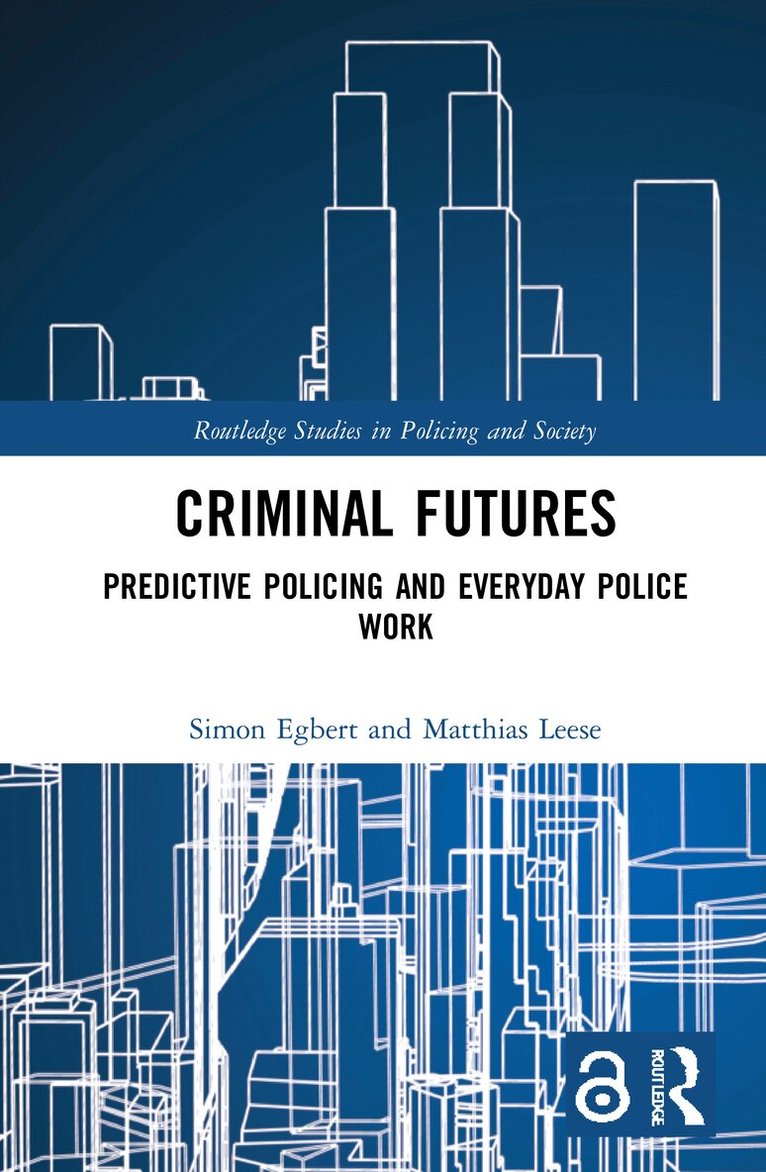
    Criminal Futures

    Predictive Policing and Everyday Police Work

    AvSimon Egbert,Matthias Leese

    Inbunden, Engelska, 2020

    Del i serien Routledge Studies in Policing and Society

    2 422 kr

    Beställningsvara. Skickas inom 10-15 vardagar. Fri frakt över 249 kr.

    Fler format och utgåvor

    Häftad

    667 kr

    Beskrivning

    This book explores how predictive policing transforms police work. Police departments around the world have started to use data-driven applications to produce crime forecasts and intervene into the future through targeted prevention measures. Based on three years of field research in Germany and Switzerland, this book provides a theoretically sophisticated and empirically detailed account of how the police produce and act upon criminal futures as part of their everyday work practices.The authors argue that predictive policing must not be analyzed as an isolated technological artifact, but as part of a larger sociotechnical system that is embedded in organizational structures and occupational cultures. The book highlights how, for crime prediction software to come to matter and play a role in more efficient and targeted police work, several translation processes are needed to align human and nonhuman actors across different divisions of police work. Police work is a key function for the production and maintenance of public order, but it can also discriminate, exclude, and violate civil liberties and human rights. When criminal futures come into being in the form of algorithmically produced risk estimates, this can have wide-ranging consequences. Building on empirical findings, the book presents a number of practical recommendations for the prudent use of algorithmic analysis tools in police work that will speak to the protection of civil liberties and human rights as much as they will speak to the professional needs of police organizations.An accessible and compelling read, this book will appeal to students and scholars of criminology, sociology, and cultural studies as well as to police practitioners and civil liberties advocates, in addition to all those who are interested in how to implement reasonable forms of data-driven policing.

    Produktinformation

    • Utgivningsdatum:2020-12-15
    • Mått:156 x 234 x 20 mm
    • Vikt:610 g
    • Format:Inbunden
    • Språk:Engelska
    • Serie:Routledge Studies in Policing and Society
    • Antal sidor:232
    • Förlag:Taylor & Francis Ltd
    • ISBN:9780367349264

    Utforska kategorier

    • Sociologi inom Samhälle och politik
    • Brottslighet och kriminologi inom Samhälle och politik

    Mer om författaren

    Simon Egbert is a postdoc researcher at the Department of Sociology, Technische Universität Berlin. Trained in sociology and criminology, his research interests include science and technology studies, security studies, sociology of prediction, time studies, discourse theory, visual knowledge studies, and sociology of testing. He has published papers on predictive policing, drug testing, lie detection, and ignition interlock devices.Matthias Leese is Senior Researcher for governance and technology at the Center for Security Studies, ETH Zurich. His research is primarily interested in the social effects produced at the intersections of security and technology. It pays specific attention to the normative repercussions of new security technologies across society, in both intended and unintended forms. His work covers various application contexts of security technologies, including airports, borders, policing, and R&D activities.

    Recensioner i media

    This timely book presents rare ethnographic data within an outstanding analysis of current debates on predictive policing. Conceptualising predictive policing as a sociotechnical system, the book describes various translation processes that lay bare the political, cultural and organisational forces at work. This welcome book sets the standards for future research on data-driven policing.Janet Chan, Professor, UNSW LawWary of simplistic dystopia/utopia dichotomies, Criminal Futures offers a theoretically sophisticated and empirically rich account of predictive policing as a sociotechnical process. This is a landmark study, providing frameworks and analytical tools for understanding - and responding to - the rapid datafication of security that is unfolding. Dean Wilson, Professor of Criminology, University of Sussex

    Innehållsförteckning

    • 1.Criminal futures 2.Predictive policing and its origins 3.The police and technology 4.Data and the need for speed 5.Humans and machines 6.Putting risk on the map 7.Patrolling risk 8.Does it work, though? 9.’Bad’ predictions 10. The future of (predictive) policing