Special Issues of the European Journal of Developmental Psychology – serie
Visar alla böcker i serien Special Issues of the European Journal of Developmental Psychology. Handla med fri frakt och snabb leverans.
14 produkter
14 produkter
Inbunden, Engelska, 2019
1 289 kr
Skickas inom 10-15 vardagar
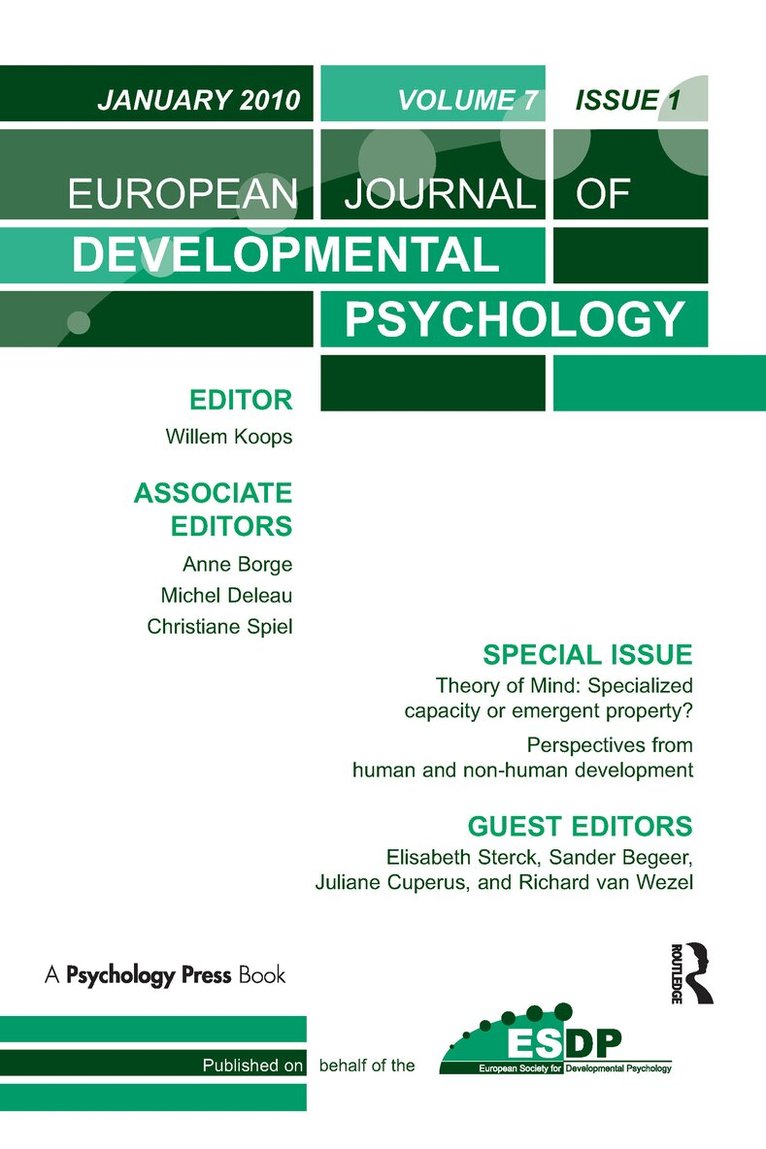
Theory of Mind, the cognitive capacity to attribute emotions, intentions and knowledge to oneself and others, has been claimed a hallmark of human cognition. Nonetheless, Theory of Mind is considered limited in young children and people with autism. Moreover, its presence in animals is much investigated, and hotly debated. Essential for cross-disciplinary discussions and real insight in this unique capacity is knowing what constitutes Theory of Mind. We aim to tackle this by combining insights from three different scientific fields that study Theory of Mind: animal behaviour, typical child development and developmental disorders such as autism and AD/HD.
Inbunden, Engelska, 2021
2 010 kr
Skickas inom 10-15 vardagar
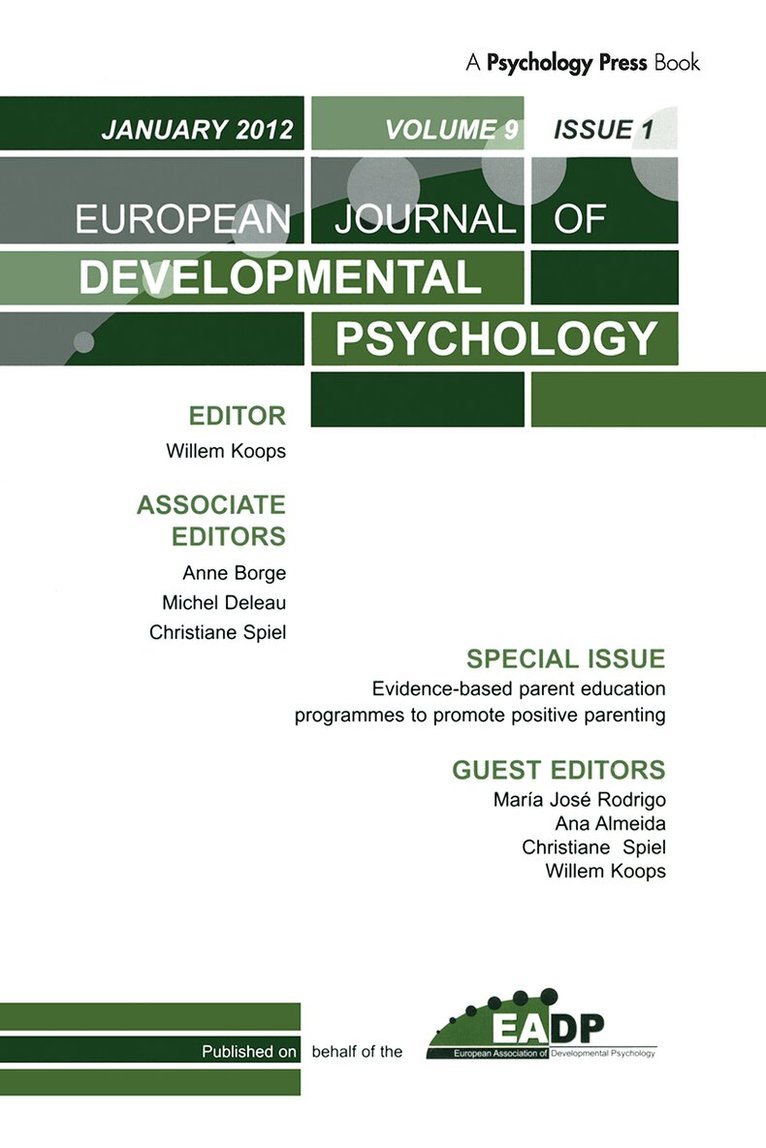
The objective of this special issue is to illustrate some of the theoretical, methodological and practical aspects involved in the evidence-based evaluation of family educational programs aimed at supporting positive parenting. The main novelty that this special issue brings is the compilation of studies involving experiences of parent education programs from several countries. The objectives of the papers are to develop theoretically based prevention programs, to evaluate their effectiveness according to standards of evidence, and to examine factors that influence implementation process. The papers also provide recommendations for researchers to establish stable cooperation with politicians, officials, service providers, and practitioners.
Inbunden, Engelska, 2018
1 289 kr
Skickas inom 10-15 vardagar
This special issue reports the findings from eight studies which examined children’s national identifications and national attitudes. Data were collected from 725 7- and 11-year-old children living in countries that have or have not experienced violence or war in the recent past. Twelve national groups participated in the studies, including Jewish and Arab children (Israel), Bosniak and Serbian children (Bosnia), Catholic and Protestant children (Northern Ireland), Greek-Cypriot and Turkish-Cypriot children (Cyprus), Basque and Spanish children (the Basque Country), and Dutch and English children (The Netherlands and England). The studies examined whether differences in the structure and content of national identity and attitudes result not only from processes of knowledge acquisition but also from cohort and context effects. Developmental and gender differences within each national group, and differences between national groups, are explored in terms of the cultural heritage of the particular group to which the children belong and the patterns of historical and contemporary relationships that exist between their own group and the various outgroups towards which their attitudes were assessed.Findings show that the development of national identifications and national attitudes exhibit considerable cross-national variation as a function of the specific socio-historical contexts within which children develop. These studies, considered together, indicate the need for developmental theorising in this area to avoid simplistic conclusions based upon data collected within just one specific location. The adoption of a broader cross-national comparative perspective is required when attempting to address questions concerning how children’s national identifications and attitudes develop within real-world settings.
Inbunden, Engelska, 2020
1 695 kr
Skickas inom 10-15 vardagar
Since the 1970s, a great number of experimental and ethnomethodological studies have brought out the fact that social interaction influences cognitive development. However, two major questions remain: what is the true nature of this influence and what are the most relevant methods to catch it? The contributions of this Special Issue are in keeping with these concerns regarding more adequate methods to describe and analyze, within a same functional unit, at least three levels of comprehension of socio-cognitive phenomena: the individual‘s cognitive functioning; the socio-cognitive functioning of the dyad or the small group; and finally, the way the first two elements are mediated by discursive activities.
Häftad, Engelska, 2015
493 kr
Skickas inom 10-15 vardagar
From the beginning of 2000, with the increase and diffusion of modern technologies, a new form of bullying using electronic means has emerged. Literature has reached some consistent findings on the description of the problem. However, there is still a lack of knowledge about developmental processes of cyberbullying and about possible predictors and correlates. Some of the main emerging areas investigated in connection with cyberbullying are: personality factors, callous unemotional traits and self-control, memory cognitive distortions, emotional and moral mechanisms, ICT use and media exposure, family and social contexts. Another important issue is the relation between cyberbullying and face to face bullying. From face to face literature we know some of the mechanisms in the peer group such as the relation between bullying, dominance and popularity and the role of bystanders in the social dynamic of the attacks. However, nothing is known about the cyber community. Contributors to this volume attempt to investigate these group mechanisms in the cyber community. Finally, for the victims, long-term consequences are also relevant, both in terms of perceived stress level and of the association between cyber-victimization and mental health. This special issue offers important new findings on the development and consequences of cyberbullying and cyber-victimization, and opens new and future directions of research.
Häftad, Engelska, 2015
493 kr
Skickas inom 10-15 vardagar
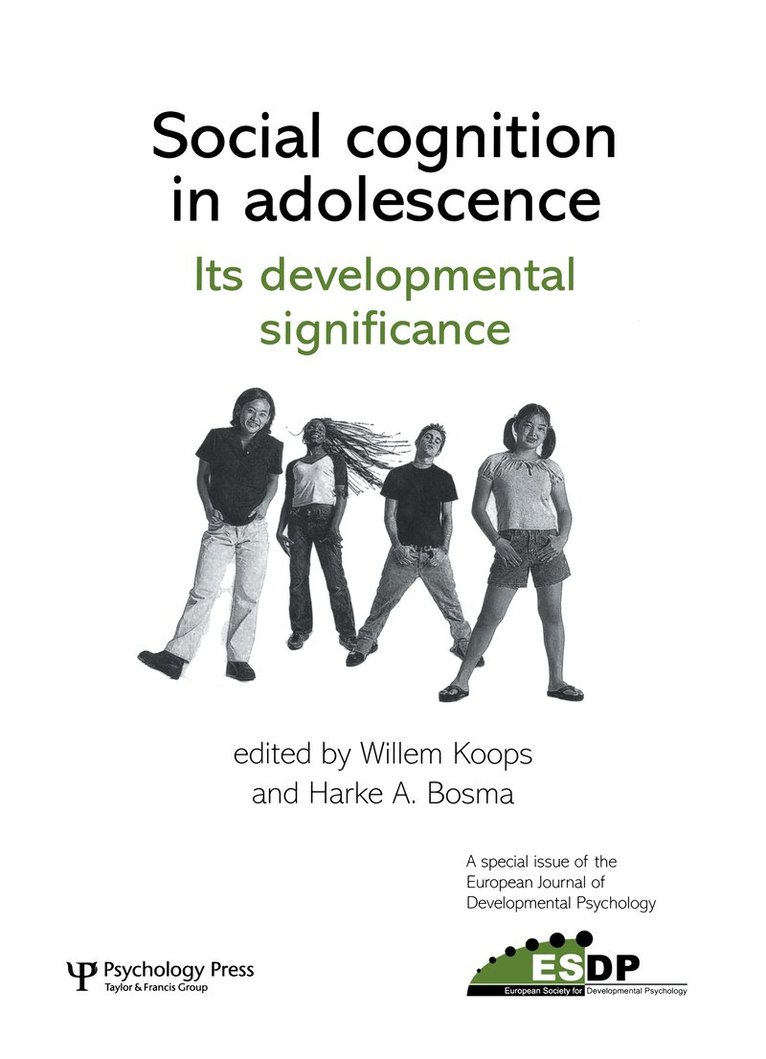
The special issue aims to develop a greater understanding of the relationship between social cognitive development in adolescence and social behaviour, to discuss the mediating effects of other aspects of development in adolescence such as the parallel emergence of ideas concerning personal identity, patterns of relationship development within or outside the family, and to examine new approaches to the study of social development in adolescence. Finally it considers the problems (practical, methodological and ethical) associated with intervention in adolescence and how the approach(es) which are adopted may be guided by our understanding of young people's social cognitive development.
Häftad, Engelska, 2019
641 kr
Skickas inom 10-15 vardagar
From the fundamental processing of human movement, through to the ability to interpret actions, infancy research is only now taking up the challenge of social cognition over a variety of cognitive areas. This special issue covers broad areas of social-cognitive development and builds a cohesive picture of the diversity within this thriving area of developmental psychology. This issue outlines and discusses changes in early development in terms of infant behaviour that may suggest how an infant with limited experience may nonetheless identify and attribute to other humans a privileged social-cognitive status.
Inbunden, Engelska, 2007
2 090 kr
Skickas inom 5-8 vardagar
From the fundamental processing of human movement, through to the ability to interpret actions, infancy research is only now taking up the challenge of social cognition over a variety of cognitive areas. This special issue covers broad areas of social-cognitive development and builds a cohesive picture of the diversity within this thriving area of developmental psychology. This issue outlines and discusses changes in early development in terms of infant behaviour that may suggest how an infant with limited experience may nonetheless identify and attribute to other humans a privileged social-cognitive status.
Häftad, Engelska, 2008
331 kr
Skickas inom 10-15 vardagar
Since the 1970s, a great number of experimental and ethnomethodological studies have brought out the fact that social interaction influences cognitive development. However, two major questions remain: what is the true nature of this influence and what are the most relevant methods to catch it?The contributions of this Special Issue are in keeping with these concerns regarding more adequate methods to describe and analyze, within a same functional unit, at least three levels of comprehension of socio-cognitive phenomena: the individual’s cognitive functioning; the socio-cognitive functioning of the dyad or the small group; and finally, the way the first two elements are mediated by discursive activities.
Inbunden, Engelska, 2005
1 600 kr
Skickas inom 5-8 vardagar
The special issue aims to develop a greater understanding of the relationship between social cognitive development in adolescence and social behaviour, to discuss the mediating effects of other aspects of development in adolescence such as the parallel emergence of ideas concerning personal identity, patterns of relationship development within or outside the family, and to examine new approaches to the study of social development in adolescence. Finally it considers the problems (practical, methodological and ethical) associated with intervention in adolescence and how the approach(es) which are adopted may be guided by our understanding of young people's social cognitive development.
Häftad, Engelska, 2010
506 kr
Skickas inom 10-15 vardagar
Theory of Mind, the cognitive capacity to attribute emotions, intentions and knowledge to oneself and others, has been claimed a hallmark of human cognition. Nonetheless, Theory of Mind is considered limited in young children and people with autism. Moreover, its presence in animals is much investigated, and hotly debated. Essential for cross-disciplinary discussions and real insight in this unique capacity is knowing what constitutes Theory of Mind. We aim to tackle this by combining insights from three different scientific fields that study Theory of Mind: animal behaviour, typical child development and developmental disorders such as autism and AD/HD.
Häftad, Engelska, 2011
493 kr
Skickas inom 10-15 vardagar
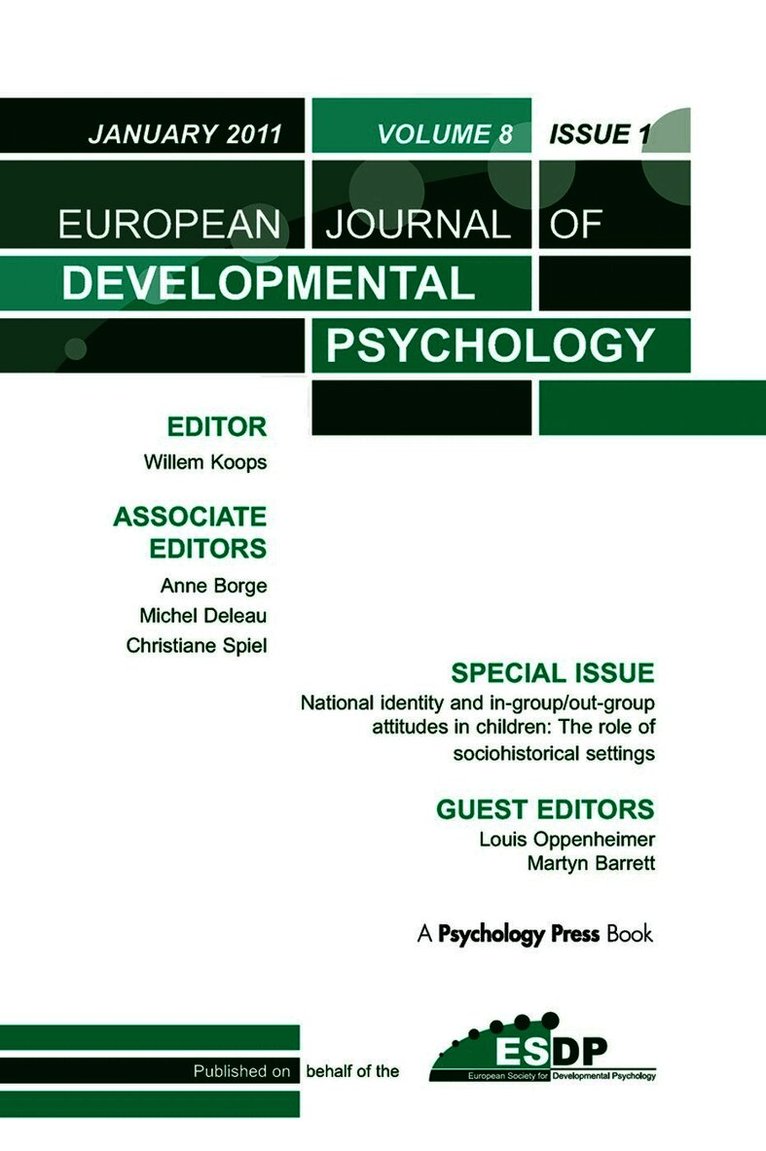
This special issue reports the findings from eight studies which examined children’s national identifications and national attitudes. Data were collected from 725 7- and 11-year-old children living in countries that have or have not experienced violence or war in the recent past. Twelve national groups participated in the studies, including Jewish and Arab children (Israel), Bosniak and Serbian children (Bosnia), Catholic and Protestant children (Northern Ireland), Greek-Cypriot and Turkish-Cypriot children (Cyprus), Basque and Spanish children (the Basque Country), and Dutch and English children (The Netherlands and England). The studies examined whether differences in the structure and content of national identity and attitudes result not only from processes of knowledge acquisition but also from cohort and context effects. Developmental and gender differences within each national group, and differences between national groups, are explored in terms of the cultural heritage of the particular group to which the children belong and the patterns of historical and contemporary relationships that exist between their own group and the various outgroups towards which their attitudes were assessed.Findings show that the development of national identifications and national attitudes exhibit considerable cross-national variation as a function of the specific socio-historical contexts within which children develop. These studies, considered together, indicate the need for developmental theorising in this area to avoid simplistic conclusions based upon data collected within just one specific location. The adoption of a broader cross-national comparative perspective is required when attempting to address questions concerning how children’s national identifications and attitudes develop within real-world settings.
Häftad, Engelska, 2012
765 kr
Skickas inom 10-15 vardagar
The objective of this special issue is to illustrate some of the theoretical, methodological and practical aspects involved in the evidence-based evaluation of family educational programs aimed at supporting positive parenting. The main novelty that this special issue brings is the compilation of studies involving experiences of parent education programs from several countries. The objectives of the papers are to develop theoretically based prevention programs, to evaluate their effectiveness according to standards of evidence, and to examine factors that influence implementation process. The papers also provide recommendations for researchers to establish stable cooperation with politicians, officials, service providers, and practitioners.
Inbunden, Engelska, 2012
1 289 kr
Skickas inom 10-15 vardagar
From the beginning of 2000, with the increase and diffusion of modern technologies, a new form of bullying using electronic means has emerged. Literature has reached some consistent findings on the description of the problem. However, there is still a lack of knowledge about developmental processes of cyberbullying and about possible predictors and correlates. Some of the main emerging areas investigated in connection with cyberbullying are: personality factors, callous unemotional traits and self-control, memory cognitive distortions, emotional and moral mechanisms, ICT use and media exposure, family and social contexts. Another important issue is the relation between cyberbullying and face to face bullying. From face to face literature we know some of the mechanisms in the peer group such as the relation between bullying, dominance and popularity and the role of bystanders in the social dynamic of the attacks. However, nothing is known about the cyber community. Contributors to this volume attempt to investigate these group mechanisms in the cyber community. Finally, for the victims, long-term consequences are also relevant, both in terms of perceived stress level and of the association between cyber-victimization and mental health. This special issue offers important new findings on the development and consequences of cyberbullying and cyber-victimization, and opens new and future directions of research.