Springer Series on Agent Technology - Böcker
Visar alla böcker i serien Springer Series on Agent Technology. Handla med fri frakt och snabb leverans.
10 produkter
10 produkter
1 577 kr
Skickas inom 10-15 vardagar
The ability of production companies to rapidly develop and deploy effective and efficient control systems is critical for success in the consumer-driven environment of contemporary manufacturing. This book presents a novel approach to the design of manufacturing control systems, based around the idea of agents, semiautonomous decision makers that cooperate to process goods and meet orders. This new methodology is DACS Designing Agent-based Control Systems. Developed at DaimlerChryslers research labs in Berlin, DACS is the first methodology specifically produced for the design of agent-based control systems. Beginning with a detailed overview of agent technologies, manufacturing control, and design methodologies, the book explains the DACS methodology and illustrates it by way of detailed case studies. The book will be of interest to researchers and practitioners in agent systems, manufacturing control, and software methodologies.
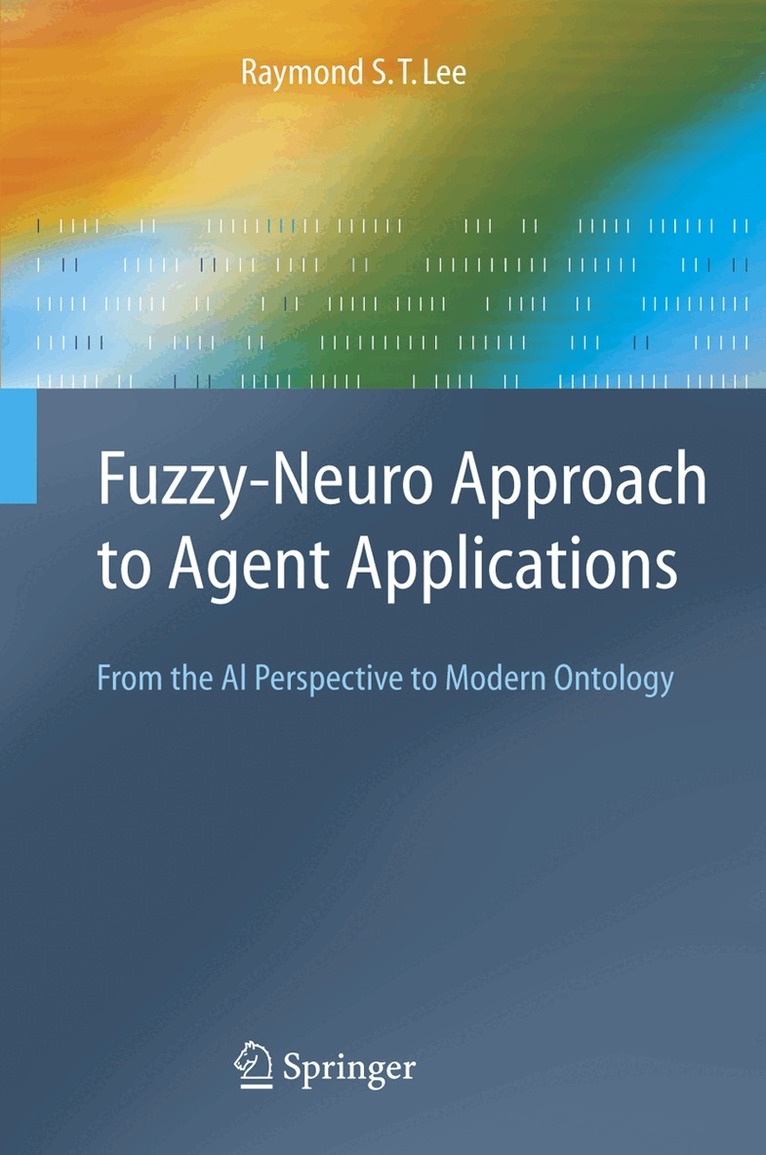
Fuzzy-Neuro Approach to Agent Applications
From the AI Perspective to Modern Ontology
Inbunden, Engelska, 2005
551 kr
Skickas inom 10-15 vardagar
The book provides a full explanation of the concepts and theories of intelligent agents and agent-based systems. Providing a comprehensive theoretical background, the author covers modern artificial intelligence topics such as ontologies, neural networks, chaos theory, fuzzy logics and genetic algorithms. Finally, the author details how the iJADK toolkit (intelligent Java agent development kit for intelligent e-business applications) can be used in the design and implementation phases of real applications. The book can be adopted as the main textbook for courses on intelligent agents, advanced topics in AI or contemporary AI technologies; application developers can use it as a complete technical guide and reference manual for the iJADK toolkit; and researchers can use it as a comprehensive reference book on modern AI techniques, and will benefit particularly from the books extensive literature survey.
1 095 kr
Skickas inom 10-15 vardagar
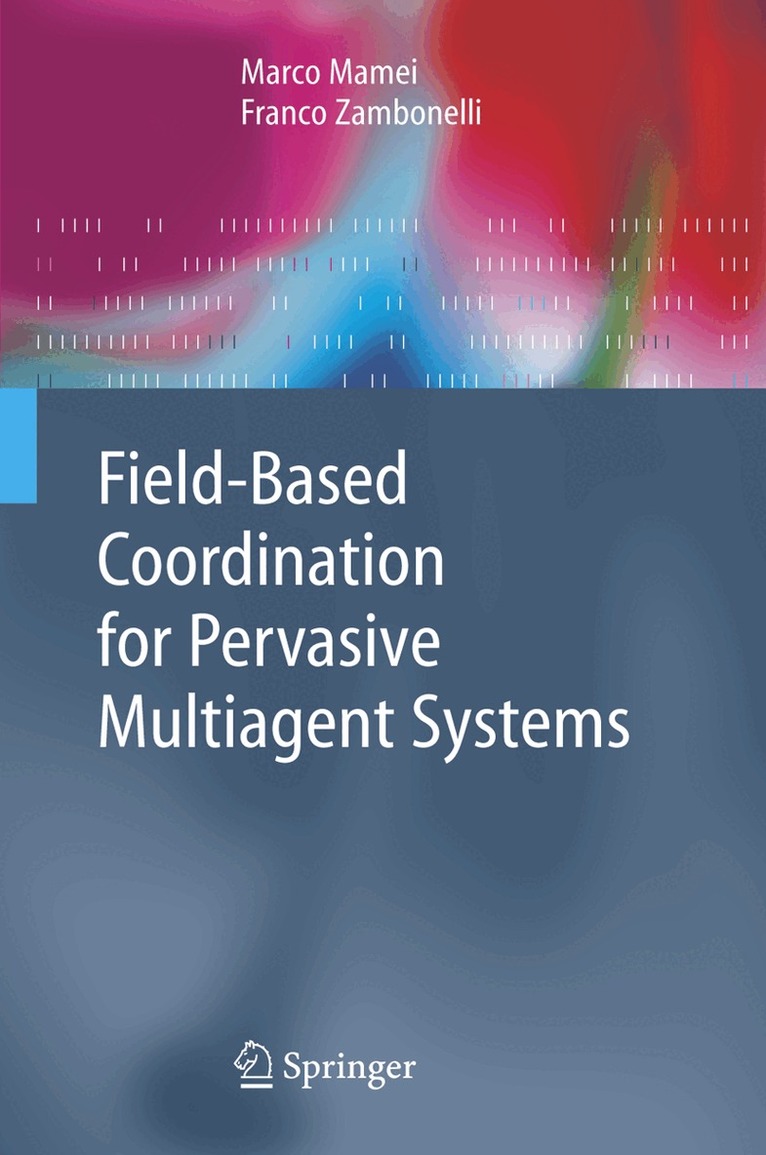
More and more, software systems involve autonomous and distributed software components that have to execute and interact in open and dynamic environments, such as in pervasive, autonomous, and mobile applications. The requirements with respect to dynamics, openness, scalability, and decentralization call for new approaches to software design and development, capable of supporting spontaneous configuration, tolerating partial failures, or arranging adaptive reorganization of the whole system.Inspired by the behaviour of complex natural systems, scientists and engineers have started to adjust their mechanisms and techniques for self-organization and adaption to changing environments. In line with these considerations, Mamei and Zambonelli propose an interaction model inspired by the way masses and particles in our universe move and self-organize according to contextual information represented by gravitational and electromagnetic fields. The key idea is to have the components’ actions driven by computational force fields, generated by the components themselves or by some infrastructures, and propagated across the environment. Together with its supporting middleware infrastructure – available with additional information under http://www.agentgroup.unimore.it – this model can serve as the basis for a general purpose and widely applicable approach for the design and development of adaptive distributed applications.
1 095 kr
Skickas inom 10-15 vardagar
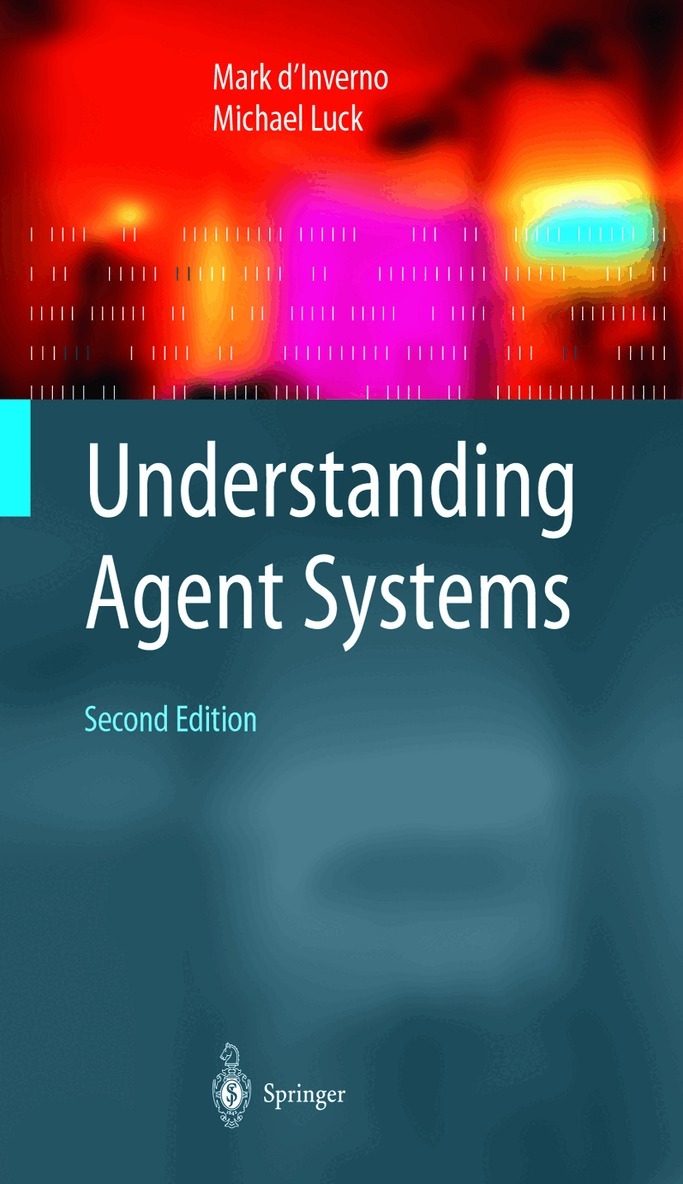
This book helps to organise the diverse landscape of agent-based systems by applying formal methods to provide a defining and encompassing agent framework. The Z specification language is used to provide an accessible and unified formal account of agent systems and inter-agent relationships. In particular, the framework precisely and unambiguously provides meanings for common concepts and terms for agent systems, enables alternative agent models and architectures to be described within it, and provides a foundation for subsequent development of increasingly more refined agent concepts. It describes agents, the relationships between them and the requisite capabilities for effective functioning in multi-agent systems, and is applied in different case studies. In the second edition the authors have revised and updated the existing chapters of the book to respond to advice from readers of the first edition, to add references to recent work in agent systems, and generally to bring the content up to date. They have extended the introduction and conclusions chapters to include a better review of the field and the current state of the art.This new edition features chapters on agent interaction and norms, and outlines an implementation framework.The book will appeal equally to researchers, students and technologists interested in intelligent agents and multi-agent systems.
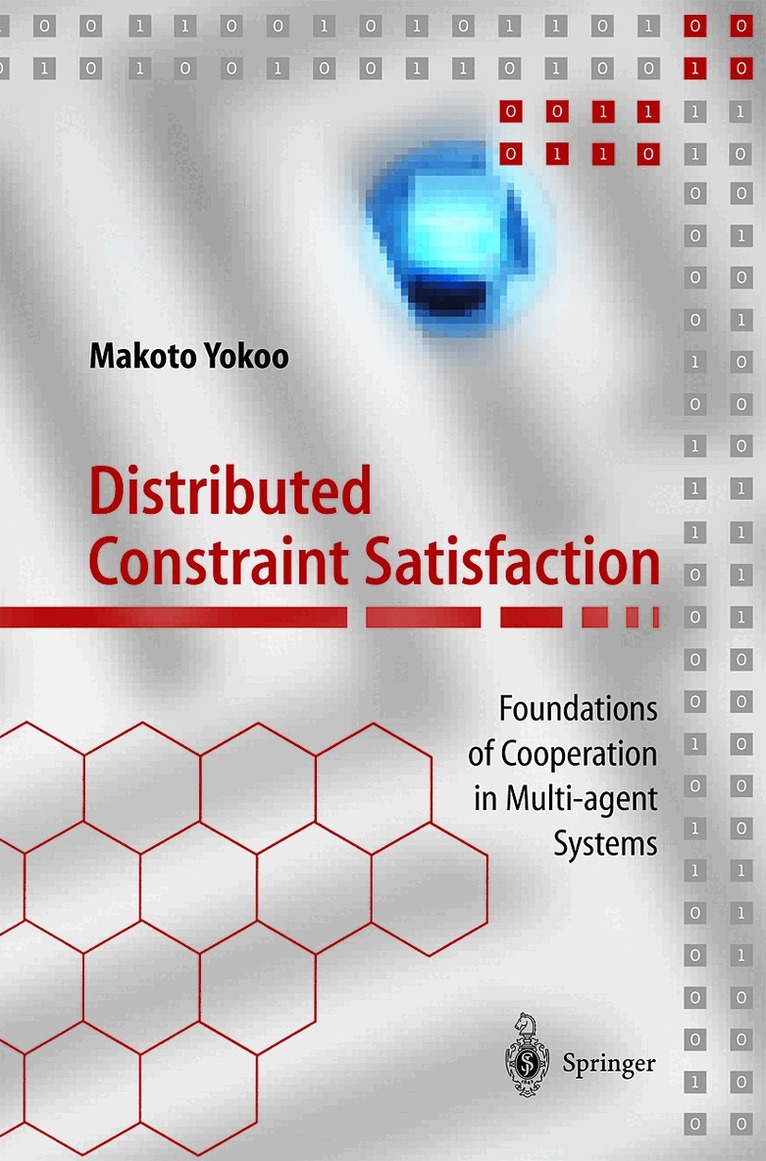
Distributed Constraint Satisfaction
Foundations of Cooperation in Multi-agent Systems
Inbunden, Engelska, 2000
551 kr
Skickas inom 10-15 vardagar
This book gives an overview of constraint satisfaction problems (CSPs), adapts related search algorithms and consistency algorithms for applications to multi-agent systems, and consolidates recent research devoted to cooperation in such systems. The techniques introduced are applied to various problems in multi-agent systems. Among the new approaches is a hybrid-type algorithm for weak-commitment search combining backtracking and iterative improvement; also, an extension of the basic CSP formalization called partial CSP is introduced in order to handle over-constrained CSPs.The book is written for advanced students and professionals interested in multi-agent systems or, more generally, in distributed artificial intelligence and constraint satisfaction. Researchers active in the area will appreciate this book as a valuable source of reference.
1 577 kr
Skickas inom 10-15 vardagar
The ability of production companies to rapidly develop and deploy effective and efficient control systems is critical for success in the consumer-driven environment of contemporary manufacturing. This book presents a novel approach to the design of manufacturing control systems, based around the idea of agents, semiautonomous decision makers that cooperate to process goods and meet orders. This new methodology is DACS – Designing Agent-based Control Systems. Developed at DaimlerChrysler’s research labs in Berlin, DACS is the first methodology specifically produced for the design of agent-based control systems. Beginning with a detailed overview of agent technologies, manufacturing control, and design methodologies, the book explains the DACS methodology and illustrates it by way of detailed case studies. The book will be of interest to researchers and practitioners in agent systems, manufacturing control, and software methodologies.
Fuzzy-Neuro Approach to Agent Applications
From the AI Perspective to Modern Ontology
Häftad, Engelska, 2010
551 kr
Skickas inom 10-15 vardagar
Complete course on Intelligent Agent or AI with focus on contemporary and latest AI technologies and development Companion technical reference for agent developers/researchers who would like to adopt the iJADK toolkit to develop their own agent-based applications and projects The advanced section on modern ontology and ontological agents serves as research literature for AI researchers who would like to explore the advanced AI/agent topics that involve the contemporary research on ontological agents and applied ontology
1 095 kr
Skickas inom 10-15 vardagar
More and more, software systems involve autonomous and distributed software components that have to execute and interact in open and dynamic environments, such as in pervasive, autonomous, and mobile applications. The requirements with respect to dynamics, openness, scalability, and decentralization call for new approaches to software design and development, capable of supporting spontaneous configuration, tolerating partial failures, or arranging adaptive reorganization of the whole system. Inspired by the behaviour of complex natural systems, scientists and engineers have started to adjust their mechanisms and techniques for self-organization and adaption to changing environments. In line with these considerations, Mamei and Zambonelli propose an interaction model inspired by the way masses and particles in our universe move and self-organize according to contextual information represented by gravitational and electromagnetic fields. The key idea is to have the components' actions driven by computational force fields, generated by the components themselves or by some infrastructures, and propagated across the environment.Together with its supporting middleware infrastructure -- available with additional information under http://www.agentgroup.unimore.it -- this model can serve as the basis for a general purpose and widely applicable approach for the design and development of adaptive distributed applications.
1 095 kr
Skickas inom 10-15 vardagar
Since the first edition was published two years ago, much has been done on extend ing the work done on SMART to address new and important areas [3-5,54,79,80, 108-110,116,118-120,122]. In this second edition, we have revised, updated and corrected the existing text and added three new chapters. These chapters provide a broader coverage of the fie1d of agents, and show in more detail how the specific framework described can be used to examine other areas. In Chapter 6, we use the concepts of discovery to apply the framework to autonomous interaction in multi agent systems; in Chapter 10 we use it for considering normative agents and sys tems; and in Chapter 11 we describe work on an implementation and development environment. As a course text, the book can be considered in different parts, as follows. - Chapter I and Chapter 2 offer a basic introduction to agents and their core com ponents. - Chapter 3 and Chapter 4 cover relationships between agents and basic notions of cooperation for multi-agent systems. - Chapter 5 and Chapter 6 introduce sociological agents, which are needed for rea soning and planning, and their use in reasoning about communication and inter action. - Chapter 7, Chapter 8, Chapter 9 and Chapter 10 each cover different application areas relating to different aspects, inc1uding coordination (through the contract net), agent architecture (through AgentSpeak(L), social dependence networks, and normative systems.
Distributed Constraint Satisfaction
Foundations of Cooperation in Multi-agent Systems
Häftad, Engelska, 2011
551 kr
Skickas inom 10-15 vardagar
When multiple agents are in a shared environment, there usually exist con straints among the possible actions of these agents. A distributed constraint satisfaction problem (distributed CSP) is a problem in which the goal is to find a consistent combination of actions that satisfies these inter-agent constraints. More specifically, a distributed CSP is a constraint satisfaction problem (CSP) in which multiple agents are involved. A constraint satisfaction problem is a problem in which the goal is to find a consistent assignment of values to variables. Even though the definition of a CSP is very simple, a surprisingly wide variety of artificial intelligence (AI) problems can be formalized as CSPs. Therefore, the research on CSPs has a long and distinguished history in AI (Mackworth 1992; Dechter 1992; Tsang 1993; Kumar 1992). A distributed CSP is a CSP in which variables and constraints are distributed among multiple autonomous agents. Various application problems in Multi-agent Systems (MAS) that are concerned with finding a consistent combination of agent actions can he formalized as dis tributed CSPs. Therefore, we can consid(~r distributed CSPs as a general framework for MAS, and algorithms for solving distributed CSPs as impor tant infrastructures for cooperation in MAS. This book gives an overview of the research on distributed CSPs, as well as introductory material on CSPs. In Chapter 1. we show the problem defi nition of normal, centralized CSPs and describe algorithms for solving CSPs.