SUNY series in Anthropological Studies of Contemporary Issues – serie
Visar alla böcker i serien SUNY series in Anthropological Studies of Contemporary Issues. Handla med fri frakt och snabb leverans.
11 produkter
11 produkter
Häftad, Engelska, 1993
553 kr
Skickas inom 3-6 vardagar
This book investigates cultural and social identity in contemporary complex societies, focusing especially on Eastern Europe. Mach explains the role of symbols and symbolic forms in he relations between groups and the protection and development of their identities, especially ethnic identity. He places his study within the context of social order and the structure of power, using case studies which deal especially with the significance of politics, state rituals and national identity (Great Britain, Israel, Russia, Poland); in the conflict and displacement of migrating groups (Polish and German); and in regional questions of identity and inter-ethnic relations (Poland, United States, Great Britain).Mach presents a clear conceptual framework for analyzing the symbolic construction of identity. He views cultural identity as a dynamic, creative process which clarifies issues that are particularly significant in contemporary society, such as nationalism, new ethnicity, minority culture, and the cultural dimension of political conflicts.
Häftad, Engelska, 1998
435 kr
Skickas inom 5-8 vardagar
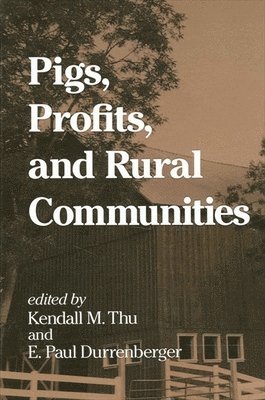
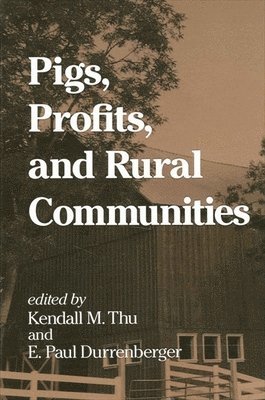
Using the pork production industry as an example, this book illuminates the processes and consequences of agricultural industrialization for the social, economic, human, environmental, and political health of the rural United States.This book illuminates the processes and consequences of agricultural industrialization, particularly within the swine production industry, for the social, economic, human, environmental, and political health of the rural United States. Contributors come from widely divergent backgrounds including a former U.S. senator, farmers, a veterinarian, a medical psychologist, an agricultural economist, a biological ecologist, a farm organization president, and anthropologists. Set within the theoretical framework of Walter Goldschmidt's research on the community consequences of industrialized food production, these contributions show that the increasing divergence of ownership has real human costs that continue to be ignored by economic developers and policymakers.
Häftad, Engelska, 2001
427 kr
Skickas inom 5-8 vardagar
Uses classical anthropological theory to understand "intentional communities" in the United States.Although anthropologists have studied intentional communities in the past, they have seldom exerted a concerted effort to evaluate the intentional community in terms of the anthropological language of cultural change. Drawing from the work of Victor Turner, Gregory Bateson, and Anthony F. C. Wallace, Intentional Community examines historic and contemporary intentional communities within the United States, leading to a better understanding of these communities, the larger nation-state of which they are a part, and the ways in which the two interact. Applying classical anthropological theory to elements of western society, the contributors discuss how the individuals function; the ways in which these communities come into being and disappear; the various forms these communities take; how their members reinterpret features of the larger culture; and the ways in which outsiders relate to people within them.
Inbunden, Engelska, 2005
1 042 kr
Skickas inom 5-8 vardagar
Examines how small firms, like large ones, are mobilizing to compete in a global economy.Globalization is often seen as driven by large corporations and supranational organizations. Enterprises operated by petty capitalists may be small, but there is nothing petty about their significance for the operation of economies or our understanding of contemporary societies, families, and localities. Petty Capitalism and Globalization uses ethnographic research to examine how small firms in Europe, Asia, and Latin America have been compelled to operate and compete in a fast-moving transnational economic environment. From Nepalese rug makers to German bakers to Taiwanese memory chip designers, these fascinating case studies delve into the complex situation of petty capitalists, often ambiguously situated between capital and labor, cooperation and exploitation, family and economy, tradition and modernity, friends and competitors. Understanding the position of petty capitalists in a global economy provides lessons in the potential and limitations of promoting small firms and entrepreneurship as a route to sustainable development.
Häftad, Engelska, 2006
367 kr
Skickas inom 7-10 vardagar
Examines how small firms, like large ones, are mobilizing to compete in a global economy.Globalization is often seen as driven by large corporations and supranational organizations. Enterprises operated by petty capitalists may be small, but there is nothing petty about their significance for the operation of economies or our understanding of contemporary societies, families, and localities. Petty Capitalism and Globalization uses ethnographic research to examine how small firms in Europe, Asia, and Latin America have been compelled to operate and compete in a fast-moving transnational economic environment. From Nepalese rug makers to German bakers to Taiwanese memory chip designers, these fascinating case studies delve into the complex situation of petty capitalists, often ambiguously situated between capital and labor, cooperation and exploitation, family and economy, tradition and modernity, friends and competitors. Understanding the position of petty capitalists in a global economy provides lessons in the potential and limitations of promoting small firms and entrepreneurship as a route to sustainable development.
Häftad, Engelska, 1987
435 kr
Skickas inom 5-8 vardagar
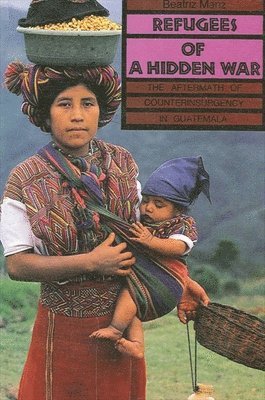
Political violence and military repression have displaced some two million people in Central America in the 1980s. While conflict elsewhere in Central America has received considerable attention, the war against an unarmed civilian population in Guatemala has largely been hidden from the outside world. The military have waged a particularly brutal and extensive counter-insurgency campaign, leaving thousands dead and prompting several hundred thousand to flee to neighboring countries.In Refugees of a Hidden War, the author examines in detail three predominantly Indian regions in northern Guatemala, reconstructing the devastation and its aftermath from the perspective of those who lived through it and its impact on the culture of the Maya Indian peasants. Individual community experiences are placed in the context of the country's pattern of land ownership and unequal exercise of political and economic power, typical of Central America. Manz also assesses the critical situation of Guatemalan refugees in southern Mexico and the prospects for their repatriation.Refugees of a Hidden War presents the first extensive fieldwork in Guatemala since the mass violence of the early 1980s. This micro look at Guatemalan community life provides important insights on the roots of conflict in Central America.
Häftad, Engelska, 1991
397 kr
Tillfälligt slut
Manaus, an urban-industrial center in the Amazon, serves in this book as a microcosmic case of dependent capitalist development in Latin America. With the creation of a Free Trade Zone and a strong program of fiscal incentives in 1967, the Brazilian government initiated a large-scale project designed to establish an industrial pole in Manaus. This book is an anthropological study of the impact of this type of development on the economic, social, and cultural life of working class families. This study underscores the work relationships between different economic sectors, the economy of households, the organization of domestic groups and, ultimately, the social engagement of working class families in the life of their neighborhoods, the city, and the larger Brazilian society. Despres examines the theoretical value of modernization, dependency, and modes of production approaches for understanding the social formation of working class populations. In discussing capitalist development in Brazil, the author grapples with the problems of urbanization, industrialization, and economic development in Latin America generally.
Inbunden, Engelska, 1998
1 051 kr
Tillfälligt slut
Using the pork production industry as an example, this book illuminates the processes and consequences of agricultural industrialization for the social, economic, human, environmental, and political health of the rural United States.This book illuminates the processes and consequences of agricultural industrialization, particularly within the swine production industry, for the social, economic, human, environmental, and political health of the rural United States. Contributors come from widely divergent backgrounds including a former U.S. senator, farmers, a veterinarian, a medical psychologist, an agricultural economist, a biological ecologist, a farm organization president, and anthropologists. Set within the theoretical framework of Walter Goldschmidt's research on the community consequences of industrialized food production, these contributions show that the increasing divergence of ownership has real human costs that continue to be ignored by economic developers and policymakers.
Inbunden, Engelska, 2001
1 042 kr
Tillfälligt slut
Uses classical anthropological theory to understand "intentional communities" in the United States.Although anthropologists have studied intentional communities in the past, they have seldom exerted a concerted effort to evaluate the intentional community in terms of the anthropological language of cultural change. Drawing from the work of Victor Turner, Gregory Bateson, and Anthony F. C. Wallace, Intentional Community examines historic and contemporary intentional communities within the United States, leading to a better understanding of these communities, the larger nation-state of which they are a part, and the ways in which the two interact. Applying classical anthropological theory to elements of western society, the contributors discuss how the individuals function; the ways in which these communities come into being and disappear; the various forms these communities take; how their members reinterpret features of the larger culture; and the ways in which outsiders relate to people within them.
Inbunden, Engelska, 2002
1 042 kr
Tillfälligt slut
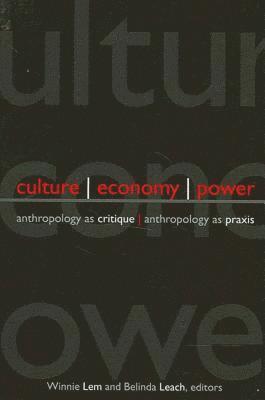
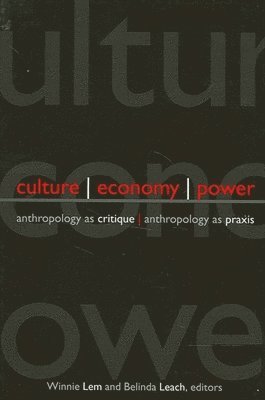
Confronts major questions facing anthropology, Marxist theory, cultural studies, feminism, and history.Grounded in a conviction that anthropological knowledge implies critique and that engaging in anthropology is also ultimately an act of praxis, various contributors explore the ways in which the precepts of Marxism continue to illuminate and enhance our understanding of culture, economy, and politics. They focus on the question of epistemology to examine the process of anthropological intellectual production in different national settings and analyze the ways in which hierarchies of power and forms of state domination figure in the formation of subjectivities in different ethnographic contexts. The authors also reflect upon how class, gender, ethnicity, racialized forms of ethnicity, as well as regional and national identities, are configured through the relationships involved in making a living under late capitalism.
Häftad, Engelska, 2002
397 kr
Tillfälligt slut
Confronts major questions facing anthropology, Marxist theory, cultural studies, feminism, and history.Grounded in a conviction that anthropological knowledge implies critique and that engaging in anthropology is also ultimately an act of praxis, various contributors explore the ways in which the precepts of Marxism continue to illuminate and enhance our understanding of culture, economy, and politics. They focus on the question of epistemology to examine the process of anthropological intellectual production in different national settings and analyze the ways in which hierarchies of power and forms of state domination figure in the formation of subjectivities in different ethnographic contexts. The authors also reflect upon how class, gender, ethnicity, racialized forms of ethnicity, as well as regional and national identities, are configured through the relationships involved in making a living under late capitalism.