Topics in Ancient Philosophy / Themen der antiken Philosophie – serie
Visar alla böcker i serien Topics in Ancient Philosophy / Themen der antiken Philosophie. Handla med fri frakt och snabb leverans.
8 produkter
8 produkter
1 285 kr
Skickas inom 5-8 vardagar
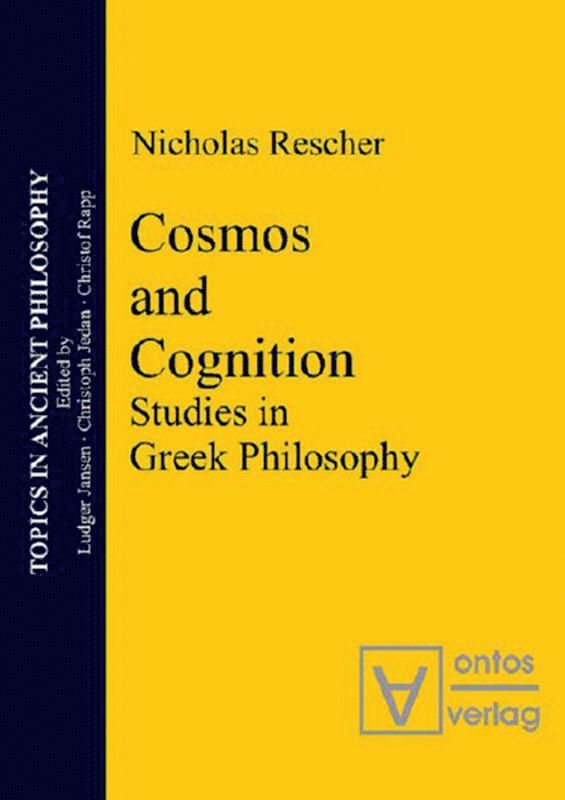
The six studies comprising this volume deal with some fundamental issues in early Greek thought: cosmic evaluation in Anaximander, the theory of opposites from the Pre-Socratics to Plato and Aristotle, thought experimentation in Pre-Socratic thought, the origins of Greek Scepticism among the Sophisists, the prehistory of "Buridan's Ass" speculation, and the role of esthesis in Aristotle's theory of science. In each case the early discussion seeks to show how certain ideas bore unexpected fruit during the subsequent development of philosophical thought.
Del 7 - Topics in Ancient Philosophy / Themen der antiken Philosophie
Teile und Teilhabe
Eine Untersuchung über Platons "Sophistes"
Inbunden, Tyska, 2016
2 206 kr
Skickas inom 5-8 vardagar
This series provides a forum for monographs and collected volumes aiming at a philosophical discussion of the texts, topics, and arguments of ancient philosophers. The authors demonstrate that philosophical historiography not only paraphrases the claims of ancient authors, but can also reconstruct the arguments for those claims and consider ongoing discussions in modern philosophy, thus enriching the philosophical debate of our time.
1 866 kr
Skickas inom 5-8 vardagar
From Plato’s Timaeus onwards, the world or cosmos has been conceived of as a living, rational organism. Most notably in German Idealism, philosophers still talked of a ‘Weltseele’ (Schelling) or ‘Weltgeist’ (Hegel). This volume is the first collection of essays on the origin of the notion of the world soul (anima mundi) in Antiquity and beyond. It contains 14 original contributions by specialists in the field of ancient philosophy, the Platonic tradition and the history of theology. The topics range from the ‘obscure’ Presocratic Heraclitus, to Plato and his ancient readers in Middle and Neoplatonism (including the Stoics), to the reception of the idea of a world soul in the history of natural science. A general introduction highlights the fundamental steps in the development of the Platonic notion throughout late Antiquity and early Christian philosophy. Accessible to Classicists, historians of philosophy, theologians and invaluable to specialists in ancient philosophy, the book provides an overview of the fascinating discussions surrounding a conception that had a long-lasting effect on the history of Western thought.
1 935 kr
Skickas inom 5-8 vardagar
This volume is a detailed study of the concept of the nutritive capacity of the soul and its actual manifestation in living bodies (plants, animals, humans) in Aristotle and Aristotelianism. Aristotle’s innovative analysis of the nutritive faculty has laid the intellectual foundation for the increasing appreciation of nutrition as a prerequisite for the maintenance of life and health that can be observed in the history of Greek thought. According to Aristotle, apart from nutrition, the nutritive part of the soul is also responsible for or interacts with many other bodily functions or mechanisms, such as digestion, growth, reproduction, sleep, and the innate heat. After Aristotle, these concepts were used and further developed by a great number of Peripatetic philosophers, commentators on Aristotle and Arabic thinkers until early modern times. This volume is the first of its kind to provide an in-depth survey of the development of this rather philosophical concept from Aristotle to early modern thinkers. It is of key interest to scholars working on classical, medieval and early modern psycho-physiological accounts of living things, historians and philosophers of science, biologists with interests in the history of science, and, generally, students of the history of philosophy and science.
2 027 kr
Skickas inom 5-8 vardagar
The volume focusses on ancient Greek dialectic and its impact on later philosophical thought, up to Byzantium. The contributions are written by distinguished scholars in their respective fields of study and shed light on the relation of ancient Greek dialectic to various aspects of human life and soul, to self-knowledge and self-consciousness, to science, rhetoric, and political theory.
327 kr
Skickas inom 5-8 vardagar
This volume is a detailed study of the concept of the nutritive capacity of the soul and its actual manifestation in living bodies (plants, animals, humans) in Aristotle and Aristotelianism. Aristotle’s innovative analysis of the nutritive faculty has laid the intellectual foundation for the increasing appreciation of nutrition as a prerequisite for the maintenance of life and health that can be observed in the history of Greek thought. According to Aristotle, apart from nutrition, the nutritive part of the soul is also responsible for or interacts with many other bodily functions or mechanisms, such as digestion, growth, reproduction, sleep, and the innate heat. After Aristotle, these concepts were used and further developed by a great number of Peripatetic philosophers, commentators on Aristotle and Arabic thinkers until early modern times. This volume is the first of its kind to provide an in-depth survey of the development of this rather philosophical concept from Aristotle to early modern thinkers. It is of key interest to scholars working on classical, medieval and early modern psycho-physiological accounts of living things, historians and philosophers of science, biologists with interests in the history of science, and, generally, students of the history of philosophy and science.
2 372 kr
Skickas inom 3-6 vardagar
The impact of Platonism in shaping the Abrahamic traditions is yet to be fully explored. The papers in this volume examine the influence of Plato and his commentators in the conception and articulation of theological issues in late antique and medieval Christianity, but also in Islamic and Jewish traditions. The contributions are arranged chronologically and address key authors and themes in the reception of Platonic thought from the third to the sixteenth century. Neoplatonic debates on the Demiurgic Intellect, imagination, and contemplation informed Christian ideas about our ability to grasp God. Gregory of Nyssa played a key role in the reception of Platonic ideas about the nature of God in Christian and Jewish thinkers, while Neoplatonic schools continued to inculcate Platonic ideals in Christian leaders and intellectuals to the fifth century. Later Platonists, like Hermias, Porphyry, and Philoponus, subtly but creatively reworked Platonic theses to harmonize Plato’s and Aristotle’s philosophies, while paving the way for Psellus’ theory of spiritual illumination. Plotinus and Proclus offer examples of the uneasy and even polemical reception of Neoplatonic concepts both in eastern and western Christianity, including medieval Georgia. The influence of Platonic themes in Islamic thought and Jewish mysticism is traced back to the Qu’ran and John Damascene. Plato’s reception by Eriugena and Thomas Aquinas is also re-examined. Finally, the concept of the Platonic city in Medieval Islamic culture and Christian Florence is considered. By revealing the historical trajectories of Platonic themes across the Abrahamic traditions, the volume aims to serve as foundational resource for Long Platonism."This impressive collection of articles edited by Eva Anagnostou-Laoutides and Georgios Steiris concerns the history of Plato’s reception from the time of the first Neoplatonic schools to the Platonic Academy of Florence. The thinkers and works under discussion range over a chronological period of approximately fifteen centuries. They belong to different schools, geographical areas, cultural environments, and religious traditions: from Plato to Plotinus, Proclus, St Augustine, the Church fathers, the ancient commentators, John Scottus, Nicolas of Methone, St Thomas Acquinas, Byzantine philosophers and hagiographers, Jewish and Islamic authors , and Plato’s reception of Plato by the Florentines in the Renaissance. Separately or jointly, the chapters of the volume highlight the extraordinary richness of the material, illustrate a variety of perspectives from which it can be studied, and open new and exciting avenues for future research." Voula Tsouna, Philosophy Department, UCSB
Del 10 - Topics in Ancient Philosophy / Themen der antiken Philosophie
Ancient Greek Dialectic and Its Reception
Häftad, Engelska, 2025
334 kr
Skickas inom 3-6 vardagar
The volume focusses on ancient Greek dialectic and its impact on later philosophical thought, up to Byzantium. The contributions are written by distinguished scholars in their respective fields of study and shed light on the relation of ancient Greek dialectic to various aspects of human life and soul, to self-knowledge and self-consciousness, to science, rhetoric, and political theory.