Translating Europe - Böcker
Visar alla böcker i serien Translating Europe. Handla med fri frakt och snabb leverans.
7 produkter
7 produkter
489 kr
Skickas inom 5-8 vardagar
Translation and Opposition is an edited volume that brings together cultural and sociological perspectives by examining translation through the prism of linguistic/cultural hybridity and inter/intra-social agency. In a collection of diverse case studies, ranging from the translation of political texts to interpreting in concentration camps, the book explores issues of power struggle, ideology, censorship and identity construction. The contributors to the volume show how translators, interpreters and subtitlers as mediators put their specific professional and ethical competences to the test by treading the dividing lines between constellations of ‘in-groups’ and cultural or political ‘others’.
489 kr
Skickas inom 5-8 vardagar
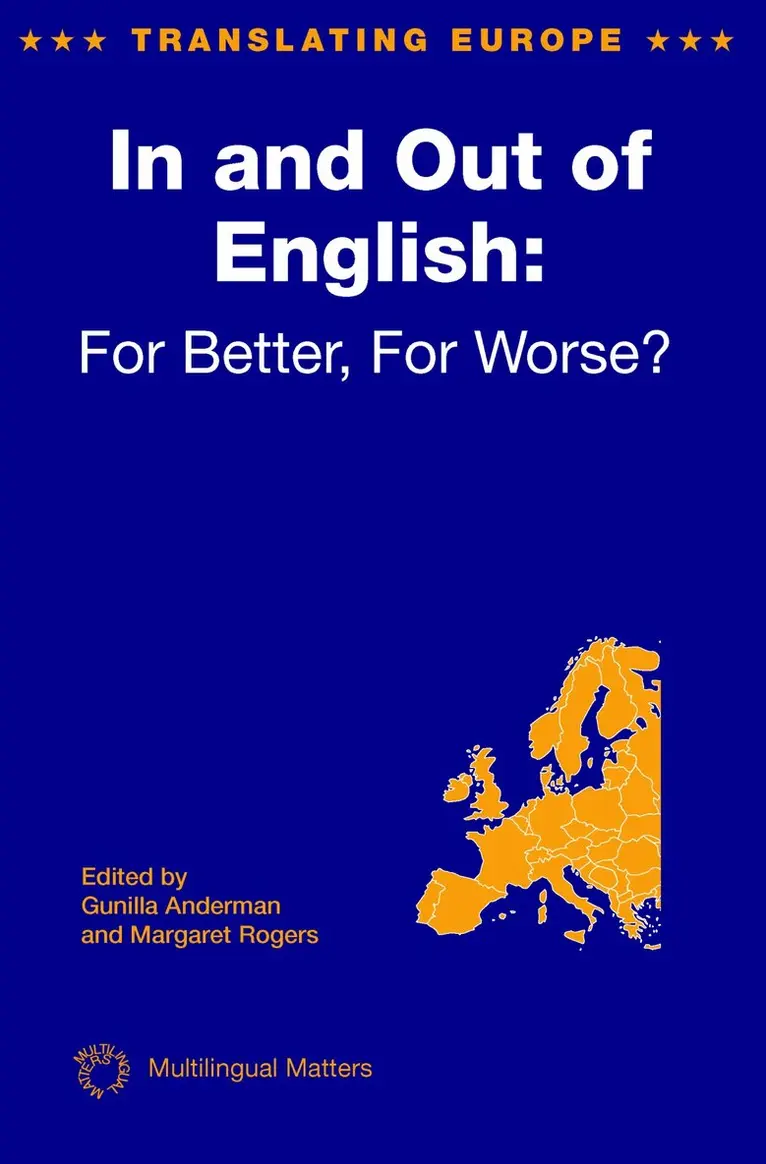
In and out of English: For Better, For Worse? is concerned with the impact of English as the lingua franca of today’s world, in particular its relationship with the languages of Europe. Within this framework a number of themes are explored, including linguistic imperialism, change as the result of language contact, the concept of the English native speaker, and the increasing need in an enlarged Europe for translation into as well as out of English.
1 689 kr
Skickas inom 5-8 vardagar
In and out of English: For Better, For Worse? is concerned with the impact of English as the lingua franca of today’s world, in particular its relationship with the languages of Europe. Within this framework a number of themes are explored, including linguistic imperialism, change as the result of language contact, the concept of the English native speaker, and the increasing need in an enlarged Europe for translation into as well as out of English.
419 kr
Skickas inom 5-8 vardagar
In choosing to render dialect and vernacular speech into Scots, Bill Findlay, to whose memory this volume is dedicated, made a pioneering contribution in safeguarding the authenticity of voices in translation. The scene of the book is set by an overview of approaches to rendering foreign voices in English translation including those of the people to whom Findlay introduced us in his Scots dialect versions of European plays. Martin Bowman, his frequent co-translator follows with a discussion of their co-translation of playwright Jeanne-Mance Delisle. Different ways of bridging the cultural divide in the translation between English and a number of plays written in a number of European languages are then illustrated including the custom of creating English versions, an approach rejected by contributions that argue in favour of minimal intervention on the part of the translator. But transferring the social and cultural milieu that the speakers of other languages inhabit may also cause problems in translation, as discussed by some translators of fiction. In addition attention is drawn to the translators’ own attitude and the influence of the time in which they live. In conclusion, stronger forces in the form of political events are highlighted that may also, adversely or positively, have a bearing on the translation process.
1 452 kr
Skickas inom 5-8 vardagar
In choosing to render dialect and vernacular speech into Scots, Bill Findlay, to whose memory this volume is dedicated, made a pioneering contribution in safeguarding the authenticity of voices in translation. The scene of the book is set by an overview of approaches to rendering foreign voices in English translation including those of the people to whom Findlay introduced us in his Scots dialect versions of European plays. Martin Bowman, his frequent co-translator follows with a discussion of their co-translation of playwright Jeanne-Mance Delisle. Different ways of bridging the cultural divide in the translation between English and a number of plays written in a number of European languages are then illustrated including the custom of creating English versions, an approach rejected by contributions that argue in favour of minimal intervention on the part of the translator. But transferring the social and cultural milieu that the speakers of other languages inhabit may also cause problems in translation, as discussed by some translators of fiction. In addition attention is drawn to the translators’ own attitude and the influence of the time in which they live. In conclusion, stronger forces in the form of political events are highlighted that may also, adversely or positively, have a bearing on the translation process.
Del 2 - Translating Europe
Incorporating Corpora
The Linguist and the Translator
Häftad, Engelska, 2007
573 kr
Skickas inom 5-8 vardagar
The emergence of studies of translation based on electronic corpora has been one of the most interesting and fruitful developments in Translation Studies in recent years. But the origins of such studies can be traced back through many decades, as this volume sets out to establish. Covering a number of European languages including Czech, Hungarian, Polish and Slovenian, as well as French, Spanish, Portuguese and Swedish, the book presents many new studies of translation patterns using parallel corpora focusing on particular linguistic features. The studies reveal systemic differences which are in turn, of relevance to the linguistic description of the languages concerned, as well as to translator training. Also included are broader-ranging contributions on the concept of translation universals, including a critical perspective on this popular topic. [127 words]
Del 2 - Translating Europe
Incorporating Corpora
The Linguist and the Translator
Inbunden, Engelska, 2007
1 829 kr
Skickas inom 5-8 vardagar
The emergence of studies of translation based on electronic corpora has been one of the most interesting and fruitful developments in Translation Studies in recent years. But the origins of such studies can be traced back through many decades, as this volume sets out to establish. Covering a number of European languages including Czech, Hungarian, Polish and Slovenian, as well as French, Spanish, Portuguese and Swedish, the book presents many new studies of translation patterns using parallel corpora focusing on particular linguistic features. The studies reveal systemic differences which are in turn, of relevance to the linguistic description of the languages concerned, as well as to translator training. Also included are broader-ranging contributions on the concept of translation universals, including a critical perspective on this popular topic. [127 words]