• Fri frakt över 249 kr
  • •
  • Snabba leveranser
  • •
  • Billiga böcker
Kundservice

Du är på sajten för privatpersoner.

Företag, bibliotek eller offentlig verksamhet?

Du handlar på classic.bokus.com, där alla dina funktioner finns intakta.
Till classic.bokus.com
Bokus logotyp. Gå till startsidan.
  • Erbjudanden
  • Nyheter
  • Student
  • Topplistor
  • Barn & ungdom
  • Bokus Play
  • E-böcker
  • Pocketböcker
  • Spel & pussel

10% rabatt på allt med kod: NYSTART10 →

Sidfot

Mina sidor

    Hjälp

    • Kundservice
    • Vanliga frågor och svar
    • Frakt och leverans
    • Retur vid ångerrätt
    • Reklamera vara
    • Betalning
    • Köpvillkor
    • Allmänna villkor
    • Information om webbplatsens tillgänglighet

    Om Bokus

    • Om oss
    • Pressrum
    • För studenter
    • För företag
    • För bibliotek och offentlig verksamhet
    • För leverantörer
    • Hållbarhet

    Populärt

    • Aktuella erbjudanden
    • Presentkort
    • Studentlitteratur
    • Nya böcker
    • Topplistor
    • Signerade böcker
    • Engelska böcker

    Inspiration

    • Boktips
    • BookTok
    • Populära bokserier
    • Barnbokskaraktärer
    • Populära författare
    Logotyp för Bokus
    Följ oss på Facebook (extern länk)Följ oss på Instagram (extern länk)Följ oss på YouTube (extern länk)Följ oss på TikTok (extern länk)
    bokus @ CookiesAnpassa cookiesIntegritetspolicyKöpvillkor
    Till Citymail hemsida (extern länk)Till Budbee hemsida (extern länk)Till Postnord hemsida (extern länk)Till Schenker hemsida (extern länk)Till Early Bird hemsida (extern länk)Till Walleys hemsida (extern länk)
    1. Naturvetenskap och teknik
    2. Teknik och industri
    3. Teknik: allmänt

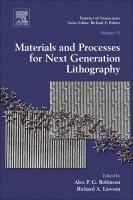
    Materials and Processes for Next Generation Lithography

    AvRichard Lawson

    Inbunden, Engelska, 2016

    Del 11 i serien Frontiers of Nanoscience

    1 689 kr

    Beställningsvara. Skickas inom 10-15 vardagar. Fri frakt över 249 kr.

    Beskrivning

    As the requirements of the semiconductor industry have become more demanding in terms of resolution and speed it has been necessary to push photoresist materials far beyond the capabilities previously envisioned. Currently there is significant worldwide research effort in to so called Next Generation Lithography techniques such as EUV lithography and multibeam electron beam lithography.

    These developments in both the industrial and the academic lithography arenas have led to the proliferation of numerous novel approaches to resist chemistry and ingenious extensions of traditional photopolymers. Currently most texts in this area focus on either lithography with perhaps one or two chapters on resists, or on traditional resist materials with relatively little consideration of new approaches.

    This book therefore aims to bring together the worlds foremost resist development scientists from the various community to produce in one place a definitive description of the many approaches to lithography fabrication.


    • Assembles up-to-date information from the world's premier resist chemists and technique development lithographers on the properties and capabilities of the wide range of resist materials currently under investigation
    • Includes information on processing and metrology techniques
    • Brings together multiple approaches to litho pattern recording from academia and industry in one place

    Produktinformation

    • Utgivningsdatum:2016-11-18
    • Mått:191 x 235 x undefined mm
    • Vikt:1 450 g
    • Format:Inbunden
    • Språk:Engelska
    • Serie:Frontiers of Nanoscience
    • Antal sidor:634
    • Förlag:Elsevier Science
    • ISBN:9780081003541

    Utforska kategorier

    • Teknik: allmänt inom Naturvetenskap och teknik
    • Maskinteknik och material inom Naturvetenskap och teknik

    Mer om författaren

    Dr Robinson obtained his PhD in 1999 for work on the development of materials for electron beam lithography performed at the Nanoscale Physics Research Laboratory of the University of Birmingham, and the Joint Research Center for Atom Technology in Japan. Following his PhD he investigated the modification of oxide surfaces using self-assembled monolayer, before returning to the Nanoscale Physics Research Laboratory to continue his research in lithography and microfabrication. He has recently taken up a Senior Research Fellowship in the Science City Research Alliance, based in the School of Chemical Engineering and the School of Chemistry at the Universities of Birmingham and Warwick respectively. He is currently investigating the application of advanced materials within the field of microfabrication, and the integration of functional materials with patterned substrates. Dr Lawson received his B.S. in Chemical Engineering at Tennessee Technological University in 2005. He received a Ph.D. in Chemical & Biomolecular Engineering in 2011 at the Georgia Institute of Technology where he also completed a Postdoctoral Fellowship. Since 2015, he has been at Milliken & Company where he is a Research Engineer working in the area of chemical technologies. He is an author of over 22 publications, 41 conference proceedings, and a U.S. Patent in the area of patterning materials including photoresist and block copolymer design, synthesis, and characterization along with simulation of resist processing and BCP self-assembly.

    Innehållsförteckning

    • 1. Overview of materials and processes for lithography2. Molecular excitation and relaxation of extreme ultraviolet lithography photoresists3. Theory: Electron-induced chemistry4. EUV lithography process challenges5. EUV lithography patterning challenges6. The chemistry and application of nonchemically amplified (non-CA) chain-scission resists7. Chemically amplified resists and acid amplifiers8. Negative-tone organic molecular resists9. Positive molecular resists10. Mainstreaming inorganic metal-oxide resists for high-resolution lithography11. Molecular organometallic resists for EUV (MORE)12. SML electron beam resist: Ultra-high aspect ratio nanolithography13. Alternative resist approaches14. Next generation lithography—the rise of unconventional methods?15. Tip-based nanolithography methods and materials16. Thermal scanning probe lithography17. Scanning helium ion beam lithography