• Fri frakt över 249 kr
  • •
  • Snabba leveranser
  • •
  • Billiga böcker
Kundservice

Du är på sajten för privatpersoner.

Företag, bibliotek eller offentlig verksamhet?

Du handlar på classic.bokus.com, där alla dina funktioner finns intakta.
Till classic.bokus.com
Bokus logotyp. Gå till startsidan.
  • Erbjudanden
  • Nyheter
  • Student
  • Topplistor
  • Barn & ungdom
  • Bokus Play
  • E-böcker
  • Pocketböcker
  • Spel & pussel

10% rabatt på allt med kod: NYSTART10 →

Sidfot

Mina sidor

    Hjälp

    • Kundservice
    • Vanliga frågor och svar
    • Frakt och leverans
    • Retur vid ångerrätt
    • Reklamera vara
    • Betalning
    • Köpvillkor
    • Allmänna villkor
    • Information om webbplatsens tillgänglighet

    Om Bokus

    • Om oss
    • Pressrum
    • För studenter
    • För företag
    • För bibliotek och offentlig verksamhet
    • För leverantörer
    • Hållbarhet

    Populärt

    • Aktuella erbjudanden
    • Presentkort
    • Studentlitteratur
    • Nya böcker
    • Topplistor
    • Signerade böcker
    • Engelska böcker

    Inspiration

    • Boktips
    • BookTok
    • Populära bokserier
    • Barnbokskaraktärer
    • Populära författare
    Logotyp för Bokus
    Följ oss på Facebook (extern länk)Följ oss på Instagram (extern länk)Följ oss på YouTube (extern länk)Följ oss på TikTok (extern länk)
    bokus @ CookiesAnpassa cookiesIntegritetspolicyKöpvillkor
    Till Citymail hemsida (extern länk)Till Budbee hemsida (extern länk)Till Postnord hemsida (extern länk)Till Schenker hemsida (extern länk)Till Early Bird hemsida (extern länk)Till Walleys hemsida (extern länk)
    1. Samhälle och politik
    2. Samhälle och kultur
    3. Kultur och medier
    4. Kulturvetenskap

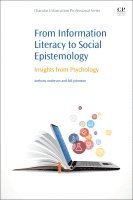
    From Information Literacy to Social Epistemology

    Insights from Psychology

    AvAnthony Anderson,Bill Johnston

    Häftad, Engelska, 2016

    Del i serien Chandos Publishing

    692 kr

    Beställningsvara. Skickas inom 10-15 vardagar. Fri frakt över 249 kr.

    Beskrivning

    From Information Literacy to Social Epistemology: Insights from Psychology focuses on information and the ways in which information literacy relates to critical thinking in education, the workplace, and in our social life.

    The broad context for our interest is the development in internet technologies often characterised by terms like the 'digital age', leading to questions of digital participation, digital divides, and the role of thinking in the information society.

    In short, to what extent is the 'digital age' engendering changes in learning directed towards the better use of information, and in addition, encouraging or even requiring improvements in critical thinking?


    • Provides a new and relevant contribution based on the authors' synthesis of a number of psychological constructs aligned to information literacy
    • Addresses the issue of information literacy in the wider population by researching adult returnees to higher education and investigating their experiences in relation to prior experience
    • Applies insights to recent developments on the topic, i.e. the Secker and Coonan IL curriculum, alowing an alternative disciplinary perspective and a new, research-based platform
    • Develops a model based on the literature reviewed and discusses the relation of the model to the broader concept of social epistemology

    Produktinformation

    • Utgivningsdatum:2016-06-13
    • Mått:152 x 229 x 13 mm
    • Vikt:210 g
    • Format:Häftad
    • Språk:Engelska
    • Serie:Chandos Publishing
    • Antal sidor:182
    • Förlag:Elsevier Science
    • ISBN:9780081005453

    Utforska kategorier

    • Kulturvetenskap inom Samhälle och politik
    • Filosofiska discipliner inom Filosofi och religion

    Mer om författaren

    Tony Anderson is a Senior Lecturer in the School of Psychological Sciences at the University of Strathclyde, Scotland, and a Fellow of the Higher Education Academy. He has undertaken research in a number of areas of psychology, including student learning, critical thinking, communication and human factors (including projects funded by the EU, the UK's Economic and Social Research Council, the UK’s Engineering and Physical Sciences Research Council, and bodies such as the former Scottish Council for Educational Technology and Learning and Teaching Scotland). In addition to his research activities and many publications, Tony has been an Adviser of Study, and is currently the Senior Academic Selector (i.e. admissions tutor) and the Associate Dean (Undergraduate) in the Faculty of Humanities and Social Sciences at the University of Strathclyde and therefore has extensive experience of all matters relating to student admissions, learning, progression and retention Bill Johnston is a retired Senior Lecturer in the Centre for Academic Practice and Learning Enhancement at the University of Strathclyde, Scotland, and a Fellow of the Higher Education Academy. He is currently an Honorary Research Fellow at the Centre for Lifelong Learning, University of Strathclyde. Bill has undertaken extensive research on curriculum development (including projects funded by the UK's Arts and Humanities Research Council and the Quality Assurance Agency, and the Australian Learning and Teaching Council). Bill has been invited keynote speaker at international conferences on the First Year Experience of Higher Education, and on Information Literacy. Since retiring, Bill has remained academically active and is currently researching the information literacy experiences of adult learners on a university pre-entry course. He is working on the development of 'Age Friendly Universities', with colleagues in Scotland, Ireland and the USA.

    Recensioner i media

    "...a highly informative read that addresses influential organizations in the field of information literacy and includes strong arguments that add psychological components to develop more theoretically and pedagogically effective ways to help individuals understand information literacy concepts and techniques." --ROLE

    Innehållsförteckning

    • Section A: Introduction and backgroundChapter 1. Introduction to the book as whole: a) a critical overview of issues and constructs, particularly the digital age, and digital participation; b) the notion of information literacy and the UNESCO human rights model; c) brief overview of epistemological development, critical thinking and metacognition and how these relate to IL and digital participation; d) summary of the structure of the book to follow.Chapter 2 Information literacy in adult returnee studentsSection B: Psychological and educational constructs related to information literacyChapter 3 Epistemological development and information literacyChapter 4 Metacognition, critical thinking and information literacy: here we consider psychological research on metacognition and critical thinking, summarise it and consider its implications for the processes involved in ILChapter 5 Study skills, pedagogy, constructivism, transformational learning, and information literacySection C: The contributions from librarians and library organizations; definitions, models and standards for information literacy; current developments in IL; critique and suggestions from psychology and pedagogy e.g. social constructivism as the theoretical basis for particular teaching practices, approaches; IL and lifelong learningChapter 6 The ACRL revised standards for IL in higher educationChapter 7 Curriculum for IL.Chapter 8 UNESCO formulation of IL and the move to a Media and Information Literacy formulation;Section D From Information literacy to social epistemologyChapter 9 Synthesis and conclusions.