• Fri frakt över 249 kr
  • •
  • Snabba leveranser
  • •
  • Billiga böcker
Kundservice

Du är på sajten för privatpersoner.

Företag, bibliotek eller offentlig verksamhet?

Du handlar på classic.bokus.com, där alla dina funktioner finns intakta.
Till classic.bokus.com
Bokus logotyp. Gå till startsidan.
  • Erbjudanden
  • Nyheter
  • Student
  • Topplistor
  • Barn & ungdom
  • Bokus Play
  • E-böcker
  • Pocketböcker
  • Spel & pussel

10% rabatt på allt med kod: NYSTART10 →

Sidfot

Mina sidor

    Hjälp

    • Kundservice
    • Vanliga frågor och svar
    • Frakt och leverans
    • Retur vid ångerrätt
    • Reklamera vara
    • Betalning
    • Köpvillkor
    • Allmänna villkor
    • Information om webbplatsens tillgänglighet

    Om Bokus

    • Om oss
    • Pressrum
    • För studenter
    • För företag
    • För bibliotek och offentlig verksamhet
    • För leverantörer
    • Hållbarhet

    Populärt

    • Aktuella erbjudanden
    • Presentkort
    • Studentlitteratur
    • Nya böcker
    • Topplistor
    • Signerade böcker
    • Engelska böcker

    Inspiration

    • Boktips
    • BookTok
    • Populära bokserier
    • Barnbokskaraktärer
    • Populära författare
    Logotyp för Bokus
    Följ oss på Facebook (extern länk)Följ oss på Instagram (extern länk)Följ oss på YouTube (extern länk)Följ oss på TikTok (extern länk)
    bokus @ CookiesAnpassa cookiesIntegritetspolicyKöpvillkor
    Till Citymail hemsida (extern länk)Till Budbee hemsida (extern länk)Till Postnord hemsida (extern länk)Till Schenker hemsida (extern länk)Till Early Bird hemsida (extern länk)Till Walleys hemsida (extern länk)
    1. Ekonomi och Ledarskap
    2. Industrier och branscher
    3. Arbetsmarknaden

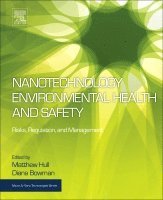
    Nanotechnology Environmental Health and Safety

    Risks, Regulation, and Management

    AvMatthew Scott Hull,Diana Bowman

    Häftad, Engelska, 2018

    Del i serien Micro and Nano Technologies

    2 250 kr

    Beställningsvara. Skickas inom 10-15 vardagar. Fri frakt över 249 kr.

    Beskrivning

    Nanotechnology Environmental Health and Safety tackles - in depth and in breadth - the complex and evolving issues pertaining to nanotechnology's environmental health and safety (EHS). The chapters are authored by leaders in their respective fields, providing thorough analysis of their research areas. The diverse spectrum of topics include nanotechnology EHS issues, financial implications, foreseeable risks including exposure, dosage and hazards, and the implications of occupational hygiene precautions and consumer protections.

    The book includes real-world case studies, wherever practical, to illustrate specific issues and scenarios encountered by stakeholders positioned on the front-lines of nanotechnology-enabled industries. These case studies will appeal to, and resonate with, laboratory scientists, business leaders, regulators, service providers, and postgraduate researchers.


    • Reviews toxicological studies and industrial initiatives, supported by numerous case studies
    • Covers new generation of nanoparticles and significantly expands on existing material from second edition
    • Only edited volume to collect research on the regulatory and risk implications of a wide array of industrial, environmental and consumer nanomaterials

    Produktinformation

    • Utgivningsdatum:2018-08-17
    • Mått:191 x 235 x 30 mm
    • Vikt:1 160 g
    • Format:Häftad
    • Språk:Engelska
    • Serie:Micro and Nano Technologies
    • Antal sidor:580
    • Upplaga:3
    • Förlag:Elsevier Science
    • ISBN:9780128135884

    Utforska kategorier

    • Arbetsmarknaden inom Ekonomi och Ledarskap
    • Teknik: allmänt inom Naturvetenskap och teknik

    Mer om författaren

    Matthew Hull has been an active part of the nanotechnology environmental health and safety (EHS) landscape for over two decades. In 2003, he developed the NanoSafe™ framework, which provided an integrated approach for managing nanotechnology EHS risks. That framework led Hull to found NanoSafe, Inc., in 2007, and contributed pioneering programs in web-enabled nanotechnology EHS management systems, nanotechnology waste recovery and recycling processes, third-party test and verification services, and life-cycle ecotoxicological studies of nanomanufacturing. After 16 years as president/owner of NanoSafe, Inc., Hull successfully exited the company in 2023, through an acquisition by ITA International, LLC. Currently, Hull serves as Research Professor in Virginia Tech’s Institute for Critical Technology and Applied Science (ICTAS) as well as Director for the Nanoscale Characterization and Fabrication Laboratory (NCFL) and the Materials Characterization Laboratory (MCL). He also serves as Associate Director for Innovation and Entrepreneurship for the NSF-funded US National Nanotechnology Coordinated Infrastructure (NNCI) and Virginia Tech’s National Center for Earth and Environmental Nanotechnology (NanoEarth). He received his Ph.D. in Civil and Environmental Engineering from Virginia Tech in 2011 and an M.S. in Biology from Virginia Tech in 2002. He received his B.S. In Environmental Science from Ferrum College in 2000. Dr. Diana Bowman is a Professor of Law in the Sandra Day O’Connor College of Law, where she serves as the Associate Dean for Applied Research and Partnerships and the School for the Future of Innovation and Society, at Arizona State University (ASU). Diana is a Co-Director of the Center for Smart Cities and Regions (CenSCR), a Faculty Innovation Fellow with ASU’s University Technology Office and Andrew Carnegie Fellow (2018). Diana’s research has primarily focused on the legal and policy issues associated with emerging technologies including, for example, nanotechnologies, CRISPR and autonomous vehicles. Diana’s second pillar of work is within the sphere of public health law and policy, with a particular focus on road safety, assisted reproductive technologies and water safety.Diana earned her Bachelor of Science (Physiology), a Bachelor of Law and a Doctor of Philosophy (Law) from Monash University (Australia). In August 2011 she was admitted to practice as a Barrister and Solicitor of the Supreme Court of Victoria (Australia). In December 2022 she graduated from the Thunderbird School of Global Management with a Masters of Global Leadership and Management (Executive Program).

    Innehållsförteckning

    • Part I: Precaution1. Nanotechnology Environmental Health and Safety – introduction2. Is there a need for any more environmental health and safety research on nanoparticles?3. Responsible Research and Innovation4. What are the warning signs that we should be looking forward?5. Emergency management of emerging technologies – nanotechnology6. The role of NGOs in shaping the Environmental Health and Safety nanotech agendaPart II: Progress7. Characterization of nanomaterials for nanoEHS studies8. Toxicological issues to consider when evaluating the safety of consumer products containing nanomaterials9. Long-term effects – assessing the chronic toxicity of engineered nanomaterials10. Workplace standards 11. Nanomaterials ecotoxicology: a case study with nanosilver12. A Nanomaterial Registry13. Nanoinformatics: data driven materials design for health and environmental needsPart III: Perspectives14. A case study of a nanoscale-research facility safety through design and operation15. What should epidemioligists be looking for, or doing, to ensure worker safety?16. Commercialization of cellulose nanocrystal (NCCTM) production: A business case focusing on the importance of proactive EHS management17. Safe, rapid development of nanotechnologies18. Nanotechnology risk management: An insurance industry perspective19. Managing nanotechnology risks in small business20. Lowering insurance premiums – a how to guide for small nanotechnology businesses21. A nanotechnology legal framework22. The EPA/NSF funded centers for environmental implications of nanotechnology23. Two Steps Forward, One Step Back: Shaping the Nanotechnologies Landscape Through Regulatory ChoicePart IV: Personal24. Consumer use of nanoparticles in sunscreens25. Cosmetics26. Cleaning productsPart V: Prediction and Sustainability27. Exploring boundaries around the safe use of advanced materials: A Prospective Product-Based Case Studies approach28. What’s ahead – what can we expect from the nano-enabled materials and systems of the future29. Nanomaterial governance, planetary health and the sustainocene transition30. Sustainable nanotechnology: a regional perspective