• Fri frakt över 249 kr
  • •
  • Snabba leveranser
  • •
  • Billiga böcker
Kundservice

Du är på sajten för privatpersoner.

Företag, bibliotek eller offentlig verksamhet?

Du handlar på classic.bokus.com, där alla dina funktioner finns intakta.
Till classic.bokus.com
Bokus logotyp. Gå till startsidan.
  • Erbjudanden
  • Nyheter
  • Student
  • Topplistor
  • Barn & ungdom
  • Bokus Play
  • E-böcker
  • Pocketböcker
  • Spel & pussel

10% rabatt på allt med kod NYSTART10 →

Sidfot

Mina sidor

    Hjälp

    • Kundservice
    • Vanliga frågor och svar
    • Frakt och leverans
    • Retur vid ångerrätt
    • Reklamera vara
    • Betalning
    • Köpvillkor
    • Allmänna villkor
    • Information om webbplatsens tillgänglighet

    Om Bokus

    • Om oss
    • Pressrum
    • För studenter
    • För företag
    • För bibliotek och offentlig verksamhet
    • För leverantörer
    • Hållbarhet

    Populärt

    • Aktuella erbjudanden
    • Presentkort
    • Studentlitteratur
    • Nya böcker
    • Topplistor
    • Signerade böcker
    • Engelska böcker

    Inspiration

    • Boktips
    • BookTok
    • Populära bokserier
    • Barnbokskaraktärer
    • Populära författare
    Logotyp för Bokus
    Följ oss på Facebook (extern länk)Följ oss på Instagram (extern länk)Följ oss på YouTube (extern länk)Följ oss på TikTok (extern länk)
    bokus @ CookiesAnpassa cookiesIntegritetspolicyKöpvillkor
    Till Citymail hemsida (extern länk)Till Budbee hemsida (extern länk)Till Postnord hemsida (extern länk)Till Schenker hemsida (extern länk)Till Early Bird hemsida (extern länk)Till Walleys hemsida (extern länk)
    1. Ekonomi och Ledarskap
    2. Ledarskapsböcker

    Plant Factory

    An Indoor Vertical Farming System for Efficient Quality Food Production

    AvToyoki Kozai,Genhua Niu

    Häftad, Engelska, 2019

    1 175 kr

    Beställningsvara. Skickas inom 10-15 vardagar. Fri frakt över 249 kr.

    Beskrivning

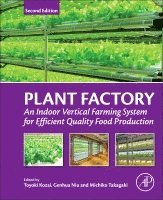
    Plant Factory: An Indoor Vertical Farming System for Efficient Quality Food Production, Second Edition presents a comprehensive look at the implementation of plant factory (PF) practices to yield food crops for both improved food security and environmental sustainability. Edited and authored by leading experts in PF and controlled environment agriculture (CEA), the book is divided into five sections, including an Overview and the Concept of Closed Plant Production Systems (CPPS), the Basics of Physics and Physiology - Environments and Their Effects, System Design, Construction, Cultivation and Management and Plant Factories in Operation.

    In addition to new coverage on the rapid advancement of LED technology and its application in indoor vertical farming, other revisions to the new edition include updated information on the status of business R&D and selected commercial PFALs (plant factory with artificial lighting). Additional updates include those focused on micro and mini-PFALs for improving the quality of life in urban areas, the physics and physiology of light, the impact of PFAL on the medicinal components of plants, and the system design, construction, cultivation and management issues related to transplant production within closed systems, photoautotrophic micro-propagation and education, training and intensive business forums on PFs.


    • Includes coverage of LED technology
    • Presents case-studies for real-world insights and application
    • Addresses PF from economics and planning, to operation and lifecycle assessment

    Produktinformation

    • Utgivningsdatum:2019-11-06
    • Mått:191 x 235 x 24 mm
    • Vikt:1 020 g
    • Format:Häftad
    • Språk:Engelska
    • Antal sidor:516
    • Upplaga:2
    • Förlag:Elsevier Science
    • ISBN:9780128166918

    Utforska kategorier

    • Ledarskapsböcker inom Ekonomi och Ledarskap
    • Lantbruk, fiske och skogsbruk inom Ekonomi och Ledarskap
    • Biokemisk teknik inom Naturvetenskap och teknik

    Mer om författaren

    Toyoki Kozai Ph.D, is the president of The Agricultural Academy of Japan. After establishing his early work on greenhouse light environments, energy savings, ventilation, and computer applications, his scientific interest was extended to in-vitro environments and their control for sugar-free medium micro-propagation and transplant production in closed systems using artificial lighting. He served as President of the Japan Plant Factory Association (a non-profit organization) and is leading the research and development of controlled environmental greenhouses using heat pumps, artificial lighting, fogging, CO2 enrichment, and nutrient solution control systems. Selected awards are Lifetime Achievement Award (2009) from Society of In Vitro Biology, USA. The 2002 Purple Ribbon Award from Japanese Ministry of Education, Culture and Sports. Japan Prize of Agricultural Sciences from Association of Japanese Agricultural Scientific Societies, 2018 honorary PhD degree from Mahidol University, Thailand ‘The Order of the Sacred Treasure, Gold and Silver Star’ from Japanese Government 2019. Dr. Genhua is a professor in urban horticulture with Texas A&M AgriLife Research at Dallas and Department of Horticultural Sciences. Her area of expertise is controlled environment agriculture and plant stress physiology. Her current research focuses on hydroponics, nutrition management, LED lighting, optimization of growing environment, and development of best management practices related to urban controlled environment agriculture. She is the co-editor and author of the book “Plant Factory - Indoor Vertical Farming for Efficient Quality Food Production” (1st & 2nd edition). Dr. Niu received several awards from Texas A&M University for her service and research, American Society for Horticultural Science, and USDA-NIFA. Dr. Takagaki is Professor at the Graduate School of Horticulture, Chiba University, assigned to the University Farm, and has engaged in education and research. In charge of foreign student affairs since 1997 and of international affairs in general since 2006. She holds a concurrent assignment as the Director of the Center for Environment, Health and Fields Sciences since 2009 (2009-2015, 2018-present). Engaging with research and experiments in Agronomy of Tropical Agriculture with major fields in Thailand, Indonesia and other Southeast Asian countries, Dr. Takagaki has done research and taught in the fields of tropical agriculture, environmental control, protected horticulture and training of basic horticulture.

    Innehållsförteckning

    • Part 1: Overview and concept of closed plant production system (CPPS)1. Introduction2. Role of the plant factory with artificial lighting (PFAL) in urban areas3. PFAL business and R&D in Asia and North America: Status and perspectives4. Vertical farming in Europe: Present status and outlook5. Plant factory as a resource-efficient closed plant production system6. Micro- and mini-PFALs for improving the quality of life in urban areas7. Rooftop plant production systems in urban areasPart 2: Basics of physics and physiology - Environments and their effects8. Light sources9. Plant responses to light10. LED advancements for plant-factory artificial lighting11. Physical environmental factors and their properties12. Photosynthesis and respiration13. Growth, development, transpiration, and translocation as affected by abiotic environmental factors14. Nutrition and nutrient uptake in soilless culture systems15. Tipburn16. Functional components in leafy vegetables17. Medicinal components18. Production of pharmaceuticals in a specially designed plant factoryPart 3: System design, construction, cultivation and management19. Plant production process, floor plan, and layout of PFAL20. Hydroponic systems21. Seeding, seedling production and transplanting22. Transplant production in closed systems23. Photoautotrophic micropropagation24. Biological factor management25. Design and management of PFALs26. Automated technology in plant factories with artificial lighting27. Life cycle assessment28. Education, training, and business workshops and forums  on plant factoriesPart 4: PFALs in operation and its perspectives29. Selected PFALs in the United States, the Netherlands, and China30. Selected PFALs in Japan31. Representative plant factories in Taiwan32. Challenges for the next-generation PFALs33. Conclusions: Resource-saving and resource-consuming characteristics of PFALs