• Fri frakt över 249 kr
  • •
  • Snabba leveranser
  • •
  • Billiga böcker
Kundservice

Du är på sajten för privatpersoner.

Företag, bibliotek eller offentlig verksamhet?

Du handlar på classic.bokus.com, där alla dina funktioner finns intakta.
Till classic.bokus.com
Bokus logotyp. Gå till startsidan.
  • Erbjudanden
  • Nyheter
  • Student
  • Topplistor
  • Barn & ungdom
  • Bokus Play
  • E-böcker
  • Pocketböcker
  • Spel & pussel

10% rabatt på allt med kod: NYSTART10 →

Sidfot

Mina sidor

    Hjälp

    • Kundservice
    • Vanliga frågor och svar
    • Frakt och leverans
    • Retur vid ångerrätt
    • Reklamera vara
    • Betalning
    • Köpvillkor
    • Allmänna villkor
    • Information om webbplatsens tillgänglighet

    Om Bokus

    • Om oss
    • Pressrum
    • För studenter
    • För företag
    • För bibliotek och offentlig verksamhet
    • För leverantörer
    • Hållbarhet

    Populärt

    • Aktuella erbjudanden
    • Presentkort
    • Studentlitteratur
    • Nya böcker
    • Topplistor
    • Signerade böcker
    • Engelska böcker

    Inspiration

    • Boktips
    • BookTok
    • Populära bokserier
    • Barnbokskaraktärer
    • Populära författare
    Logotyp för Bokus
    Följ oss på Facebook (extern länk)Följ oss på Instagram (extern länk)Följ oss på YouTube (extern länk)Följ oss på TikTok (extern länk)
    bokus @ CookiesAnpassa cookiesIntegritetspolicyKöpvillkor
    Till Citymail hemsida (extern länk)Till Budbee hemsida (extern länk)Till Postnord hemsida (extern länk)Till Schenker hemsida (extern länk)Till Early Bird hemsida (extern länk)Till Walleys hemsida (extern länk)
    1. Naturvetenskap och teknik
    2. Geovetenskap
    3. Miljövetenskap och miljöpolitik

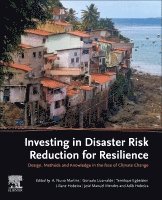
    Investing in Disaster Risk Reduction for Resilience

    Design, Methods and Knowledge in the face of Climate Change

    AvA. Nuno Martins,Gonzalo Lizarralde

    Häftad, Engelska, 2022

    1 199 kr

    Beställningsvara. Skickas inom 10-15 vardagar. Fri frakt över 249 kr.

    Beskrivning

    Disaster prevention and the mitigation of climate change effects call for global action. Joint efforts are required among countries, economic sectors, and public and private stakeholders. Not surprisingly, international organizations, such as the United Nations agencies, propose policy frameworks aimed at worldwide influence. The 2015-2030 Sendai Framework seeks to create consensus about the need to act for disaster risk reduction and climate adaptation. A key goal is to promote investments in risk reduction and resilience. But how useful is this policy framework? What does it say, and what does it overlook? How can it be implemented among vulnerable communities, in historic sites, and in other sensitive locations affected by disasters?

    In this book, prominent scholars and practitioners examine the successes and failures of the Sendai Framework. Their case studies show that, despite its good intentions, the Framework achieves very little. The main reason is that, while avoiding a political engagement, it fails to deal with disasters’ root causes and guide the difficult path of effective implementation. The authors bring a fresh look to international policy and design practices, highlighting cross-disciplinary research avenues, and ideas and methods for low-income communities, cities and heritage sites in Portugal, Haiti, the United States, the Philippines, New Zealand, Sri Lanka, Nigeria, among other countries.Global action requires collaboration between heterogeneous stakeholders, but also the recognition of inequalities, power imbalances, and social and environmental injustices.


    • Analyzes outcomes and drawbacks of implementing the third priority of the Sendai Framework for Disaster Risk Reduction
    • Presents real-life attempts to increase risk resilience and climate-change adaptation, both before and after disasters
    • Addresses design as a means to build resilience in community and heritage interventions
    • Calls for embracing the complexities and dynamic character of DRR and climate-change knowledge, investment, and communication

    Produktinformation

    • Utgivningsdatum:2022-03-17
    • Mått:191 x 235 x 25 mm
    • Vikt:660 g
    • Format:Häftad
    • Språk:Engelska
    • Antal sidor:320
    • Förlag:Elsevier Science
    • ISBN:9780128186398

    Utforska kategorier

    • Miljövetenskap och miljöpolitik inom Naturvetenskap och teknik

    Mer om författaren

    Since 2013 Dr. Martins has been an integrated researcher of CIAUD, the Research Centre for Architecture, Urbanism, and Design, within the Faculty of Architecture of the University of Lisbon with a project addressing risk, resilience as well as humanitarian architecture for disaster-prone and informal-settlement environments. In the past three years, he has chaired major global conferences and design competitions focused on risk, resilience, and humanitarian architecture. As a project manager of the NGO Building 4Humanity, Design, and Reconstructing Communities Association, he has been leading multidisciplinary teams in projects and missions in Portugal, Africa, and Brazil. The outcomes of the action-research fieldwork have been presented in conferences in the areas of sustainability, urban disaster as well as design in development, and subsequently published in proceedings, books, and journals. His current research interests include the re-visitation of the concept of incremental housing and the introduction of humanitarian architecture into architectural education. Gonzalo Lizarralde is a professor at the School of Architecture of Université de Montréal. He studies the relationships between planning, design and construction processes. He has a PhD from Université de Montréal, a Masters in Architecture from McGill University and a post doctorate from the Department of Construction Economics and Management of University of Cape Town, South Africa. He has taught in leading Universities in Canada, Colombia and South Africa. Dr. Temitope Egbelakin is an Associate Professor at the School of Architecture and Built Environment (SABE) and the Executive Director of CIFAL Newcastle at the University of Newcastle in New South Wales, AU. Her research interests include Construction Project Performance, Disaster Resilience, Prefabrication and Affordable Housing, as well as Smart Construction and Informatics. Dr. Temitope is a prolific researcher, having led several funded research projects and has published widely in top international refereed journals. She has been active in several local and international research groups such as QuakeCore, National Science Challenges (NSC), Integrated Research on Disaster Risk (IRDR), and the International Council for Research and Innovation in Building and Construction (CIB). Liliane Hobeica is an architect-urbanist whose research activities have been following a broad disciplinary approach. After three master degrees, in urbanism, human ecology, and risk sciences, she concluded in 2018 a PhD in risk sciences, in which she explored the potentials of spatial design as a flood-adaptation tool within urban-riverfront interventions. She is currently interested in the social dimensions of flood adaptation, community-based resilient design, and risk mainstreaming in architectural practices. José Manuel Mendes holds a PhD in Sociology from the School of Economics of the University of Coimbra, where he is an Associate Professor with Aggregation. He is also a researcher at the Centre for Social Studies, where he has been working in the fields of risk and social vulnerability, planning, public policies and citizenship. He is coordinator of the Risk Observatory (OSIRIS) of the Centre for Social Studies and is the Editor of Revista Crítica de Ciências Sociais. Adib Hobeica is an independent consultant and researcher, with Master degrees in international management (ISC Paris) and in risk sciences (University of Coimbra), extensive exposure to the development sphere, and manifold experiences in data collection and analysis, writing and reviewing, gained in both academic environments and assignments with international organizations (ICRC, UNDP, UNIDO and the World Bank).

    Innehållsförteckning

    • Part A Investing in design for disaster risk reduction1. Investing in community participation for disaster recovery2. Investing in the social places of heritage towns3. Investing in contingency in a heritage sitePart B Investing in new methods for resilience4. Physical services index for flooding hazards5. Resilience planning in antagonistic communities6. Systems thinking toward climate resilience7. Assessing urban resilience to cope with climate changePart C Building knowledge on disaster risk reduction investment8. Incentives for retrofitting heritage buildings in New Zealand9. Dissatisfaction after postdisaster resettlement10. The media coverage of climate change in Portugal11. Investing in flood adaptation in Jakarta, Indonesia