• Fri frakt över 249 kr
  • •
  • Snabba leveranser
  • •
  • Billiga böcker
Kundservice

Du är på sajten för privatpersoner.

Företag, bibliotek eller offentlig verksamhet?

Du handlar på classic.bokus.com, där alla dina funktioner finns intakta.
Till classic.bokus.com
Bokus logotyp. Gå till startsidan.
  • Erbjudanden
  • Student
  • Topplistor
  • Barn & ungdom
  • Bokus Play
  • E-böcker
  • Ljudböcker
  • Pocketböcker
  • Spel & pussel

10% rabatt på allt med kod NYSTART10 →

Sidfot

Mina sidor

    Hjälp

    • Kundservice
    • Vanliga frågor och svar
    • Frakt och leverans
    • Retur vid ångerrätt
    • Reklamera vara
    • Betalning
    • Köpvillkor
    • Allmänna villkor
    • Information om webbplatsens tillgänglighet

    Om Bokus

    • Om oss
    • Pressrum
    • För studenter
    • För företag
    • För bibliotek och offentlig verksamhet
    • För leverantörer
    • Hållbarhet

    Populärt

    • Aktuella erbjudanden
    • Presentkort
    • Studentlitteratur
    • Nya böcker
    • Topplistor
    • Signerade böcker
    • Engelska böcker

    Inspiration

    • Boktips
    • BookTok
    • Populära bokserier
    • Barnbokskaraktärer
    • Populära författare
    Logotyp för Bokus
    Följ oss på Facebook (extern länk)Följ oss på Instagram (extern länk)Följ oss på YouTube (extern länk)Följ oss på TikTok (extern länk)
    bokus @ CookiesAnpassa cookiesIntegritetspolicyKöpvillkor
    Till Citymail hemsida (extern länk)Till Budbee hemsida (extern länk)Till Postnord hemsida (extern länk)Till Schenker hemsida (extern länk)Till Early Bird hemsida (extern länk)Till Walleys hemsida (extern länk)
    1. Data och IT
    2. Programmeringsböcker
    3. Programspråk

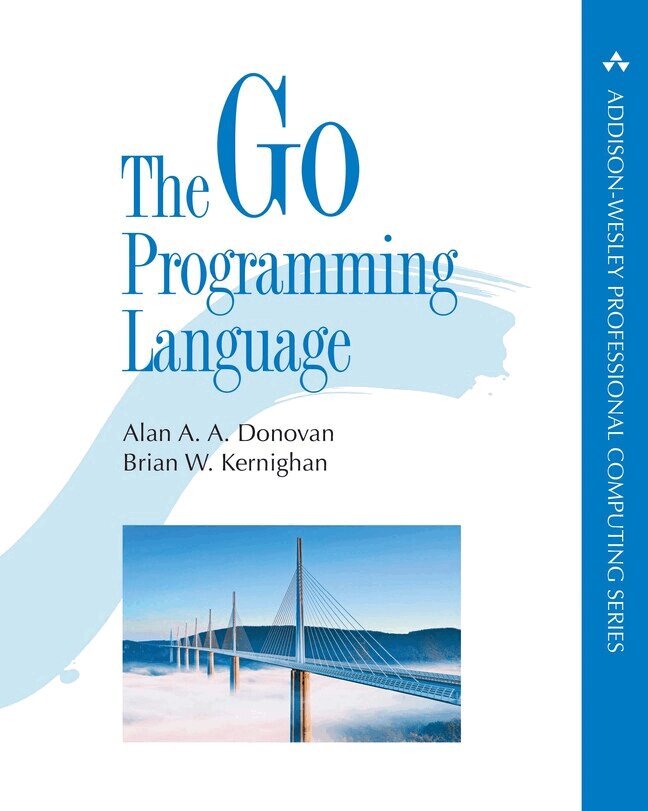
    Go Programming Language, The

    AvAlan Donovan,Brian Kernighan

    Häftad, Engelska, 2015

    Del i serien Addison-Wesley Professional Computing Series

    315 kr

    Beställningsvara. Skickas inom 7-10 vardagar. Fri frakt över 249 kr.

    Beskrivning

    The authoritative resource to writing clear and idiomatic Go to solve real-world problems

    Google’s Go team member Alan A. A. Donovan and Brian Kernighan, co-author of The C Programming Language, provide hundreds of interesting and practical examples of well-written Go code to help programmers learn this flexible, and fast, language. It is designed to get you started programming with Go right away and then to progress on to more advanced topics.

    • Basic components : an opening tutorial provides information and examples to get you off the ground and doing useful things as quickly as possible. This includes:
      • command-line arguments
      • gifs
      • URLs
      • web servers
    • Program structure : simple examples cover the basic structural elements of a Go program without getting sidetracked by complicated algorithms or data structures.
    • Data types: Go offers a variety of ways to organize data, with a spectrum of data types that at one end match the features of the hardware and at the other end provide what programmers need to conveniently represent complicated data structures.
    • Composite types :
      • arrays
      • slices
      • maps
      • structs
      • JSON
      • test and HTML templates
    • Functions : break a big job into smaller pieces that might well be written by different people separated by both time and space.
    • Methods :
      • declarations
      • with a pointer receiver
      • struct embedding
      • values and expressions
    • Interfaces : write functions that are more flexible and adaptable because they are not tied to the details of one particular implementation.
    • Concurrent programming : Goroutines, channels, and with shared variables.
    • Packages : use existing packages and create new ones.
    • Automated testing : write small programs that check the code.
    • Reflection features : update variables and inspect their values at run time.
    • Low-level programming : step outside the usual rules to achieve the highest possible performance, interoperate with libraries written in other languages, or implement a function that cannot be expressed in pure Go.

    Each chapter has exercises to test your understanding and explore extensions and alternatives. Source code is freely available for download and may be conveniently fetched, built, and installed using the go get command.

    Produktinformation

    • Utgivningsdatum:2015-11-12
    • Mått:188 x 232 x 20 mm
    • Vikt:663 g
    • Format:Häftad
    • Språk:Engelska
    • Serie:Addison-Wesley Professional Computing Series
    • Antal sidor:400
    • Upplaga:1
    • Förlag:Pearson Education
    • ISBN:9780134190440

    Utforska kategorier

    • Programspråk inom Data och IT

    Mer om författaren

    Alan A. A. Donovan is a member of Google’s Go team in New York. He holds computer science degrees from Cambridge and MIT and has been programming in industry since 1996. Since 2005, he has worked at Google on infrastructure projects and was the co-designer of its proprietary build system, Blaze. He has built many libraries and tools for static analysis of Go programs, including oracle, godoc -analysis, eg, and gorename.Brian W. Kernighan is a professor in the Computer Science Department at Princeton University. He was a member of technical staff in the Computing Science Research Center at Bell Labs from 1969 until 2000, where he worked on languages and tools for Unix. He is the co-author of several books, including The C Programming Language, Second Edition (Prentice Hall, 1988), and The Practice of Programming (Addison-Wesley, 1999).

    Innehållsförteckning

    • Preface xiChapter 1: Tutorial 11.1 Hello, World 11.2 Command-Line Arguments 41.3 Finding Duplicate Lines 81.4 Animated GIFs 131.5 Fetching a URL 151.6 Fetching URLs Concurrently 171.7 A Web Server 191.8 Loose Ends 23Chapter 2: Program Structure 272.1 Names 272.2 Declarations 282.3 Variables 302.4 Assignments 362.5 Type Declarations 392.6 Packages and Files 412.7 Scope 45Chapter 3: Basic Data Types 513.1 Integers 513.2 Floating-Point Numbers 563.3 Complex Numbers 613.4 Booleans 633.5 Strings 643.6 Constants 75Chapter 4: Composite Types 814.1 Arrays 814.2 Slices 844.3 Maps 934.4 Structs 994.5 JSON 1074.6 Text and HTML Templates 113Chapter 5: Functions 1195.1 Function Declarations 1195.2 Recursion 1215.3 Multiple Return Values 1245.4 Errors 1275.5 Function Values 1325.6 Anonymous Functions 1355.7 Variadic Functions 1425.8 Deferred Function Calls 1435.9 Panic 1485.10 Recover 151Chapter 6:. Methods 1556.1 Method Declarations 1556.2 Methods with a Pointer Receiver 1586.3 Composing Types by Struct Embedding 1616.4 Method Values and Expressions 1646.5 Example: Bit Vector Type 1656.6 Encapsulation 168Chapter 7: Interfaces 1717.1 Interfaces as Contracts 1717.2 Interface Types 1747.3 Interface Satisfaction 1757.4 Parsing Flags with flag.Value 1797.5 Interface Values 1817.6 Sorting with sort.Interface 1867.7 The http.Handler Interface 1917.8 The error Interface 1967.9 Example: Expression Evaluator 1977.10 Type Assertions 2057.11 Discriminating Errors with Type Assertions 2067.12 Querying Behaviors with Interface Type Assertions 2087.13 Type Switches 2107.14 Example: Token-Based XML Decoding 2137.15 A Few Words of Advice 216Chapter 8: Goroutines and Channels 2178.1 Goroutines 2178.2 Example: Concurrent Clock Server 2198.3 Example: Concu rent Echo Server 2228.4 Channels 2258.5 Looping in Parallel 2348.6 Example: Concurrent Web Crawler 2398.7 Multiplexing with select 2448.8 Example: Concurrent Directory Traversal 2478.9 Cancellation 2518.10 Example: Chat Server 253Chapter 9: Concurrency with Shared Variables 2579.1 Race Conditions 2579.2 Mutual Exclusion: sync.Mutex 2629.3 Read/Write Mutexes: sync.RWMutex 2669.4 Memory Synchronization 2679.5 Lazy Initialization: sync.Once 2689.6 The Race Detector 2719.7 Example: Concurrent Non-Blocking Cache 2729.8 Goroutines and Threads 280Chapter 10: Packages and the Go Tool 28310.1 Introduction 28310.2 Import Paths 28410.3 The Package Declaration 28510.4 Import Declarations 28510.5 Blank Imports 28610.6 Packages and Naming 28910.7 The Go Tool 290Chapter 11: Testing 30111.1 The go test Tool 30211.2 Test Functions 30211.3 Coverage 31811.4 Benchmark Functions 32111.5 Profiling 32311.6 Example Functions 326Chapter 12: Reflection 32912.1 Why Reflection? 32912.2 reflect.Type and reflect.Value 33012.3 Display, a Recursive Value Printer 33312.4 Example: Encoding S-Expressions 33812.5 Setting Variables with reflect.Value 34112.6 Example: Decoding S-Expressions 34412.7 Accessing Struct Field Tags 34812.8 Displaying the Methods of a Type 35112.9 A Word of Caution 352Chapter 13: Low-Level Programming 35313.1 unsafe.Sizeof, Alignof, and Offsetof 35413.2 unsafe.Pointer 35613.3 Example: Deep Equivalence 35813.4 Calling C Code with cgo 36113.5 Another Word of Caution 366Index 367